
Politics
Between Democracy And Politics In Nigeria

“The values of freedom, respect for human rights and the principle of holding periodic and genuine elections by universal suffrage are essential elements of democracy. In turn, democracy provides the natural environment for the protection and effective realization of human rights. These values are embodied in the Universal Declaration of Human Rights.” –UN.
Nigeria does not have a
democracy. There is politics in Nigeria, in fact too much of it, but no democracy. Having civilian rulers does not make a democracy. And unlike the USA, where as Hilary Clinton said-in-Nigeria, “our democracy is yet evolving,” Nigeria does not yet have a democracy, so nothing is evolving.
Democracy is about the provision of, and protection of Human Rights. It is not simply a process of putting papers in ballot boxes. The conditions to test; questions to ask ourselves are: Are we lead or ruled? Are any of those who rule us the people we would really choose with our eyes open? Do those who rule us represent us and provide us our basic rights? Do they lead us to where we need be, or do they only rule over us for their gains? Are we able to remove them when they fail? And then, can we honestly say that the 80 million rural dwellers are represented, know candidates and vote for candidates to lead them in our current system, or these villagers do not count in the selection but suffer the most from its consequences; these rural dwellers who account for 80 per cent of our 100 million destitute population. These questions are essential conditions democracy fulfils; do we have them?
Choosing leadership is not the single reason why democracy is advocated and why nations adopt it. Getting rid of leaderships is the difference, beauty, essence and unique advantage of democracy. That is the point of democracy. If a so-called ‘juvenile’ democracy does not yet have the ‘eviction’ capacity, it is not a democracy. Democracy is a very expensive system. The idea of applying this method is not because you for one second think the candidate you are choosing is a great person. Does this mean we hate our sons and daughters who sign-up with the military? Or we think these disciplined family members are less of people and do not have what it takes to lead a nation? The ability to terminate the leadership is as important as the provision of selection. And we must actively have both; having only the one is as good as having none.
In biology of the cell, when a cell fails to pass a ‘check-point,’ the cell automatically tries to repair the problem, and when it is unable, the cell kills itself in a process called Apoptosis. This protects cells from becoming cancerous. In our traditional systems, we used to apply such systems as giving the king the empty calabash or gift of parrot’s eggs, which tells him he has been disapproved of and must take his own life.
Good enough people are plentiful and we actually usually end up with the worst of us with democratic choice. The politician candidates we choose, even if ‘good’ now, we do know they can change to bad people too, and may already be bad people in sheep’s clothing. But we go through that arduous, money wasting, ethnic-fracturing, nation-wrecking, lengthy process of campaigns, political jamborees, pauses in governance, political mismanagement and all other pains of democratic processes, simply because democracy should provide us certain conditions. These conditions are the primary reasons and requisites of democracy.
The first is the perceived ability abinitio to have a choice of candidates that all have a real chance of actually coming into power. Democracy is all about choice. One and even two party systems limit and cancel any reality of choice. A malicious cabal chooses in primaries and the nation is forced to accept and vote-in that one choice or tops, two choices in two party systems. Abolishing parties and at least, prohibiting or capping party expenses which could be by government equal funding of all campaigns, with no private financing allowed, can resolve these, embezzlement and many other campaign financing related issues.
The second condition for a true democracy is the ability to vote out candidates at their term, without conversation of extension of term or threat of terror if they lose the next round. We do not have this.
The third is the ability and likelihood of impeachment of candidates who fail to execute their obligations, within terms. After all, nature usually has its way of ridding us of military dictatorships, and they are usually replaced in our particular experience in about 8 years, making them not much different in terms of lengthy terms, than civilian regimes. Our rules should be firm and protected.
When people are unable to select their candidates but are only imposed candidates, and when only certain party-elite blocks’ imposed candidates have the ability to win, and when candidates cannot be voted out until two terms are completed and/or terms are extended, and then finally when impeachment for failure within term are unavailable, then we have a disguised dictatorship.
On Tuesday the 3rd of December, 2013, the U.S. House of Representatives Committee on the Judiciary met to discuss the impeachment of President Barack Obama. The hearing was titled “The President’s Constitutional Duty to Faithfully Execute the Laws.” {Washington Post}
Republican senators felt Obama had not faithfully executed the laws of the land and so they considered impeachment. Ex-US President Bill Clinton was impeached for “laughable” reasons.
The risk and reality of impeachment is as vital to democracy as is the voting process. Leaders merit democracy’s bounty when they are voted in power, and the masses reap its fruit when the leaders know they can and will be impeached when they lie, steal, or in any way fail in their duty to execute the law.
The Nigerian system does not have this key aspect of democracy and as such it is not a democracy. The entire legislature is bribed to abandon their obligation to protect the right of the masses for a check on government.
But to make our non-democracy even more apparent, consider the recurrent dimension of our system with the proposal of term elongations when candidates either realize their term is set to expire or they realize they cannot win again.
The CNPP party said those who suggested a term elongation deserved investigation and repudiation. They were spot-on. Nigerians elected leaders based on four-year term expiration. That was the deal, the package. To waste time, money and muddy the national intelligence by proposing term elongations is frankly criminal.
Will there be a referendum? Are there term truncations? How about the more suggestion to consider a term reduction to three-years to more favorably resolve the quagmire that this political block has put the nation into?
As it stands, the Nigeria is begging for a democracy. One had to just take a look at the recent Anambra elections to know it was and will continue to waste its time as the leadership continues to take advantage of and promote our dictatorial system.
The pictures of those women throwing themselves on and rolling on the ground were pathetic but clearly pretentious. Overall they demonstrated the fact that the system in place did not serve the people and abused the people.
Secondly, in the Anambra election, there were over a million invalid votes, the second largest vote counted. Ballot sheets where voters filled out nonsense. With the general interested populace not being able to vote, this democracy is no democracy as far as people’s choice goes.
There was open and widespread distribution of bribes to buy voters. Indomie noodles boxes (not scholarships) were one such cheap buyoff.
And the candidate party disputes, the widely reported fraud, these things will never go away and as long as they exist, we end up with imposed rulers and not leaders we sort of chose.
In satisfaction of my ideals for my human rights, that I may deem I have a democracy, the minimum I would require is for the administration to establish an enlightened committee to sit down and trash our leadership selection process from scratch. So long as we continue with this useless selection programme and are denied expulsions for failure, my rights are not protected and I am not under a democracy.
Our return to a less tribal and ethnic provocative and less societal rendering parliamentary system of leadership selection is a proposed tactic many have presented that needs to be tabled. When 40 million people go to ballots all around the nation to vote for candidates they know next to nothing of, except a few posters here and there and as we know, having received some peanuts in enticement during campaigns, what results is wars, and the election of the most unworthy. With a parliamentary system, people are restricted to choosing only their local representatives who they have a better chance of actually knowing and holding to account, and it is these reps that select from among them the President. This reduces cost and eliminates volatile complaint and social-media curses being thrown at the top.
We should consider reducing usage of ballots which simply do not work for us. Let us redesign from our objective—representation. The idea is to get representatives and in this, this system fails us. Our market places have representative leaders we are comfortable with. Our Universities have representative leaders we trust, our mechanic unions have leaders we are comfortable with. Our religious organizations select leaders based on skill, rather easily. And all these are chosen inexpensively without bloodshed or precipitating hatred. These same social group leaders can be our representatives? This can be considered to stave off this billion dollar wasteful system that yields nothing.
It is time we have a democracy in Nigeria.
Brimah is a commentator on public affairs
Peregrino Brimah
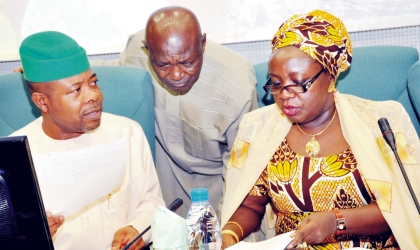
L-R: Deputy Speaker, House of Representatives, and Chairman, ad-hoc Committee on Review of the 1999 Constitution, Rep. Emeka Ihedioha, Chairman, House Committee on Rules and Business, Rep. Albert Tsokwa and House leader, Rep. Mulikat Akande-Adeola, during the committee’s public hearing in Abuja, recently.
Photo: NAN


Rt Hon. Abbas secured the party’s ticket through an affirmation exercise conducted across the 13 electoral wards in the constituency.
The wards involved include Kwarbai A, Kwarbai B, Limancin-Kona, Unguwar Fatika, Unguwar Juma, Dutsen Abba, Gyallesu, Kufena, Dambo, Wuchichiri, Tudun Wada, Tukur-Tukur, and Kaura.
The exercise, which began simultaneously in all wards at about 10 a.m., recorded large turnout of APC members who gathered at various party offices across the constituency.
At Kwarbai B Ward, the Speaker’s ward, the process was conducted peacefully under the supervision of the ward APC Returning Officer, Malam Iliyasu Muhammad Balarabe, in the presence of Rt Hon. Abbas.
According to the ward APC secretary, Nafiu Sabo, the ward has over 10,000 registered members, but 220 members were accredited for the exercise.
Before the affirmation, Mallam Balarabe informed members that Rt Hon Abbas was the only aspirant who purchased nomination forms, underwent screening, and was cleared by the APC national leadership to contest the Zaria Federal Constituency seat.
Following a voice vote by accredited members, the Speaker was affirmed as the party’s candidate in the ward, a process replicated across the remaining 12 wards.
At the constituency collation centre, the APC Returning Officer for the House of Representatives primary in Zaria Federal Constituency, Dr. Hamisu Ibrahim Kubau, announced that 1,376 APC members across the 13 wards endorsed Rt Hon. Abbas as the party’s flag bearer.
He explained that although thousands of party members participated in the exercise, only accredited delegates were allowed to vote.
Dr. Kubau declared: “There are 13 wards in Zaria Federal Constituency, and only one aspirant purchased a form, was screened, and cleared. He is Rt. Hon. Abbas Tajudeen. After due process, we conducted affirmations across all wards.”
He added that the process was peaceful and monitored by officials of the Independent National Electoral Commission (INEC) and party representatives.
Chairman of the APC House of Representatives Primary Elections in Kaduna State, Senator Yakubu Oseni, described the outcome as a reflection of the Speaker’s popularity and acceptance among constituents.
He expressed confidence that Rt Hon Abbas would secure victory in the 2027 general elections.
Speaking after his declaration, Rt Hon. Abbas expressed appreciation to APC members for reaffirming their confidence in him.
The incumbent Reps including Emily Inyang and Godwin Offionio, in separate interviews
protested the handling of the primaries conducted by the leadership of the party in the state, saying it was skewed against them.
The aspirants further described the primaries as a charade and an embarrassment to the state.
According to them, the House of Representatives primaries fell short of the provisions of both the Electoral Act as amended in 2026 and the party’s constitution.
They accused the leadership of the party in the state, backed by Governor Bassey Otu, of violating the party’s constitution in the conduct of the House of Representatives primaries across the state on Saturday.
Hon. Godwin Offiono, representing Ogoja/Yala Federal Constituency, particularly expressed disappointment with the primary that allegedly disenfranchised registered members of the party in his constituency.
Hon. Offiono asserted that having failed to arrive at a consensus, the party leadership opted for a direct primary to decide the candidate for the 2027 election.
“But what I witnessed today was not only alarming, but quite disheartening that our electoral system have not shown any improvement, especially now that we have a man of God in the person of the governor as the leader of the party.
“How do you declare a result by 9:00am even when the electoral materials were yet to arrive at Yala.
“As an aspirant, I couldn’t even vote or see the materials for my own primary at my Okuku ward in Yala Local Government Area, where I come from. But no matter what happens I am still in the race and have not stepped down for anybody.
“The governor had all the time in the world to drive the process of consensus but he never did. As a representative, I cannot even see my governor. I called, no response. I sent text no reply. I am treated as an out cast,” he lamented.
In an emotion laden tone during a telephone interview, Hon. Offiono further said: “I could not believe that first term NASS members like me can be treated in this shoddy manner even when I don’t know my offence.
“I have been a loyal party man. I appeal to the governor to do the right thing, follow the Electoral Act and party constitution in electing representatives.”
Similarly, Hon. Emil Inyang of Akamkpa/Biase Federal Constituency said he still remained in the race and had not stepped down for anybody.
According to him, “If this shenanigan called primary is allowed to stand, it would affect the party’s fortune in the general elections.
“My appeal to the governor is to allow the people to decide. And if they so voted against me, I will rest and not fight over anything.
“There was no stakeholders meeting held to decide on anything before now, and someone can not be unilaterally imposed on us all in the name of compromised primary,” he stated.
A coalition of support groups within the All Progressives Congress (APC) has protested the disqualification of former presidential aspirant, Mr Tein Jack-Rich, from the Rivers West Senatorial race ahead of the party’s primaries for the 2027 general elections.
The groups, in a statement issued on Saturday morning in Abuja, described the action of the party’s screening committee as unjust and capable of worsening internal divisions within the APC in Rivers State.
The statement, signed by the coalition’s National Coordinator, Dr. Bilal Galadima, and General Secretary, Hon. James Ogenyi, accused the party leadership in Rivers State of favouring politicians loyal to the Minister of the Federal Capital Territory, Chief Nyesom Wike, while sidelining long-standing members of the APC.
The coalition alleged that only aspirants aligned with Chief Wike were cleared to contest for elective positions in the state.
“How can our party allow only one man who is not a member of our party to make decisions or dictate the direction of our party?”, the group queried.
The coalition specifically faulted the exclusion of Mr Jack-Rich, describing him as a loyal party member who had supported the APC for more than 13 years and previously contested the party’s presidential ticket.
It also questioned the alleged clearance of Chief Felix Obua, whom it described as a recent entrant into the party and an ally of Chief Wike.
“How can our party disqualify Jack-Rich, a former presidential aspirant who has been loyal and supported our party for the last 13 years, only for our party to choose Felix Obua, a Wike loyalist who only joined the party three months ago?”, the statement read.
The group warned that failure by the APC leadership and National Working Committee (NWC) to address the matter as it could weaken the party’s structure in Rivers State ahead of the 2027 elections.
It called on party leaders to uphold internal democracy, reward loyalty and ensure a level playing field for all aspirants.
INEC TO BEGIN MEMBERSHIP VERIFICATION AS POLITICAL PARTIES SUBMIT REGISTER
All 22 registered political parties have successfully submitted their membership registers to the Independent National Electoral Commission (INEC) in compliance with the Electoral Act 2026, the Commission has said.
In a statement issued on Friday, Chairman, Information and Voter Education Committee, Mr Mohammed Haruna, said the submission followed the extension granted by the Commission after political parties raised concerns during a meeting on Tuesday, March 24, 2026, regarding the timeline provided in the Revised Timetable and Schedule of Activities for the 2027 general elections.
He said, “The Commission is pleased to note that all registered parties submitted their registers as of 8th May 2026, two days before the extended deadline.”
He recalled that following a meeting with political parties, the Commission, in a statement issued on the 27th of March, 2026, adjusted the deadline for the submission of party registers from 21st April 2026 to 10th May 2026 to align with the provisions of Section 77(4) of the Electoral Act 2026 and the actual dates fixed by political parties for their primaries.
Mr Haruna noted that political parties were accordingly allowed to conduct their primaries within the approved period from 23rd April 2026 to 30th May 2026, while the register of party members was required to be submitted to the Commission not later than 21 days before the conduct of their respective primaries.
He added, “INEC wishes to state that all registered political parties complied with the requirement within the extended timeframe and will subject the submitted registers to the necessary verification processes in line with the law.”
The Commission restated its commitment to the conduct of free, fair, credible and inclusive elections.
-

 Maritime5 hours ago
Products, Others, To Arrive Lagos Ports Today — MPA
-

 Environment3 hours ago
MOSOP – Tinubu Not Sincere With Ogoni People For Oil Resumption
-

 Oil & Energy4 hours ago
SEED: FG To Train 6,000 Energy Professionals
-

 Environment3 hours ago
NEWSAN Urges Investment For Water And Sanitation services
-

 Environment3 hours ago
NGOs Task Media On Investing In Climate Literacy
-

 Oil & Energy4 hours ago
‘Trans Niger Pipeline Records Zero Infraction ‘ ……..As FG Hits 99.2% OPEC Target
-
Politics3 hours ago
Primaries: Diri Lauds APC’s Unity, Cohesion In Bayelsa
-

 Maritime5 hours ago
Lagos Records Major Gains In Road, Rail, Water Transport —Osiyemi