
Business
Nigeria, Brazil Sign MoU On Trade Investment

Nigeria and Brazil recently in Abuja signed a Memorandum of Understanding (MoU) to strengthen their bilateral cooperation on trade and investment.
The Minister of Trade and Investment, Mr Olusegun Aganga, signed on behalf of Nigeria, while Mr Ricardo Shaefer, his Brazilian counterpart on Development, Industry and Foreign Trade, signed for his country.
The Tide source reports that the agreement aims at strengthening bilateral cooperation on the promotion and facilitation of trade and investment between the two countries.
Speaking at the ceremony, Aganga said that the MoU was a follow-up to the recent meeting between President Goodluck Jonathan and his Brazilian counterpart, Dilma Rousseff.
According to him, the agreement goes beyond trade and investment to include industrial cooperation and financing as well as how both countries can double their trade volume.
The minister listed the sectors covered by the MoU to include infrastructure, power, automobile, agriculture and sugarcane to sugar among others.
“Nigeria has policies on sugar and automobile development. These are areas that Brazil has very strong presence and this is how we work together to develop those sectors.
“In the area of trade, the balance of payment is in favour of Nigeria but that is because of the export of crude oil to Brazil.
“We have agreed that we need to look at the non-oil sector and double trade within the next two years in all the sectors in terms of industrial products, services, agriculture and all that.
“Then we have looked at how to strengthen institutions to deliver and support industrial and SMEs development as well as trade.
“In Brazil, there is Sindra and of course SINACH, both of which offer almost the same services as the Small and Medium Enterprises Development Agency of Nigeria (SMEDAN).
“We want to make sure that there is a strong relationship because that is what is going to address the development of micro, small and medium enterprises in both countries.
“So, this agreement will cover cooperation in all these areas including how we double trade between the two countries, and of course how we attract investment into strategic areas of the economy.”
Aganga, however, decried the presence of some obstacles to free movement of people between both countries, which he said, were a threat to implementation of the agreement.
He identified a lack of direct flight from Nigeria to Brazil and the difficulty in obtaining visa at the Brazilian Embassy as some of the obstacles that should be addressed.
In his remark, Shaefer, observed that Brazil and Nigeria shared some development challenges that could be addressed through cooperation.
He noted that stronger economic and trade ties between Nigeria and Brazil would translate into economic development for both countries and a better life for their citizens.
The minister, who spoke through an interpreter, expressed his delight on the MoU, pledging the commitment of his country to its implementation for the benefit of both countries.
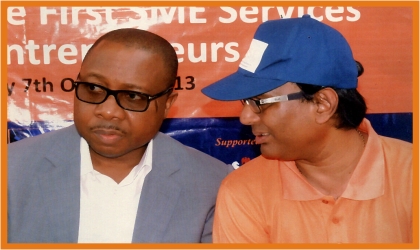
Executive Director, RSSDA, Mr Noble Pepple (left), with Managing Director, ICMSE Nigeria Limited, Dr Mostaq Ahmed, during the presentation of starter packs to micro entrepreneurs in Woji Town, near Port Harcourt, last Monday. Photo: Egberi A. Sampson



Business
Jonathan, Diri, Others Laud Firm’s Milestone in Bayelsa …Says Project Will Drive Industrialisation, Create Jobs



-

 News3 days ago
RSG Targets Nine Million Residents in Mosquito Net Distribution Campaign
-

 Oil & Energy2 days ago
Aiyedatiwa Signs New Electricity Bill
-

 Oil & Energy2 days ago
NLNG Commissions Research And Innovation Centre In RSU
-

 Maritime2 days ago
Marine Minister Commends President Tinubu On NPERA Bill Assent
-

 News3 days ago
KenPoly Holds Eight Convocations, August 29
-

 News3 days ago
RMAFC Completes Revenue Sharing Review, Proposes New Pay
-

 News3 days ago
RSG Begins Another Phase of Projects Commissioning Today
-

 Maritime2 days ago
NAGAFF Petitions IGP Over Alleged Maritime Police Harassment