
City Crime
NASS’ Subsidy Debate Delays Fuel Imports

Nigeria’s fuel import allo
cations for the fourth quarter are being delayed as National Assembly debates the removal of subsidies and as petrol held in offshore floating storage surges to record levels, trade sources said on Monday.
Nigeria is Africa’s top oil exporter but insufficient refining capacity means it relies on fuel imports, mostly petrol, for up to 85 percent of its oil product needs.
About half of the country’s yearly petrol needs are imported through swap exchanges arranged by a subsidiary of state-run Nigerian National Petroleum Corporation (NNPC), according to traders. The other half is organised independently through deals with Nigeria-based distributors.
The parliamentary debate about subsidies and an excess supply of gasoline stored offshore have put a spanner in the allocation talks for this quarter, traders said, which could drag on into next year.
“These allocations should have been out by October or mid-October but they’re not out still,” one trader said. “There are two key things being looked at – the deregulation talks and the oversupply currently in the market.”
Nigerian President Goodluck Jonathan has backed a plan to remove costly gasoline import subsidies, currently running at about 30 percent. This could prove sensitive in a country where a large section of the population survives on less than $2 (about N320) a day.
Finance Minister and Coordinator of the economy, Ngozi Okonjo-Iweala, has said fuel subsidies will cost Nigeria at least N1.2 trillion ($7.7 billion) this year.
The former World Bank official believes subsidies are a wasteful use of funds, as they are mainly paid to importers of refined products and do not reduce gasoline costs at the pump.
The central bank governor and other key officials have also said a necessary step in reforming the downstream oil sector and expanding sub-Saharan Africa’s second-largest economy will involve weaning Nigerians off hefty fuel subsidies, but the negotiations could drag on for months.
The debate is expected to prove controversial as many Nigerians regard cheap fuel as the only benefit they get from living in an oil-rich nation. Proposed fuel price increases in the past led to nationwide strikes.
Nigeria obtains gasoline via two routes. The NNPC has swap agreements with providers to exchange crude oil for refined fuel products, and through the Petroleum Products Pricing Regulatory Agency (PPPRA) it awards allocations to different suppliers.
Nigeria’s gasoline consumption has increased over recent years amid steady economic growth, with gross domestic product expected to rise by about 7 percent this year.
Monthly consumption of the motor fuel is around one million tonnes, a trader said.
NNPC data suggests Nigeria imported in excess of five million tonnes of premium motor spirit or petrol last year, although traders said that does not take into account the PPPRA allocations.
An excess of gasoline in floating storage offshore has tempered demand from the PPPRA this quarter, according to traders.
One trader estimated there is around 1.3 million tonnes of gasoline floating off the coast of Nigeria, or some 45 mid-range cargo ships carrying roughly 30,000 tonnes each. This is well in excess of the almost one million tonnes held at the previous peak in May.
“We are seeing the usual delays in Nigeria – there is enough product offshore to chew through,” said a gasoline broker. The over-supply could provide rich pickings for pirates in the Gulf of Guinea. An oil products tanker was hijacked a week ago in the latest in a string of attacks in the emerging trading hub.
The removal of the subsidy could also mean a consolidation of the government’s several oil agencies into one overseeing organisation, a trader said.
Earlier this year, the country’s PPPRA censured Noble Group for shipping gasoline to tankers near Lagos Bay for floating storage, which was then unloaded away from the country’s official tenders.



A former staff of the Rivers State Newspaper Corporation, publisher of The Tide Newspapers, Idongpee Akwaowo Reuben, has been appointed the Acting Registrar/Chief Executive Officer of Chartered Chemists of Nigeria (ICCON) by the Federal Government of Nigeria.
Akwaowo’s appointment follows the expiration of the second tenure of the former Registrar, Chemist Jwalshik Wilford.
According to a letter released from the office of the Minister of State for Health and Social Welfare dated August 5, 2026, the Minister of State for Health and Social Welfare, Dr. Iziaq Adekunle Salako, said the appointment was with immediate effect.
The minister had earlier announced Akwaowo’s appointment during a meeting with the Permanent Secretary, Heads of Departments, and Directors in June 10, 2026 in the Minister’s Conference Room.
He said the appointment was automatic and effective 1st June, 2026 following the satisfactory handover that followed the succession procedure.
The Minister nullified the earlier process put in place for a substantive appointment, citing it as a contravention of the provision of the ICCON Act.
He further directed that the appointment letter be issued without further delay.
The Minister admonished the new ICCON Chief Executive to take charge and ensure that the Institute is on the path of peace and progress to deliver her mandates.
In his response, Akwaowo thanked the the Federal Government for the appointment which, he said, has laid every uncertainty surrounding the leadership of the Institute to rest.
He pledged his unalloyed loyalty to the Federal Government and the Minister and promised to work with his Management Team to align with the policy directives of the Ministry as well as the renewed hope agenda of the Federal Government.
Akwaowo joined ICCON in 2005 as a pioneer staff, rose through the ranks and served in many capacities transcending virtually all the departments in the Institute including HOD, Administration/Accounts & Finance.
Most recently, he served as the pioneer Team Lead and the Registrar/CEO Representative in the National Chemical Personnel Audit excercise to Chemical companies and Chemistry Departments in Tertiary Institutions as part of the Institute’s regulatory mandates.
He has attended several courses and workshops and represented the Institute at various conferences and fora.
Akwaowo is a Chartered Chemist and also a member of a number of professional bodies.
He rose to the rank of Director, Scientific in 2025, and was until his appointment, the Coordinator, Zonal Offices of ICCON.
City Crime
Bayelsa Water Coys Raise Alarm Over Business Threats …Set To Resist Multiple Levies Amid High Production Cost

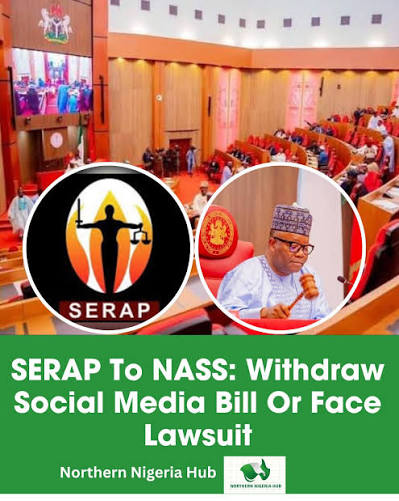
The Socio-Economic Rights and Accountability Project has asked the National Assembly to immediately withdraw the proposed Nigeria Data Protection (Amendment) Bill, 2026, describing it as a backdoor attempt to regulate social media and expand government control over online expression.
SERAP warned that it would institute legal action if the bill is passed in its current or substantially similar form.
The bill, sponsored by Senator Ned Nwoko (APC, Delta North), seeks to compel social media platforms, data controllers and data processors operating in Nigeria to establish physical offices in the country.
It also empowers the Nigeria Data Protection Commission to shut down or prohibit the operations of any entity that fails to comply within 30 days.
In a letter dated July 18, 2026, and addressed to Senate President Godswill Akpabio and Speaker of the House of Representatives Tajudeen Abbas, SERAP said the proposed amendment posed a threat to constitutionally guaranteed rights.
The letter, signed by SERAP Deputy Director Kolawole Oluwadare and issued on Sunday, read in part, “Requirements compelling technology companies to establish local offices would increase government leverage over platforms, facilitate political pressure, make censorship demands easier and expose local employees to retaliation.
“The Bill would create sweeping powers capable of shutting down or excluding social media platforms from the Nigerian market and expose millions of Nigerians to serious violations of their constitutionally and internationally guaranteed human rights.”
SERAP argued that the bill revives previous attempts to regulate social media that attracted widespread public opposition.
“The current Bill revives substantially similar proposals previously introduced by Senator Nwoko, raising renewed concerns that localisation requirements are being used as a vehicle for expanding governmental control over digital platforms and online expression,” it said.
The organisation warned that it would challenge the legislation in court if enacted.
“Should the Bill be enacted into law in its current or substantially similar form, SERAP shall promptly take all appropriate legal actions to challenge its legality in the public interest and to ensure that Nigerians’ fundamental rights are fully protected,” the letter stated.
According to SERAP, the proposed legislation would give the Nigeria Data Protection Commission excessive powers to block digital platforms without adequate procedural safeguards.
“The Bill constitutes a backdoor attempt to regulate social media and increase governmental control over online expression through corporate localisation requirements rather than through transparent and constitutionally permissible regulation,” it said.
The group argued that the bill lacks provisions for prior judicial authorisation, meaningful opportunities for compliance beyond the proposed 30-day period, and safeguards to protect the rights of millions of Nigerians who rely on digital platforms.
SERAP also cited the judgment of the ECOWAS Court of Justice on Nigeria’s suspension of Twitter, arguing that the proposed amendment could produce similar consequences by indirectly excluding social media platforms from operating in the country.
“The Bill also risks recreating the very dangers previously condemned by the ECOWAS Court of Justice. In SERAP and Others v. Federal Republic of Nigeria, the Court held that the suspension of Twitter violated the rights to freedom of expression, access to information and media freedom protected under the African Charter.
“Although the present Bill differs from the Twitter suspension in form, it creates the possibility of achieving the same result indirectly by empowering regulators to prohibit digital platforms from operating in Nigeria.
“The National Assembly should not enact legislation capable of producing, through indirect regulatory means, the very restrictions on fundamental rights that regional human rights law prohibits,” the organisation said.
It maintained that while governments have a legitimate interest in regulating digital platforms, such measures must comply with constitutional guarantees and international human rights standards.
The organisation further warned that mandatory localisation requirements would increase compliance costs for technology companies, startups, educational institutions and artificial intelligence developers.
“The proposed amendment conflicts directly with the objectives of the Nigeria Startup Act 2022 and the National Digital Economy Policy and Strategy.
“Mandatory localisation requirements substantially increase compliance costs, particularly for startups, open-source projects, educational institutions, research organisations, AI developers and smaller technology companies, while reducing Nigeria’s attractiveness as a destination for innovation and investment.
“No major democratic jurisdiction requires every social media platform to establish a physical office as a blanket precondition for providing services.”
SERAP added, “The National Assembly should immediately reject and withdraw the Bill, as it is manifestly incompatible with the Nigerian Constitution and Nigeria’s obligations under the African Charter on Human and Peoples’ Rights and the International Covenant on Civil and Political Rights.”
-

 News4 days ago
RSG Targets Nine Million Residents in Mosquito Net Distribution Campaign
-

 Oil & Energy4 days ago
Aiyedatiwa Signs New Electricity Bill
-

 Maritime4 days ago
Marine Minister Commends President Tinubu On NPERA Bill Assent
-

 Oil & Energy4 days ago
NLNG Commissions Research And Innovation Centre In RSU
-

 News4 days ago
KenPoly Holds Eight Convocations, August 29
-

 News4 days ago
RSG Begins Another Phase of Projects Commissioning Today
-

 News4 days ago
RMAFC Completes Revenue Sharing Review, Proposes New Pay
-

 Maritime4 days ago
NAGAFF Petitions IGP Over Alleged Maritime Police Harassment