
Politics
Consolidating Nigeria’s Electoral Successes

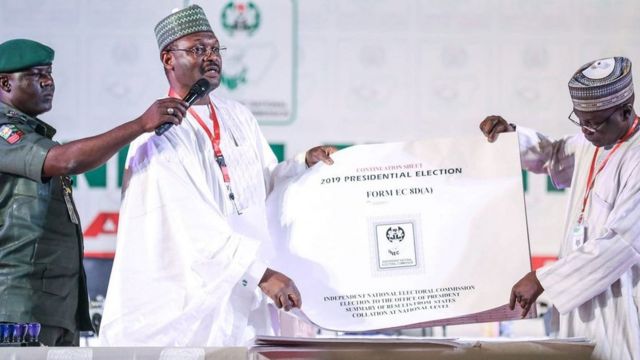
On September 19, the nation’s electoral umpire, the Independent National Electoral Commission (INEC), proved book makers wrong by conducting what has so far been termed as one of the freest and most credible elections in the country.
The election was devoid of the usual violence and conspiracies to steal the mandate of the electorate to choose who governs them.
INEC, in just 24 hours delivered a verdict from the Edo polls, that returned incumbent Governor Godwin Obaseki of the opposition Peoples Democratic Party (PDP), for a second term in office.
That day, Edo, The Heartbeat of the Nation, was calm and the fear that the state would experience bloodletting was doused by the conduct and carriage of most of the political stakeholders, before, during and after the governorship polls.
Months before the exercise, following the utterances from political gladiators, Edo was almost torn apart, as hoodlums masquerading as party loyalists, fought at the gate of the palace of the Benin monarch.
The Oba of Benin, Ewuare II, had prior to the incident, said that he would call his sons, Obaseki and his main challenger, Pastor Osagie Ize Iyamu, to a peace meeting, in order to ensure violence-free election in Edo.
The Oba did. With the National Peace Committee, led by former military Head of State, Abdulsalami Abubakar, and Bishop Matthew Kukah, its secretary, following immediately after, a peace accord was eventually signed, setting the stage to what came out of Edo.
The questions now are: After Edo what next? Will INEC do an encore in the next election already scheduled for Ondo State on October 10? Will the votes of the Ondo State electorate count and will it also be non-violent?
INEC already knows that all eyes are on it and that if it achieves the same feat as it has done in Edo, it would have fully restored credibility in the nation’s electoral system.
In Edo, INEC used its newly created Z-pad, a technology-driven visual portal to upload all results collated at the polling units to a central portal to remove any act or attempt to manipulate the outcome of the results at the various collation centres.
The Z-pad was akin to the strategy adopted by then Chairman of the National Electoral Commission (NEC), Prof. Humphrey Nwosu, for the June 12, 1993 Presidential Election.
The Commission mounted a bill board at the commission’s headquarters in Abuja, where collated results were published in quick sequence.
Available results showed that Chief MKO Abiola, the presidential candidate of the Social Democratic Party was coasting to victory before the election was annulled.
The Z-pad adopted by INEC for Edo governorship election worked as the usual cobwebs which hitherto festooned the dusky beams of form EC8, the document for the recognised manual transmission of results, were removed.
INEC Chairman, Prof. Mahmood Yakubu, on September 23 began a three-day visit to Ondo State to assess the preparedness of his men to replicate the feat in Edo.
He assured Nigerians, especially Ondo State electorate that the Commission was fully ready for October 10.
The reassurance has been a soothing balm to the people, after a wild fire on September 10, torched more than 5,000 card readers for the polls stacked in containers in the state INEC office.
“We have already recovered. Unfortunately, we lost 5,000 smart card readers, but we recovered by getting the prerequisite number of card readers from the neighbouring Oyo State, and they have been delivered.
“They have arrived, been charged and configured and are ready for the election on October 10, in Ondo State.
“ We will use the Z-pads to upload results on election day real-time and we have moved those Z-pads from Edo to Ondo State for the election.
“So, the same preparations that we made for Edo, we have also made for Ondo State, so we are prepared for the election,” he said.
Yakubu said he would also meet with the council of traditional rulers, security agencies, and officials of the Commission in the 18 local government areas of the state for the purpose of the election.
“This is the first visit. We are still coming back a week after for the main stakeholders’ visit and the signing of the peace accord,” he said.
INEC achieved success in Edo, but remaining on top is usually a major challenge for persons and institutions that must be exposed to tests.
It is expected that the umpire will not relax as it must gather all information on what transpired in all previous elections, assess what went wrong in some instances and do its possible best to correct them.
Available records showed that Edo has 2.21million registered voters, 1.73 million qualified to vote, as 483,796 persons failed to collect their voter cards.
The winner emerged with 307,955, votes, while the state’s population from a 2014 estimate is five million.
Obviously, it was not 100 per cent success in Edo as there were still cases of poor voters’ turnout, intimidation by the presence of 30,000 police men, harassment of mostly female voters and various allegations of vote-buying.
Various groups, politicians, diplomatic community and ordinary Nigerians have hailed Edo polls and want its lessons to spread to Ondo State and other subsequent polls.
The U.S., which had issued a no visa order on any person that could undermine the Edo polls, on September 24, endorsed the processes that led to a successful Edo polls.
The country lauded INEC and the security agencies on the positive roles they played during the election, which it said, strengthened democracy in the country.
It called on all stakeholders, including INEC, political parties, and the security agencies to improve the electoral process during the October 10, Ondo State governorship election.
“The United States remains concerned with reports of some violence that did emerge during the election, and reports of vote-buying and intimidation of both voters and civil society domestic observers.
“We will continue to encourage all stakeholders, including INEC, political parties, and the security services to improve the electoral process in the upcoming Ondo State governorship election.
“As a democratic partner of Nigeria, the United States remains committed to working together to achieve our mutual goals of peace and prosperity for the citizens of both countries,” it said via the Facebook page of the United States Diplomatic Mission to Nigeria.
The U.S. stressed the need for all Nigerians and other stakeholders to give its support in anyway, to make the system better for posterity.
Analysts recall that former President Goodluck Jonathan, demonstrated statesmanship and sportsmanship after the 2015 Presidential Election as he put a call to President Muhammadu Buhari to prevent endless tussle at the election tribunal and usher in peace to the electoral space.
Buhari had since built on this by making sure that there was improvement in conduct of elections so that the opposition, no matter who, has the hope that victory can come its way.
Nigeria cannot afford to disregard the already established principles; the country should continue marching forward. It can never be late.
Ugwu is of the News Agency of Nigeria.



The Independent National Electoral Commission (INEC) has extended the deadline for political parties to submit the list of candidates for the 2027 governorship and state Houses of Assembly elections from Saturday, August 8, to Tuesday, August 11, 2026.
The commission announced the extension in a statement issued on Saturday and signed by the National Commissioner and Chairman of its Information and Voter Education Committee, Mohammed Haruna.
According to INEC, the decision followed appeals by political parties for additional time to complete the submission process through the dedicated online portal.
“The submission window, which according to the revised Timetable and Schedule of Activities for the General Election was originally scheduled to close on Saturday, 8th August, 2026, has been extended to Tuesday, 11th August, 2026,” the commission said.
In a a related development, INEC announced the suspension of PVC collection in Osun State ahead of the August 15 governorship election.
The commission said voters who applied for replacement of lost, damaged or defaced Permanent Voter Cards would have until midnight on Sunday, August 9, to print downloadable copies of their cards.
The electoral body explained that the deadline was necessary to enable it compile data on downloaded PVCs and produce final statistics on the total number of cards collected ahead of the election.
INEC said PVC collection in Osun commenced at the Registration Area level from July 22 to 28, 2026, but was extended to July 31 following complaints about large crowds and difficulties experienced by voters at collection centres.
The exercise subsequently moved to the local government level and ran from August 1 to 7.
The commission also disclosed that replacement downloadable PVCs had been made available to voters in Odo-Otin and Ife Central Local Government Areas following the theft of cards during attacks on the two collection centres.
It stressed that the stolen cards could not be used to vote.
INEC reassured Osun residents of its preparedness for the August 15 governorship election.
“The commission reiterates that the stolen cards cannot be used to vote.
“INEC reassures the people of Osun State of its readiness to conduct a free, fair, credible and inclusive governorship election on 15th August, 2026,” the statement said.
The commission said the deadline, initially set for Saturday, 8 August, has been extended to Tuesday, 11 August 2026, following appeals from political parties for more time.
INEC also announced that the window for voters who applied to replace lost, damaged or defaced PVCs to download their replacement cards will close at midnight on Sunday, 9 August.
The move is to enable the commission compile final PVC collection figures ahead of the 15 August Osun governorship election.
INEC said replacement downloadable PVCs have also been provided to affected voters in Odo-Otin and Ife Central Local Government Areas after hoodlums carted away cards from two collection centres, stressing that the stolen cards cannot be used to vote.
The commission reaffirmed its readiness to conduct a free, fair, credible and inclusive election in Osun State.
Gov. Kefas made the remarks over the weekend at the Federal Medical Centre (FMC), Jalingo, during the flag-off of the second phase of the Renewed Hope Medical Outreach in Taraba State, organised as part of activities marking Prof. Yilwatda’s 58th birthday.
The governor commended Prof. Yilwatda for choosing to mark his birthday by providing medical care to people in need.
“What Professor Nentawe did is a powerful demonstration of what leadership should be,” Gov. Kefas said.
He assured that his administration would continue to support initiatives that complement government efforts to improve healthcare delivery and the wellbeing of residents.
Speaking at the event, Prof. Yilwatda called on Nigerian leaders to embrace the culture of giving and use their positions to touch the lives of the less privileged.
He said his decision to celebrate his 58th birthday in Taraba State was deliberate and informed by the needs of underserved communities, particularly people who face difficulties accessing healthcare because of distance and financial constraints.
According to him, the intervention followed a needs assessment and was extended across the three senatorial districts of the state.
He said the exercise commenced on August 3 at Takum General Hospital and covered the Federal University Teaching Hospital, Wukari; First Referral Hospital, Sunkani, Ardo-Kola Local Government Area; General Hospital, Bali; General Hospital, Gembu; and FMC Jalingo.
Prof. Yilwatda said the intervention provided medical services to thousands of beneficiaries, including people who required surgical procedures.
He said sustainable national development could only be achieved when strong institutions placed Nigerians at the centre of development.
“Leadership is about service,” he said, urging political and public leaders to make giving back to society an important part of their responsibilities.
He reaffirmed his commitment to serving Nigeria and its people, saying his personal vision was to make every day of his life useful to humanity.
“Every day that I live, the vision is: let it be useful to humanity,” he said.
The Taraba State Commissioner for Health, Dr. Bordiya Buma, commended the initiative, saying it was consistent with the Renewed Hope agenda and efforts to strengthen healthcare delivery in the state.
Dr Buma said the second phase followed the successful completion of the first phase, which was conducted simultaneously in six local government areas, with two LGAs selected from each of the three senatorial districts.
According to him, more than 10,000 patients were attended to during the first phase, including people with medical and surgical conditions.
He disclosed that 327 general surgeries, 71 eye surgeries and 575 dental procedures were carried out during the exercise.
The commissioner expressed appreciation to President Bola Tinubu for the Renewed Hope Medical Outreach and thanked Prof. Yilwatda for supporting the initiative and choosing Taraba State as a beneficiary.
The Minister of Health and Social Welfare, Prof. Muhammad Ali Pate, also commended Prof. Yilwatda for choosing Taraba State to mark his 58th birthday through a medical outreach.
Prof. Pate said making healthcare the centrepiece of the birthday celebration was significant because health affects everyone.
-

 News4 days ago
RSG Targets Nine Million Residents in Mosquito Net Distribution Campaign
-

 Oil & Energy4 days ago
Aiyedatiwa Signs New Electricity Bill
-

 Maritime4 days ago
Marine Minister Commends President Tinubu On NPERA Bill Assent
-

 Oil & Energy4 days ago
NLNG Commissions Research And Innovation Centre In RSU
-

 News4 days ago
KenPoly Holds Eight Convocations, August 29
-

 News4 days ago
RSG Begins Another Phase of Projects Commissioning Today
-

 News4 days ago
RMAFC Completes Revenue Sharing Review, Proposes New Pay
-

 Maritime4 days ago
NAGAFF Petitions IGP Over Alleged Maritime Police Harassment