
Politics
…As NGE Rejects Conditions

The Nigerian Guild of Editors (NGE) yesterday rejected the new guidelines for accreditation of media organisations and journalists for coverage of the 9th National Assembly.
The Guild in a statement by its General Secretary, Mrs Mary Atolagbe, described the move as an infringement on press freedom, saying it was “primitive, undemocratic and blatantly anti-press and anti-people.”
The guidelines issued by the authorities of the National Assaembly (NASS) is due to become effective from June 11.
“It demands among other draconian provisions that a media organisation wishing to be accredited for coverage of NASS activities should submit a copy of its income tax return for the last two years.
“Presentation of evidence of Certificate of Incorporation of the media organisation, evidence of membership of professional bodies for the journalists, maintenance of a functional Bureau in Abuja (staff strength not less than five editorial staff) and daily circulation of 40,000 copies for print media with evidence to support the claimed circulation figure,” it said.
The Guild, however, finds this vexatious, disrespectful and draconian. It is a scurrilous attempt to gag the press in a democracy and it cannot stand.
“These guidelines run contrary to the grains of reason, democratic ideals and they are a clear affront on the letter and spirit of the Nigerian constitution which empowers journalists to freely practise their profession without any gag, muzzling and restriction.
“The NASS guidelines negate the constitutional principle of freedom of expression and run contrary to the African Charter on Fundamental Rights and the right of the people to know.
“The Guild strongly objects to these guidelines in their entirety as they serve no public good except the myopic interest of its chroniclers and purveyors.
“The Guild is disappointed that the same 8th National Assembly which benefited immensely from free press in its moments of trial has turned around to put the same press in shackles and chains.
“We reject this crude abrasion of our constitutional rights to freely disseminate information. It cannot stand,” the Guild said.
It therefore, urged all media houses to reject the infringement on the nation’s media who fought for restoration of democracy in the nation.



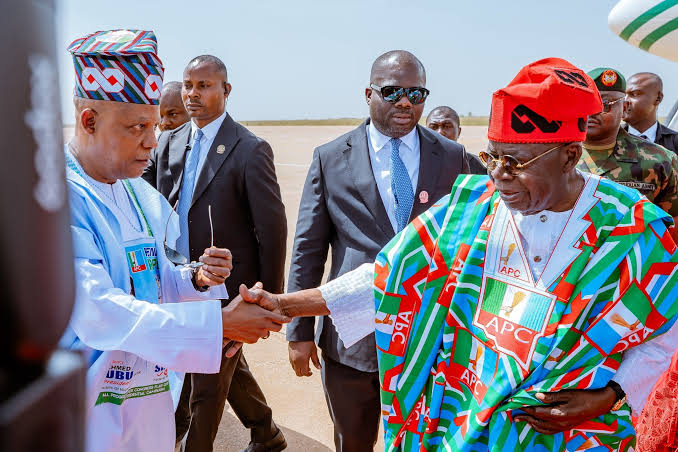
The campaign rally, held at the Kaduna Township Stadium, attracted Vice-President Kashim Shettima, APC governors, party leaders, federal and state lawmakers, political stakeholders and supporters from across the country.
The flag-off marks the beginning of the APC’s drive to secure a second presidential term for President Tinubu, with the party expected to promote its achievements, defend its economic reforms and outline its policy priorities under the proposed Renewed Hope 2.0 agenda.
Kaduna’s selection for the campaign launch underscores the strategic importance of the North-West, a region with a substantial voting population and considerable influence on presidential election outcomes.
The APC faces a significant challenge in Kaduna, where the Peoples Democratic Party’s presidential candidate, Alhaji Atiku Abubakar, defeated President Tinubu in the 2023 election. The rally therefore provides the ruling party an opportunity to strengthen its grassroots structures and regain electoral support in the state.
Addressing supporters, Vice-President Shettima appealed to Northern voters, highlighting President Tinubu’s political relationships with prominent Northern leaders, including Alhaji Abubakar, Mallam Nuhu Ribadu and the late President Muhammadu Buhari.
The Vice-President’s appeal reflects the APC’s determination to consolidate its support in the North as the party intensifies preparations for the presidential contest.
The Renewed Hope 2.0 agenda is expected to feature prominently in the campaign, providing a platform for President Tinubu to explain his administration’s economic policies and outline plans for another term.
However, the President’s record on economic reforms, rising living costs, petrol prices, employment, infrastructure and insecurity is expected to attract considerable scrutiny during the electioneering period.

-

 Education2 days ago
FCE Yola Graduates 3,555 Teachers , Seeks Upgrade to University
-

 Sports2 days ago
Nigerian Trio Target Titles At PFL Africa Finals
-

 Niger Delta2 days ago
Diri Restates Stance On Lagos-Calabar Coastal Highway
-

 Niger Delta2 days ago
C’River, NUJ Pay Tribute To Late Guardian Editor
-

 News2 days ago
NDLEA Recovers Tons Of Illicit Drug Consignments In Nine States
-

 Opinion2 days ago
Checking Voter Apathy In Nigeria’s Electoral Process
-

 Politics2 days ago
2027: DICKSON’S EX-ALLY VOWS TO WORK AGAINST NDC INTEREST IN BAYELSA
-

 Politics2 days ago
2027: GROUP PLEDGES 40,000 SUPPORTERS FOR COALITION CANDIDATES IN RIVERS