
Business
States Can Demand Revenue Sharing Formula Review -RMAFC

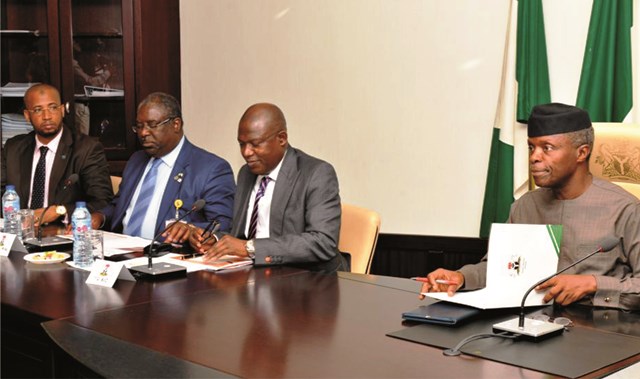
The Revenue Mobilisation Allocation and Fiscal Commission (RMAFC), says state governments are right to demand for a review of the revenue sharing formula of the Federation Account.
The outgone Acting Chairman, Mr Shettima Abba-Gana, said this while speaking with The Tide source in Abuja.
He, however, said that reviewing the formula was not the solution to states and Local Government Areas’ (LGAs) quest for increasing their revenue.
Under the current sharing formula, the Federal Government takes the lion share of 52.68 per cent from the Federation Account.
The 36 states are allocated 26.72 per cent , while the balance of 20.60 per cent is given to the 774 LGAs.
“Reviewing the formula is not an easy process and I am not particularly sure whether the review of the revenue sharing formula is the best solution for states.
“This is because the formula itself is based on a foundation and that is the constitution that has given the federal exclusive functions and states and LGAs concurrent functions.
“Unless you move functions from one tier to another, it will be very difficult to just transfer funds boldly to another tier.”
According to him, the magnitude of what the states are requiring may not be necessarily easy without some constitutional amendments to look at what the concurrent and exclusive functions of the states, LGs and Federal Governments are.
Abba-Gana, however, said that what the RMAFC always advocated was getting more revenue that would be enough for the three tiers to share. He added that even the Federal Government itself required more funds, especially with the current security situation in some parts of the country and the demand for infrastructure which also required funding.
The former chairman said that through the review of the product sharing contracts (PSCs) and enhancement of the Joint Venture Contracts (JVCs) and the states going to do some more work on their Internally Generated Revenue (IGR), it would uplift revenue across board. This, he said, was more important than trying to share from a cake that was presently not enough or was shrinking.
On the review of the PSCs, Abba-Gana said it was an ongoing process that had been done in the past and was last reviewed in 2008.



Business
Jonathan, Diri, Others Laud Firm’s Milestone in Bayelsa …Says Project Will Drive Industrialisation, Create Jobs



-

 News3 days ago
RSG Targets Nine Million Residents in Mosquito Net Distribution Campaign
-

 Oil & Energy3 days ago
Aiyedatiwa Signs New Electricity Bill
-

 Maritime3 days ago
Marine Minister Commends President Tinubu On NPERA Bill Assent
-

 Oil & Energy3 days ago
NLNG Commissions Research And Innovation Centre In RSU
-

 News3 days ago
KenPoly Holds Eight Convocations, August 29
-

 News3 days ago
RSG Begins Another Phase of Projects Commissioning Today
-

 News3 days ago
RMAFC Completes Revenue Sharing Review, Proposes New Pay
-

 Maritime3 days ago
NAGAFF Petitions IGP Over Alleged Maritime Police Harassment