
Business
FG Adopts New Strategy To Tackle Oil Spillage

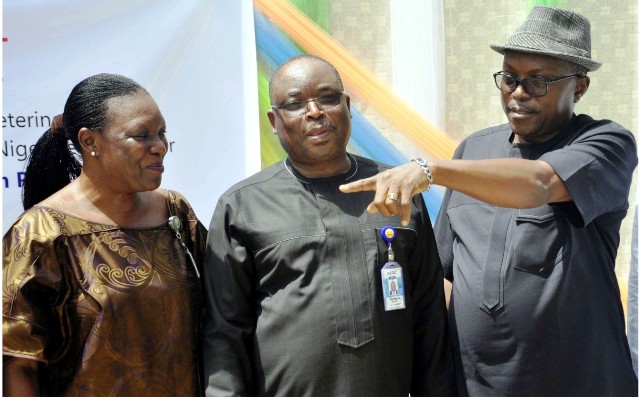
The Federal Government has said it will adopt a new innovation to tackle the menace of oil spillage in the Niger Delta region.
The Environment Minister, Hajia Amina Mohammed, disclosed this at a workshop on Oil Spill Trajectory Modelling in Maritime Environment held yesterday in Abuja.
She said the Federal Government would adopt the technology through the National Oil Spill Detection and Response Agency (NOSDRA) to aid in quick response to oil spill disaster in the oil producing states.
The minister, who was represented by NOSDRA Director General, Peter Idabor, explained that the trajectory modelling technique would help determine oil spill directions in the maritime environment and devising a quick response.
She said due to increasing level of oil spillage caused by activities of illegal bunkering, artisanal refining, oil theft and armed militancy, the trajectory modelling would as well reduce impact of environmental degradation.
Her words: “The use of oil spill modelling techniques in predicting the direction of movement of spilled oil in the marine environment is quite a laudable innovation, although it is difficult to accurately predict or simulate actual events, this tool presents a very valuable opportunity for both oil spill preparedness and response activities.
“There is a growing level of oil spill incidents caused majorly by activities of illegal bunkering, artisanal refining, oil theft and armed militancy. There is need for development of capacity to deal with the challenges that may be presented by oil spill, this workshop is therefore timely and a welcome development.”
She restated the Federal Government’s commitment to completing the Ogoni land clean-up exercise and extending such to other parts of the country affected by oil spillage.
“As a demonstration of the commitment of this administration to oil spill management in Nigeria, His Excellency President Muhammadu Buhari recently kick started the implementation of the United Nations Environment Programme (UNEP) Report on Ogoni land.
“This gesture will be extended to other parts of Niger Delta that have been devastated as a result of oil spillage and indeed across the country,
“The Federal Government is committed to working with the other stakeholders within the Global Initiative for West and Central Africa (GI WACAF) framework to adequately prepare and rapidly respond to any eventual trans-boundary oil spill incident within the region and also to offer support to any of the cooperating countries,” she added.
The Consultant, Oil Spill Response, Mr. Liam Harrington, in his remarks, explained that about two to three dimensional models would be used to check the movement of oil spill on the surface or underneath the water level.
He said with the innovation, NOSDRA can perform its mandate as expected and respond swiftly to oil spill related occurrences.
“We have a number of models ready to be engaged, we can use three and two dimensional models to look at the oil spill movement on the surface or underneath the water surface, as well as model how the oil changes overtime, that has key impact in the response strategies you want to employ.
“Oil spill response is an advocacy role, so we are constantly going out and talking to various organizations. We have agreement with all the response organizations around the world, we communicated constantly about the development in oil spill modelling,” he added.



Business
Jonathan, Diri, Others Laud Firm’s Milestone in Bayelsa …Says Project Will Drive Industrialisation, Create Jobs



-

 News3 days ago
RSG Targets Nine Million Residents in Mosquito Net Distribution Campaign
-

 Oil & Energy3 days ago
Aiyedatiwa Signs New Electricity Bill
-

 Oil & Energy3 days ago
NLNG Commissions Research And Innovation Centre In RSU
-

 Maritime3 days ago
Marine Minister Commends President Tinubu On NPERA Bill Assent
-

 News3 days ago
KenPoly Holds Eight Convocations, August 29
-

 News3 days ago
RSG Begins Another Phase of Projects Commissioning Today
-

 News3 days ago
RMAFC Completes Revenue Sharing Review, Proposes New Pay
-

 Maritime3 days ago
NAGAFF Petitions IGP Over Alleged Maritime Police Harassment