Connect with us

Oil & Energy

SPDC Rewards Most Peaceful Communities In Rivers

Published

on

For promoting peace and providing a congenial environment for business to thrive in 2009, the Shell Petroleum Development Company (SPDC) last Friday, rewarded some host communities in Rivers State with prizes for winning the maiden edition of the Community Role Model Peace Project in Port Harcourt.

The communities are those within Shell Land-1 East areas of operations, which form Port Harcourt-1 and 2, as well as Ogoni, and bring together secondary schools in Bori, Ogale, Igbo-Etche, Igwuruta, Rumuokurusi, Odagwa, Elelenwo, Umuechem, Egwi, Olakwor, in Obio/Akpor, Ikwerre, Etche, Eleme, and Khana local governments, among others.

The event brought together eight secondary schools, which vied for honours and glory with the projection of the core values of peace in essay and quiz competitions on the topics: “Effects of Pipeline Vandalism on the Environment”, and “Illegal Bunkering: Effects on the Environment and Economy”, as well as a community football competition.

At the end of the keenly contested essay competition,  Gladys Echi of  Elelenwo community came out tops, and was rewarded with N400,000.00 cash, a laptop computer and certificate, among others.

Captain Nwigwe of Igbo-Etche community clinched the second position, just as Chukwudi Okoronkwo took the third place, both rewarded with mouthwatering prizes and certificates.

In the quiz competition, Government Secondary School, Ogale, Eleme, swept through the lot to grab the first position with 14points, a cash reward of N20,000.00, among other prizes.

Community Boys Secondary School, Elelenwo won the second position with 13points while Birabi Memorial Grammar School, Bori, garnered the third position with 12points, and were also rewarded with valuable prizes.

However, in the football competition between PH-1 and PH-2, comprising a selection of talented football players from the participating secondary schools, PH-1 defeated PH-2 by 2-1 to lift the gold trophy and a cash reward of N300,000.00.

Speaking at the football prize presentation ceremony, Shell’s General Manager, Onshore Assets/Asset Manager, Swamp East, Woji Weli, thanked the participating schools from the local communities for promoting peaceful business environment in their areas in 2009, and charged the communities to continue to exhibit high level of hospitality and friendship in order to facilitate the sustainable development of their areas.

Making his presentation to winners of the essay competition, Manager, Government and Community Relations, SPDC, Theo Wellington, said the project was designed to recognize bright youths in the company’s host communities, and hoped that the participating youths will serve as role models by helping others in the communities to channel their minds, energy, time and resources to worthwhile activities that benefit the Niger Delta in particular and Nigeria in general.

He challenged the youths to be more creative and innovative in their career pursuits, and work assiduously towards the promotion of peace and development in their communities, as according to him, once peace is achieved in the rural communities, development and economic growth would be accomplished in the affected communities, local governments and state, and by extension, Nigeria.

In his speech, the Operations Manager, SPDC Land-1 East, Chuks Ikeobi, noted that majority of oil spills in the Niger Delta are the result of sabotage caused when thieves drill into pipelines or open up wellheads to steal oil and natural gas liquids, adding that on the average, these two causes account for more than 70 per cent of all oil spilled from Shell facilities in the Niger Delta over the last five years.

The operations manager assured that for whatever reasons may be adduced for misdirecting meaningful energies into the sabotage of the nation’s strategic economic livewire, as well as delaying the clean-up process by the emergency response teams, Shell was committed to improving its performance in all fronts, reduce the number of spills under its control, while striving to maintain oil production so as to sustain the nation’s economic growth and development.

“Whatever the cause”, Ikeobi said, “SPDC is committed to stopping and containing all spills, recovering and cleaning up as much oil as it can and restoring sites in compliance with regulations”, adding that Shell has “researched and adopted a technique for restoring land sites impacted by oil spills that we believe to be effective for the soil and climate conditions in the equatorial heat of the Niger Delta”.

He tasked host communities to continue to support and cooperate with the company in order to fast-track the development of the Niger Delta region by promoting the core values of peace and non-violence in their day-to-day activities, assuring that Shell would remain their advocate and partner. 

Shell’s Assets Manager, Land – East, Mrs Chidube Nnene-Anochie, presented the Community Peace and quiz prizes to winners of the competition.

Highlights of the event were the presentation of Community Peace plaques, cash ranging from N5,000.00 to N400,000.00, certificates, trophies, LCD television sets, laptop computers, among other prizes to winners and other participating schools, teachers and students.


Nelson Chukwudi

Continue Reading

Oil & Energy

NERC, OYSERC  Partner To Strengthen Regulation

Published

on

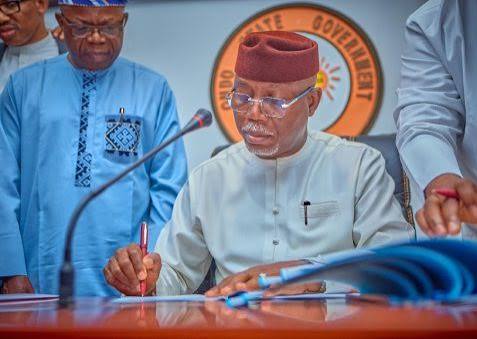
THE Nigerian Electricity Regulatory Commission (NERC) has stressed the need for strict adherence to due process in operationalizing state electricity regulatory bodies.
It, however, pledged institutional and technical support to the Oyo State Electricity Regulatory Commission (OYSERC).
The Chairman, NERC, Dr Musiliu Oseni, who made the position known while receiving the OYSERC delegation, emphasised that the establishment and take-off of state commissions must align fully with the law setting them up.
Oseni said that the NERC remains committed to partnering with State Electricity Regulatory Commissions (SERC) to guarantee their institutional stability, operational effectiveness and long-term success.
He insisted that regulatory coordination between federal and state institutions is critical in the evolving electricity market framework, noting that collaboration would help to build strong institutions capable of delivering sustainable outcomes for the sector.
Also speaking, the Acting Chairman, OYSERC and leader of the delegation, Prof. Dahud Kehinde Shangodoyin, said that the visit was aimed at formally introducing the commission’s acting leadership to the NERC and laying the groundwork for a productive working relationship.
Shangodoyin said , the acting members were appointed to provide direction and lay a solid foundation for the commission during its transitional period, pending the appointment of substantive members.
“We are here to formally introduce the acting leadership of OYSERC and to establish a working relationship with NERC as we commence our regulatory responsibilities,” he said.
He acknowledged NERC’s readiness to provide technical and regulatory support, particularly in the area of capacity development, describing the backing as essential for strengthening the commission’s operations at this formative stage.
“We appreciate NERC’s willingness to support us technically and regulatorily, especially in building our capacity during this transition,” he added.
Continue Reading

Oil & Energy

NLC Faults FG’s 3trn Dept Payment To GenCos

Published

on

The Nigeria Labour Congress and the Association of Power Generation Companies have engaged in a showdown over federal government legacy debt.
NLC president Joe Ajaero has faulted the federal government’s move to give GenCos N3 trillion from the Federation account as repayment for a power sector legacy debt, which amounts to N6.5 trillion.
In a statement on Thursday, Ajaero said the Federal Government proposed the N3 trillion payment and the N6 trillion debt as a heist and grand deception to shortchange the Nigerian people.
“Nigerians cannot and should not continue to pay for darkness,” Ajaero stated.
Meanwhile, the Chief Executive Officer of the Association of Power Generation Companies, APGC, Dr. Joy Ogaji, said Ajaero may be ignorant of the true state of things, insisting that the federal government is indebted to GenCos to the tune of N6.5 trillion.
She feared the longstanding conflict could result in the eventual collapse of the country’s power.
According to her, the federal government’s N501 billion issuance of power sector bonds is inadequate to address its accumulated debt.
Continue Reading

Oil & Energy

PENGASSAN Rejects Presidential EO On Oil, Gas Revenue Remittance  ……… Seeks PIA Review 

Published

on

The Natural Gas Senior Staff Association of Nigeria(PENGASSAN) Festus Osifo, has faulted the public explanation surrounding the Federal Government’s recent oil revenue Executive Order(EO).
President of the association, Festus Osifo, argued that claims about a 30 per cent deduction from petroleum sharing contract revenue are misleading.
Recall that President Bola Ahmed Tinubu, last Wednesday, February 18, signed the executive order directing that royalty oil, tax oil, profit oil, profit gas, and other revenues due to the Federation under production sharing, profit sharing, and risk service contracts be paid directly into the Federation Account.
The order also scrapped the 30 per cent Frontier Exploration Fund under the PIA and stopped the 30 per cent management fee on profit oil and profit gas retained by the Nigerian National Petroleum Company Limited.
In his reaction, Osifo, while addressing journalists, in Lagos, Thursday, said the figure being referenced does not represent gross revenue accruing to the Nigerian National Petroleum Company Limited.
He explained that revenues from production sharing contracts are subject to several deductions before arriving at what is classified as profit oil or profit gas.
Osifo also urged President Bola Tinubu to withdraw his recently signed Presidential Executive Order to Safeguard Federation Oil and Gas Revenues and Provide Regulatory Clarity, 2026.
He warned that the directive undermines the Petroleum Industry Act and could create uncertainty in the oil and gas industry, insisting that any amendment to the existing legal framework must pass through the National Assembly.
Osifo argued that an executive order cannot override a law enacted by the National Assembly, describing the move as setting a troubling precedent.
“Yes, that is what should be done from the beginning. You can review the laws of a land. There is no law that is perfect,” he said.
He added that the President should constitute a team to review the PIA, identify its strengths and weaknesses, and forward proposed amendments to lawmakers.
“When you get revenue from PSC, you have to make some deductibles. You deduct royalties. You deduct tax. You also deduct the cost of cost recovery. Once you have done that, you will now have what we call profit oil or profit gas. Then that is where you now deduct the 30 per cent,” he stated..
According to him, when the deductions are properly accounted for, the 30 per cent being referenced translates to about two per cent of total revenue from the production sharing contracts.
“In effect, that deduction is about two per cent of the revenue of the PLCs,” he added, maintaining that the explanation presented in the public domain did not accurately reflect the structure of the deductions.
Osifo warned that removing the affected portion of the revenue could have operational implications for NNPC Ltd, noting that the funds are used to meet salary obligations and other internal expenses.
“That two per cent is what NNPC uses to pay salaries and meet some of its obligations.The one you are also removing from the midstream and downstream, it is part of what they use in meeting their internal obligations. So as you are removing this, how are they going to pay salaries?” he queried.
Beyond the immediate impact on the company’s workforce, he cautioned that regulatory uncertainty could affect investor confidence in the sector.
“If the international community and investors lose confidence in Nigeria, it has a way of affecting investment. That should be the direction. You don’t put a cow before the horse,” he added.
According to him, stakeholders, including labour unions and industry operators, should be given the opportunity to make inputs at the National Assembly as part of the amendment process saying “That is how laws are refined,”
Continue Reading

Trending