Connect with us

Business

Subsidy: NLC Charges FG On Transparency, Ahead Removal

Published

on

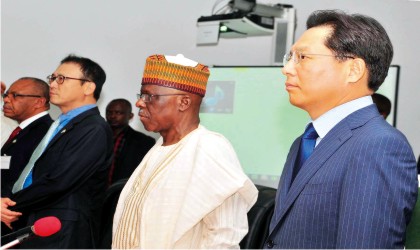
R-L:  Secretary, National Planning Commission, Mr Bassey Akpanyung; Director, Korea  International Cooperation Agency  in Nigeria (Koica), Mr Jung Sang-hoon; Gov. Idris Wada  of  Kogi State and Korean Ambassador to Nigeria, Mr Noh Kyu-duk, at the  KOICA Seminar on the Development of  vocational training in Nigeria, in Lokoja recently.

R-L: Secretary, National Planning Commission, Mr Bassey Akpanyung; Director, Korea International Cooperation Agency in Nigeria (Koica), Mr Jung Sang-hoon; Gov. Idris Wada of Kogi State and Korean Ambassador to Nigeria, Mr Noh Kyu-duk, at the KOICA Seminar on the Development of vocational training in Nigeria, in Lokoja recently.

The President of the Nigeria Labour Congress (NLC), Mr Ayuba Wabba, has  urged the Federal Government to clean up the system before addressing subsidy or the deregulation in the nation’s petroleum sector.
Wabba told newsmen in Lagos on Monday  that subsidy was not the issue but inherent corruption in the system.
He said that it was the inefficiencies in the public sector that were fuelling corruption in the country and cautioned that care should be taken to ensure that they were not transferred to the citizenry.
The NLC president urged the government to recover public funds that had been diverted into private pockets, before looking at the subsidy issue.
“The issue is inherent corruption in the system; it is inefficiency and it should not be transferred to the entire citizens.
“First, let the system be cleaned up and then we can then look up into other issues that are associated with subsidy or deregulation.
“In every government, the citizens should benefit from the system that is being transferred but in Nigeria, everything is tied to oil.
“Any slight increase in the price of oil, which is what subsidy stands for, will have multiple effects on the citizens.
“Everything will go up and at this period when poverty is ravaging the country, I think it is appropriate to find a way around, to make the system transparent.
“The Nigerian Extractive Industry Transparency Initiative (NEITI) audit shows that a lot of resources are going to private pockets; let the government work to recover the money in a transparent process.
“Thereafter, we can then look at the subsidy issue; but for now, I don’t think we should add salt to injury because already Nigerians are on the ground and he who is on the ground is no longer afraid of falling.
“Unemployment is high, many people cannot afford to eat three square meals a day,” he said.
Wabba said that the issue at present was how we could strengthen our system and put a structure of good governance.
He urged government to proceed on splitting the Nigerian National Petroleum Corporation (NNPC) into two bodies, to enhance its efficiency and effectiveness.


Continue Reading

Business

Dangote Refinery Ending Nigeria’s Dependence on Imported Fuel – EIU

Published

on

Dangote Petroleum Refinery & Petrochemicals is fundamentally transforming Nigeria’s downstream oil sector by significantly reducing the country’s reliance on imported refined petroleum products and strengthening foreign exchange earnings, according to the Economist Intelligence Unit (EIU).
In its latest assessment of Nigeria’s fuel market and regulatory environment, the EIU said the operational ramp-up of the 650,000 barrels-per-day refinery has reshaped a sector previously characterised by heavy dependence on imported fuel despite Nigeria being Africa’s largest crude oil producer.
The report stated that refinery supplied nearly 80 per cent of Nigeria’s domestic petrol demand in April and has produced sufficient volumes to meet local consumption needs as it approaches full operational capacity.
Describing Nigeria’s downstream petroleum sector before the refinery as “long dysfunctional,” the EIU noted that the country had relied almost entirely on costly fuel imports while producing nearly 1.5 million barrels of crude oil daily.
According to the report, the emergence of the refinery has improved domestic fuel availability, reduced import dependence, and strengthened Nigeria’s balance of payments position through lower import demand and increasing exports of refined petroleum products.
“The gradual ramp up of the 650,000 barrel/day Dangote refinery since May 2023 has transformed Nigeria’s long dysfunctional downstream sector.
“The country’s main refineries, all state-owned, had been inoperative for years and Nigeria was almost entirely reliant on costly imported fuel”, the report stated.
The EIU, the research and analysis division of The Economist Group, added that the refinery’s attainment of full operational capacity and planned future expansion would further support Nigeria’s economic growth and foreign exchange earnings in the coming years.
It projected that increased exports from the refinery, alongside plans to double production capacity before the end of the decade, would boost Nigeria’s real Gross Domestic Product (GDP) growth and forex inflows from 2026 onward.
Industry analysts said the refinery is positioning Nigeria as a major refining and export hub in Africa, potentially reshaping regional energy trade flows and reducing the continent’s dependence on imported fuel.
The EIU also noted that the refinery’s growth has coincided with major reforms in Nigeria’s downstream petroleum sector, including the removal of fuel subsidies and the introduction of market-driven pricing mechanisms.
However, the report observed that the shift from a state-dominated import structure to large-scale domestic refining has generated resistance from interests linked to the old import regime.
The latest controversy followed the decision by the Nigerian Midstream and Downstream Petroleum Regulatory Authority to relax restrictions on petrol imports despite the refinery’s increasing production capacity.
Dangote Industries Limited subsequently initiated legal action, arguing that continued import approvals undermine investments in local refining and contradict the objectives of the Petroleum Industry Act aimed at promoting domestic refining capacity.
Analysts further noted that the availability of large-scale domestic refining capacity has improved Nigeria’s energy security while reducing exposure to external supply shocks and foreign exchange volatility.
The Centre for the Promotion of Private Enterprise also warned against unrestrained fuel importation, saying such a policy could weaken Nigeria’s industrialisation drive and discourage investment in domestic refining.
Chief Executive Officer of the CPPE, Muda Yusuf, said continued dependence on imported fuel had historically exerted pressure on foreign reserves, contributed to exchange rate instability, and created fiscal leakages.

Nkpemenyie Mcdominic

Continue Reading

Business

NCDMB Partner Dafinone For Youths Technical Skills Training

Published

on

The lawmaker representing the Delta Central Senatorial District, Senator Ede Dafinone, in collaboration with the Nigerian Content Development and Monitoring Board has unveiled a three-week capacity building programme on rigging and scaffolding for youths in the Senatorial District.

Reports say that the training is designed to equip youths with practical technical skills for employment in the oil and gas and construction sectors, with emphasis on employability, safety, competence and self reliance.

In attendance at the flag-off ceremony  this week, at the Petroleum Training Institute (PTI) Conference Hall, Effurun, were stakeholders, dignitaries, and political representatives, among others.

Dafinone, represented by his Chief of Staff, Adelabu Bodjor, said the initiative reflects a deliberate political investment in human capital development across Delta Central.

He explained that the training focuses on rigging and scaffolding, noting that “both are essential technical competencies required in industrial operations, construction projects, and oil and gas installations”.

Bodjor added, “The programme is intended to reduce dependency among youths by providing job-ready skills capable of supporting long-term economic opportunities and self-sufficiency. The initiative aligns with Senator Dafinone’s broader development agenda, which prioritises practical skill acquisition as a pathway to sustainable empowerment.”

Also addressing the participants, the NCDMB, Felix Omatsola Ogbe, represented by Mr. Teddy Bai, commended Dafinone for sponsoring the programme, describing it as “a timely response to critical manpower gaps in the industry”.

Bai explained that rigging and scaffolding remain safety-sensitive skills required across fabrication yards, offshore platforms, and construction sites, stressing that the programme bridges the gap between certification and practical competence.

He also charged the training consultant, OROH Contractors Limited, to maintain strict standards of professionalism, safety, and discipline, while urging participants to remain committed, focused, and disciplined throughout the exercise.

The Senate Liaison Officer for Sapele Local Government Area, Chief Patrick Akamuvba, , described the programme as a major step in strengthening human capital development in Delta Central.

Akamuvba said scaffolding and rigging skills are in high demand across residential, commercial, and industrial construction projects, noting that the training offers real employment opportunities for beneficiaries

He urged participants to prioritise knowledge and certification over short-term material expectations, stressing that discipline and seriousness would determine their long-term success.

He also cautioned youths against social vices and distractions, advising them to remain focused to maximise the opportunities provided by the programme.

Continue Reading

Business

Commercial Aviation: Bayelsa Begins Operations As Pioneer Airline Launches Maiden Flight

Published

on

Bayelsa State has officially commenced commercial aviation operations recently as Pioneer Airlines operated its first non-scheduled flight using one of the state government’s newly acquired aircraft, an ATR 72-600.
This was contained in a statement issued by the Chief Press Secretary to the Governor, Daniel Alabrah, this week and made available to Aviation correspondents .
The statement said that the initiative reflects Governor Diri’s commitment to transforming Bayelsa through visionary leadership and strategic investments.
 Governor Diri in  the statement expressed satisfaction with the airline’s operational capacity and professionalism, noting that he was optimistic about a productive and mutually beneficial partnership between the state and the airline.
The governor described the development as another milestone in the state’s drive toward economic growth and infrastructural advancement.
The historic maiden flight departed the Nnamdi Azikiwe International Airport in Abuja at 11:10 a.m. after taxiing off the tarmac at about 11:00 a.m. and receiving clearance from the control tower.
The aircraft, piloted by Captain M. Ibrahim alongside First Officer Joyce, a female co-pilot, arrived at the Bayelsa International Airport at 12:15 p.m. after a smooth one-hour, five-minute journey.
On board of the inaugural flight was the Governor of Bayelsa State, Senator Douye Diri, who occupied seat 1A as the symbolic first passenger of the airline operation.
RYa1.
Also on the flight were former House of Representatives member, Hon. Gabriel Onyenwife, the Governor’s Special Adviser on Political Matters I, High Chief Collins Cocodia, and five aides to the governor.
The launch marks the beginning of Bayelsa State’s entry into the commercial aviation sector through its partnership with Pioneer Airlines, a move expected to boost connectivity and expand the state’s internally generated revenue base.
Enoch Epelle


Continue Reading

Trending