
Politics
Card Reader: As Controversy Rages On

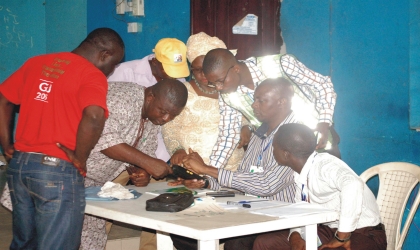
A House of Assembly candidate of Peoples Democratic Party in Mushin Local Government Area, Mr Lekan Fijabi with others (left), testing the workings of Card Readers in Onigbongbo Ward, Ikeja LGA, Lagos, recently.
Of all the innovations
the Independent National Electoral Commission (INEC) under Prof. Attahiru Jega came up with, the use of the Smart Card Readers (SCR) for the forthcoming general elections appears to be most controversial. Barely 13 days to the polls, the controversy still rages on.
There is hardly any issue regarding the execution of the 2015 general elections that has elicited as much naivety and contradictory reactions from key actors as the CR. Not even the postponement of the elections from the initial February 14 and 28. The bone of contention has been whether to use the CR or not.
The political class has been perplexed, particularly since the demonstration of the use of the CR in selected states of the country penultimate weekend:While those against using it find it difficult to openly come out to denounce the device, given its effective blockage of fake Permanent Voter Cards (PVCs), others in support of the use of the device were also constrained by the shortcomings associated with it, as seen in its failure to effectively read the thumbprints of a significant number of potential voters in many places it was used.
Key stakeholders have taken divergent positions on the device. For the Independent National Electoral Commission (INEC), its Chairman, Professor Attahiru Jega, said there is no going back on the use of the CR, because”the cards would stop multiple voting by ensuring that only possessors of the PVCs can vote at voting points where the PVCs are programmed to”.
His Chief Press Secretary, Mr.Kayode Idowu explained that”nothing happened during the mock election to warrant going back on the use of card readers for the general elections. The deployment of the card readers was successful and even international observers from the UN have attested to it.Contrary to some claims, only one case of card reader challenge was recorded at our Situation Room and it was a human thing.
“Concerning some alleged hitches, there were guidelines on what to do at any polling unit to make sure that an eligible voter is allowed to exercise his or her right.
“The flaws being claimed were anticipated. The states where fingerprints were not authenticated had the PVC incident form procedure, it was agreed with political parties that the form will be filled.”
Meanwhile, the Peoples Democratic Party (PDP) had, following the trial-run of the CR, expressed reservations, noting difficulties in the accreditation through the failure of the biometric confirmation among some voters. Governors of PDP- controlled states were the first to oppose it.
The governors said they are opposed to the use of the machine because it has proved to be ineffective and hence constitutes a burden to the accreditation process. They met in Lagos last week, and vowed to scuttle any attempt by the Independent National Electoral Commission (INEC) to use the devise in the March 28 and April 11 elections.
Their reasons, given at different fora, have semblance with the stand taken by youths under the aegis of Middle Belt Concerned Youths who staged a protest at the headquarters of INEC in Abuja against the use of PVCs and the card readers for the elections.
Their take was that “judging from what transpired during the (CR test-run) exercise, it has been proven that batteries of the card readers do not function for more than three hours. The question therefore is, what happens if the battery fails during the election proper, especially in the rural areas?”
However, the All Progressives Congress (APC), the major opposition, on its part, said it was satisfied with the device and urged the commission to go ahead with the use of the card readers.The party noted that the opposition to the use of CR in the coming elections was an indication that those in the corridors of power see the machine as the nemesis of those opposed to the idea of a free and fair election.
From the perspective of the APC, “Only dishonest politicians, those who plan to rig, those who have engaged in a massive purchase of PVCs and those who have something to hide are opposed to use of the machine.
“For the avoidance of doubt, our party is ready for any tool, including the card reader that will ensure that the votes of Nigerians will count in the election…The card reader has been demonstrated to work, including at the Senate, and no one must come out to tell Nigerians anything to the contrary.”
While supporting the APC stand, the National Chairman of the All Progressives Grand Alliance (APGA) and senatorial candidate for Anambra Central Senatorial Zone, Chief Victor Umeh, said his party is throwing its weight behind the use of CR in the 2015 general elections.
“The use of card reader is a sure way of fighting election rigging, especially when it is known that some politicians prefer to use a system that would make it possible for them to write results that would favour them as they had done in the past. APGA is in support of free, fair and credible election and the use of card reader can guarantee free and fair election, which is why we are supporting it”, he said.
While acknowledging the challenges noticed during the test-run of the CR, the electoral umpire has assured Nigerians that all hope is not lost, as voters whose thumbprints are not read by the CR could still vote but would have to fill an incident report form to reflect the development.
This position is, however, viewed as a connivance between the APC and INEC by those who opposed the use of the CR, as represented by the PDP, whose scepticism was expressly stated by the Middle Belt Concerned Youths.
“The simple fact that APC and INEC are on the same page on the use of PVCs and card readers speaks volumes about their plan to rig the forthcoming polls, which all right-thinking and well-meaning Nigerians must resist with vigour”, they said.
According to the group, those that claim that the electronic machines did not fail during the mock exercise in their states “are simply playing to the gallery; it is a cover-up and a far cry from the ugly reality starring everybody in the face”.
The group summarized its stand thus: “In as much as we appreciate the steadfastness and enormous innovations introduced by INEC to bequeath free and fair elections to the nation, it is still the contention of majority of Nigerians that such efforts must not be sacrificed on the altar of a fool-hardy insistence of proceeding with the use of PVCs, despite the glaring imperfections inherent in them. Insisting on using them for the elections will only end up disenfranchising a huge segment of Nigeria’s voting population.
“We frown at this orchestrated plot to disenfranchise a high number of eligible Nigerian voters by INEC as epitomised in its determination to go ahead with the use of PVCs and card readers regardless of the genuine concerns expressed by relevant stakeholders in the polity, a development that is likely to compromise the integrity of the elections.
“Unlike the TVCs, which are easy to obtain and use during elections, PVCs are a bit technically complicated for an average rural dweller. Instead of this straight-jacketed insistence of using PVCs and card readers, INEC should rather be thinking of fashioning out alternative measures of ensuring the success of the elections that will not only be acceptable to Nigerians, but also meet international standards”.
The stands taken by all concerned party show that while they all agree that INEC should conduct free, fair and credible elections, they are sceptical about the support of the other party for a process, in this case, the use of the card reader, which INEC says will checkmate rigging.
The stand of the opposition to the use of the CR is that it will disenfranchise a notable population of voters. The question that readily comes to mind is, what informed the esoteric belief and consequent apprehension that this population that may be so disenfranchised will all be supporters of the PDP, which is spearheading the opposition against the use of the card reader?
Beyond winning the election, it is high time political parties stood for enthronement of real democracy and electoral system that would stand the test of time. They should therefore know that given the innovations of theINEC under the chairmanship of Professor Jega, what the electoral body needs now is suggestions on have to confront the challenges noticed in the use of the CR.
Consequently, all stakeholders should be thinking of fashioning out alternative measures of ensuring the success of the elections that will not only be acceptable to Nigerians, but also meet international standards.
Soibi Max-Alalibo



The Independent National Electoral Commission (INEC) has extended the deadline for political parties to submit the list of candidates for the 2027 governorship and state Houses of Assembly elections from Saturday, August 8, to Tuesday, August 11, 2026.
The commission announced the extension in a statement issued on Saturday and signed by the National Commissioner and Chairman of its Information and Voter Education Committee, Mohammed Haruna.
According to INEC, the decision followed appeals by political parties for additional time to complete the submission process through the dedicated online portal.
“The submission window, which according to the revised Timetable and Schedule of Activities for the General Election was originally scheduled to close on Saturday, 8th August, 2026, has been extended to Tuesday, 11th August, 2026,” the commission said.
In a a related development, INEC announced the suspension of PVC collection in Osun State ahead of the August 15 governorship election.
The commission said voters who applied for replacement of lost, damaged or defaced Permanent Voter Cards would have until midnight on Sunday, August 9, to print downloadable copies of their cards.
The electoral body explained that the deadline was necessary to enable it compile data on downloaded PVCs and produce final statistics on the total number of cards collected ahead of the election.
INEC said PVC collection in Osun commenced at the Registration Area level from July 22 to 28, 2026, but was extended to July 31 following complaints about large crowds and difficulties experienced by voters at collection centres.
The exercise subsequently moved to the local government level and ran from August 1 to 7.
The commission also disclosed that replacement downloadable PVCs had been made available to voters in Odo-Otin and Ife Central Local Government Areas following the theft of cards during attacks on the two collection centres.
It stressed that the stolen cards could not be used to vote.
INEC reassured Osun residents of its preparedness for the August 15 governorship election.
“The commission reiterates that the stolen cards cannot be used to vote.
“INEC reassures the people of Osun State of its readiness to conduct a free, fair, credible and inclusive governorship election on 15th August, 2026,” the statement said.
The commission said the deadline, initially set for Saturday, 8 August, has been extended to Tuesday, 11 August 2026, following appeals from political parties for more time.
INEC also announced that the window for voters who applied to replace lost, damaged or defaced PVCs to download their replacement cards will close at midnight on Sunday, 9 August.
The move is to enable the commission compile final PVC collection figures ahead of the 15 August Osun governorship election.
INEC said replacement downloadable PVCs have also been provided to affected voters in Odo-Otin and Ife Central Local Government Areas after hoodlums carted away cards from two collection centres, stressing that the stolen cards cannot be used to vote.
The commission reaffirmed its readiness to conduct a free, fair, credible and inclusive election in Osun State.
Gov. Kefas made the remarks over the weekend at the Federal Medical Centre (FMC), Jalingo, during the flag-off of the second phase of the Renewed Hope Medical Outreach in Taraba State, organised as part of activities marking Prof. Yilwatda’s 58th birthday.
The governor commended Prof. Yilwatda for choosing to mark his birthday by providing medical care to people in need.
“What Professor Nentawe did is a powerful demonstration of what leadership should be,” Gov. Kefas said.
He assured that his administration would continue to support initiatives that complement government efforts to improve healthcare delivery and the wellbeing of residents.
Speaking at the event, Prof. Yilwatda called on Nigerian leaders to embrace the culture of giving and use their positions to touch the lives of the less privileged.
He said his decision to celebrate his 58th birthday in Taraba State was deliberate and informed by the needs of underserved communities, particularly people who face difficulties accessing healthcare because of distance and financial constraints.
According to him, the intervention followed a needs assessment and was extended across the three senatorial districts of the state.
He said the exercise commenced on August 3 at Takum General Hospital and covered the Federal University Teaching Hospital, Wukari; First Referral Hospital, Sunkani, Ardo-Kola Local Government Area; General Hospital, Bali; General Hospital, Gembu; and FMC Jalingo.
Prof. Yilwatda said the intervention provided medical services to thousands of beneficiaries, including people who required surgical procedures.
He said sustainable national development could only be achieved when strong institutions placed Nigerians at the centre of development.
“Leadership is about service,” he said, urging political and public leaders to make giving back to society an important part of their responsibilities.
He reaffirmed his commitment to serving Nigeria and its people, saying his personal vision was to make every day of his life useful to humanity.
“Every day that I live, the vision is: let it be useful to humanity,” he said.
The Taraba State Commissioner for Health, Dr. Bordiya Buma, commended the initiative, saying it was consistent with the Renewed Hope agenda and efforts to strengthen healthcare delivery in the state.
Dr Buma said the second phase followed the successful completion of the first phase, which was conducted simultaneously in six local government areas, with two LGAs selected from each of the three senatorial districts.
According to him, more than 10,000 patients were attended to during the first phase, including people with medical and surgical conditions.
He disclosed that 327 general surgeries, 71 eye surgeries and 575 dental procedures were carried out during the exercise.
The commissioner expressed appreciation to President Bola Tinubu for the Renewed Hope Medical Outreach and thanked Prof. Yilwatda for supporting the initiative and choosing Taraba State as a beneficiary.
The Minister of Health and Social Welfare, Prof. Muhammad Ali Pate, also commended Prof. Yilwatda for choosing Taraba State to mark his 58th birthday through a medical outreach.
Prof. Pate said making healthcare the centrepiece of the birthday celebration was significant because health affects everyone.
-

 News3 days ago
RSG Targets Nine Million Residents in Mosquito Net Distribution Campaign
-

 Oil & Energy3 days ago
Aiyedatiwa Signs New Electricity Bill
-

 Maritime3 days ago
Marine Minister Commends President Tinubu On NPERA Bill Assent
-

 Oil & Energy3 days ago
NLNG Commissions Research And Innovation Centre In RSU
-

 News3 days ago
KenPoly Holds Eight Convocations, August 29
-

 News3 days ago
RSG Begins Another Phase of Projects Commissioning Today
-

 News3 days ago
RMAFC Completes Revenue Sharing Review, Proposes New Pay
-

 Maritime3 days ago
NAGAFF Petitions IGP Over Alleged Maritime Police Harassment