
News
Health Ministry, UNICEF Partner To End FGM …….. Trains 60 Community Facilitators



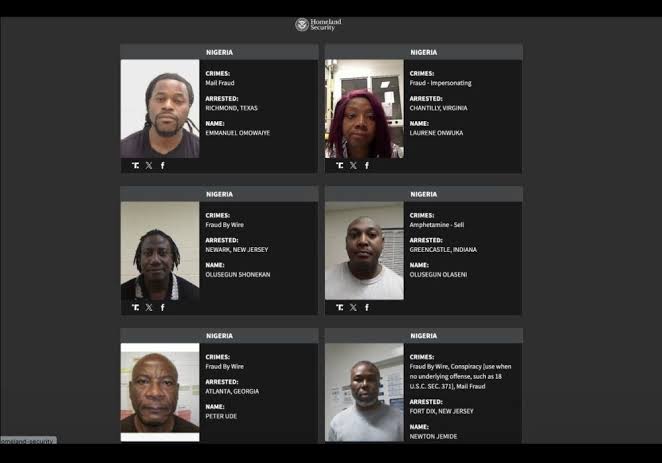
The United States Department of Homeland Security has released the names and photographs of 24 Nigerian nationals arrested by immigration officers over alleged criminal offences as the Donald Trump administration intensifies its immigration enforcement campaign.
According to information published by the department, the Nigerians were arrested by officers of the US Immigration and Customs Enforcement in different locations across the country.
The offences listed include wire fraud, mail fraud, money laundering, drug-related crimes, identity theft, assault, forgery, weapons violations and child cruelty.
Announcing the arrests, DHS said it was highlighting non-US citizens with criminal records apprehended by immigration enforcement officers.
“The US Department of Homeland Security is highlighting the worst of worst criminal aliens arrested by the US Immigration and Customs Enforcement (ICE),” the department said.
It added, “Under DHS leadership, the hardworking men and women of DHS and ICE are fulfilling President Trump’s promise and carrying out mass deportations – starting with the worst of the worst – including the illegal aliens you see here.”
The list published by the department identifies the Nigerian nationals, the offences associated with their cases and the locations where they were arrested. The list includes
- Emmanuel Omowaiye — Mail fraud; Richmond, Texas.
- Laurene Onwuka — Fraud and impersonation; Chantilly, Virginia.
- Olusegun Shonekan — Wire fraud; Newark, New Jersey.
- Olusegun Olaseni — Amphetamine sale; Greencastle, Indiana.
- Peter Ude — Wire fraud; Atlanta, Georgia.
- Newton Jemide — Wire fraud, conspiracy and mail fraud; Fort Dix, New Jersey.
- Shedrack Umukoro — Money laundering; Yazoo City, Mississippi.
- Olasoji Akinbode — Fraud and impersonation; Kearny, New Jersey.
- Oluwatosin Afolabi — Fraud; Conroe, Texas.
- Alameen Adetunji Tokosi — Drug possession; Chicago, Illinois.
- Joshua Ipoade — Wire fraud; Atlanta, Georgia.
- Michael Orji — Weapons violation, fraud, identity theft, wire fraud, false citizenship and mfoney laundering; Oxford, Wisconsin.
- Ahmadu Apooyin — Drug-related offence; Baltimore, Maryland.
- Teslim Kiriji — Money laundering; Yazoo City, Mississippi.
- Onomen Uduebor — Identity theft; Seattle, Washington.
- Charles Ochi — Money laundering; White Deer, Pennsylvania.
- Daniel Eta — Wire fraud; White Deer, Pennsylvania.
- Ifeanyi Ibennah — Cruelty towards a child; Tampa, Florida.
- Kazeem Runsewe — Wire fraud; Thomson, Illinois.
- Fatiu Lawal — Wire fraud; Lompoc, California.
- Justin Akubueze — Money laundering; Orem, Utah.
- Moyinoluwaseun Okeowo — Larceny, forgery and concealing stolen property; Orlando, Florida.
- Babajide Oluwaseun Faseyi — Assault; Alden, New York.
- Bright Eigbedion — Money laundering; Lompoc, California.
DHS said the announcement was part of the US government’s broader immigration enforcement drive, with ICE carrying out arrests across the country.
The publication comes as the Trump administration pursues its policy of removing non-US citizens identified as priorities under its immigration enforcement programme.
However, the information released by DHS does not specify the final immigration status of each individual or provide details of their respective deportation proceedings.
Their inclusion on the list does not, by itself, establish that they have already been deported or that every offence listed resulted in a criminal conviction.
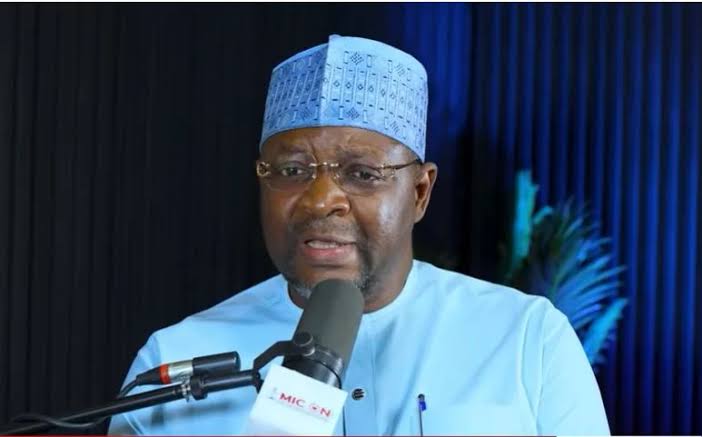
The Presidency yesterday dismissed former Vice President Atiku Abubakar’s proposed production subsidy on petrol as “a dangerous mathematical fantasy wrapped in political deceit,” saying Nigeria does not have the crude oil volumes to fund it.
Special Adviser to the President on Media and Public Communications, Sunday Dare, stated this in a statement signed and released yesterday titled ‘Atiku’s Demagoguery in the Face of Tinubu’s Logical Policies.’
Dare described the recent press conference in Abuja by Atiku, the African Democratic Congress presidential candidate, as “a seminal example of shallow, election-laced demagoguery.”
Atiku had criticised the 30-day discount on petrol by NNPC Retail and a price modulation framework, which he described as a “panic-driven gimmick,” according to Dare, and had claimed that President Bola Tinubu copied his economic homework without the production subsidy that made it work.
Dare cited the Minister of Finance and Coordinating Minister of the Economy, Taiwo Oyedele, as saying on Channels Television that Nigeria produces about 1.8 million barrels of crude per day for a population of over 200 million.
However, the presidency said the Federal Government does not directly own all of that oil.
It argued that under joint ventures and production sharing contracts signed over decades, production costs, royalties and profit-oil sharing ratios “severely reduce the equity crude available to the state,” leaving fewer than 700,000 barrels per day of unencumbered free crude.
“To propose a blanket ‘targeted production subsidy’ on crude without the physical, unencumbered volume to back it up is pure economic illiteracy,” Dare said, adding that, “It invites the very opacity, fraudulent round-tripping, and fiscal haemorrhage that crippled Nigeria for decades under the old subsidy regime.”
The presidency noted that refineries such as the Dangote Petroleum Refinery need more feedstock than the state can freely supply without breaching international supply contracts, which is why Dangote and other domestic refiners also import crude.
It rejected a comparison of crude allocation with farm produce like garri or cassava, saying it misrepresented commodity markets.
It also pointed to the United States, which it said produces over 10 million barrels per day for 330 million people but sells petroleum at market prices, and to Qatar, which it said had to cut energy subsidies significantly despite its large gas reserves and a population of under 500,000.
The presidency also rejected Atiku’s claim that the NNPC Retail discount amounted to a return to subsidy.
It said NNPC had offered the discount to mark Nigeria’s 66th Independence anniversary and had now offered to extend it by another 30 days.
“When NNPC Retail agrees to sell fuel at landing cost for 30 days during an unprecedented global crude price spike, it is not writing checks to opaque import cartels.
“It is leveraging its corporate balance sheet to absorb short-term global volatility, backed directly by President Bola Ahmed Tinubu,” Dare stated.
He said the negotiated interim ceiling of N1,350 per litre on ex-gantry costs was “a structural shock absorber, not price control.”
Under it, refiners and importers absorb short-term cost spikes above the ceiling and recover them later when crude prices cool or the exchange rate adjusts.
The ceiling is reviewed monthly based on published cost audits, the statement noted.
“N1,400 today and N1,400 tomorrow provides far greater economic stability than N1,500 today and N1,300 tomorrow,” Dare said, adding that erratic fuel prices trigger transport fare hikes that rarely fall back.
The presidency further listed other measures the administration had taken, including a state-backed strategic energy reserve; a rapid rollout of compressed natural gas, which he said is 60 to 70 per cent cheaper than petrol; naira-for-crude supply to domestic refineries; windfall taxes on energy operators who gouge consumers, with the proceeds earmarked for transport vouchers and minimum-wage support; and enforcement of the 2025 tax reform laws to dismantle illegal road levies.
Dare said the removal of the petrol subsidy and the unification of the exchange rate had ended a multi-trillion-naira drain on public funds, which he said now flows to the 36 states and local governments through FAAC allocations.
He added that fuel queues had been eliminated and the gap between the official and parallel exchange rates closed.
Referring to Atiku’s reported description of Tinubu as a “dull student,” the presidency said, “It is sheer absurdity that a man who graduated from a school of hygiene dares to call a first-class accounting graduate a dull student.”
It added that “the Nigerian electorate is far too sophisticated to trade long-term national economic security for Atiku’s shallow, short-term demagoguery.”
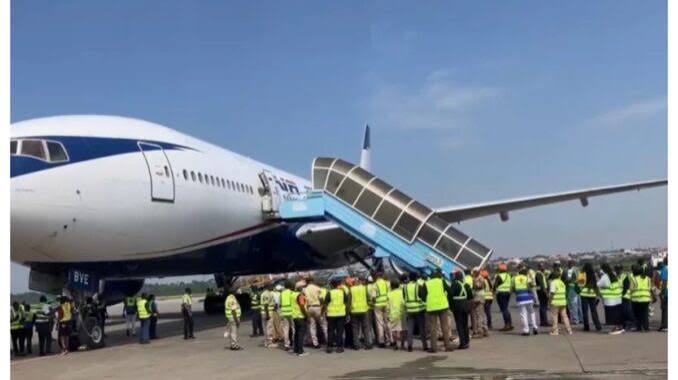
The Federal Government has evacuated another batch of 111 distressed Nigerians from South Africa amid concerns over xenophobic and Afrophobic attacks in the country.
The returnees, comprising 44 men, 23 women and 44 children, arrived in Lagos aboard South African Airways Flight SA060 on Thursday, October 8, 2026.
The Ministry of Foreign Affairs disclosed this yesterday in a statement signed by its spokesperson, Oluwafemi Adeniyi.
The ministry said the returnees were received by officials of the ministry, the Nigerians in Diaspora Commission, the National Agency for the Prohibition of Trafficking in Persons, the National Emergency Management Agency and other relevant Federal Government agencies.
According to the statement, the evacuation was fully funded by the $265,854 donation made by the Redeemed Christian Church of God to support the evacuation of 500 distressed Nigerians from South Africa.
The arrival of the returnees brings the total number of consular evacuations conducted from South Africa to 15 since the commencement of the ongoing evacuation exercise on 10th June, 2026, the statement said.
It added that the latest evacuation brought the cumulative number of Nigerians evacuated from South Africa to 2,037, including 1,388 whose repatriation costs were fully covered by the Federal Government.
The ministry disclosed that 318 Nigerians had so far benefited from the RCCG-funded evacuation, leaving 182 more to be repatriated under the church’s commitment.
It said, “With the successful evacuation of this RCCG-funded batch, a total of 318 Nigerian nationals have had their one-way tickets funded by the Church. Therefore, 182 more nationals are expected to be repatriated under RCCG’s commitment to fund 500 one-way tickets.”
The Federal Government expressed appreciation to the RCCG, under the leadership of its General Overseer, Pastor Enoch Adejare Adeboye, for its financial support towards the evacuation of distressed Nigerians.
It also reaffirmed its commitment to engaging the South African authorities and other stakeholders to address xenophobia and Afrophobia in the country.
“The Federal Government remains committed to engaging relevant stakeholders, including authorities of South Africa, to address Xenophobia and Afrophobia in the country, and promote the welfare, safety and dignity of Nigerians residing there,” the statement added.
The ministry advised Nigerians living in South Africa to comply with local laws, remain vigilant and prioritise their safety.
It urged them to maintain contact with the Nigerian High Commission in Pretoria and the Consulate General in Johannesburg for consular assistance whenever necessary.
“The Federal Government remains steadfast in its commitment to providing timely consular support to Nigerians in the diaspora and safeguarding their welfare and well-being,” the statement read.
-
Sports4 days ago
BAL: SWAN Rivers Urges Hoopers To Make Nigeria Proud
-
 Nation4 days ago
Amaewhule Family Warns Public Against Ada-Oro Fam Land Transactions
-
News4 days ago
RSG Extends ?200,000 Cash Support, Free Medicals To Flood Victims In Eneka
-
News3 days ago
Rivers Police Arrest Two Kidnappers As Victim Regains Freedom After ?10.3m Ransom
-
News3 days ago
Flood: RSG Extends ?200,000 Cash Support To 35 Flood-Affected Household In Npolu Rumuigbo
-
 Featured3 days ago
NLC Gives FG Two-Week Ultimatum To Reduce Petrol Price …Begins Minimum Wage Talks
-
 Oil & Energy6 hours ago
FG Halts Ban On Solar Import, Gets Stakeholders’ Commendation
-
News3 days ago
Consider Career In Nigerian Army, RSG Tells Youths