
Featured
NLC Gives FG Two-Week Ultimatum To Reduce Petrol Price …Begins Minimum Wage Talks

The Nigeria Labour Congress (NLC) has given the Federal Government a two-week ultimatum to reduce the price of petrol, commence renegotiation of the national minimum wage and implement outstanding agreements with workers.
The ultimatum followed a joint meeting of the National Executive Council and Central Working Committee of the NLC held at the Olaitan Oyerinde Hall, Labour House, Abuja.
In a communiqué signed by the NLC President, Joe Ajaero, and made available to newsmen, yesterday, the union said the two-week ultimatum would commence on Friday, October 9, 2026.
It warned that failure by the government to meet its demands would compel the Congress to take further action.
The NLC specifically demanded that the government reduce the price of Premium Motor Spirit to the level it was when the current national minimum wage was signed into law in 2024.
It also demanded the immediate commencement of negotiations for a new minimum wage, implementation of the February 5, 2026, Terms of Settlement reached with the Joint Health Sector Unions and Assembly of Healthcare Professionals, and action on the demands of the Joint Public Sector Negotiating Council.
The Congress further demanded tax relief and immediate wage awards for workers, arguing that the measures were necessary to cushion the impact of rising living costs.
The NLC said, “The current national minimum wage has been rendered worthless by the relentless depreciation of the naira and the astronomical rise in the cost of living.”
It added that workers could no longer meet basic needs, including food, shelter, healthcare, transportation and education, on their current earnings.
The labour body, therefore, demanded that the Federal Government commence renegotiation of the national minimum wage before the end of October.
“NEC-in-session demands that the Federal Government commence the renegotiation of the national minimum wage before the end of this month,” the communiqué stated.
The Congress also linked the erosion of workers’ purchasing power to the high cost of petrol, saying the price of the commodity had continued to drive up transportation costs and the prices of other essential goods.
“The exorbitant pump price of petrol has had a cascading effect on the cost of transportation, food, and other essential goods, further deepening the hardship of workers and the masses,” it said.
The NLC further demanded that the government grant tax relief to workers and immediately introduce wage awards, describing the measures as “the bare minimum required to alleviate the suffering of Nigerian workers and restore a measure of dignity to their lives.”
The latest ultimatum escalates the labour movement’s pressure on the Federal Government after public-sector workers under the Joint National Public Service Negotiating Council embarked on a three-day warning strike earlier in October over rising living costs, petrol prices, wage awards and minimum wage negotiations.
The workers had demanded, among other measures, a reduction in petrol prices and the commencement of negotiations for a new minimum wage.
The NLC had also raised concerns in September over the declining purchasing power of workers, with Ajaero arguing that the N70,000 minimum wage had been overtaken by increases in the cost of food, transportation, housing, education and other essential expenses.
The current minimum wage was approved by President Bola Tinubu in July 2024 after negotiations involving the government, organised labour and the private sector.
Tinubu increased the Federal Government’s offer from N62,000 to N70,000 and agreed that the wage should be reviewed after three years rather than five years.
The NLC’s latest demand comes as the Federal Government announced fresh measures aimed at containing petrol-price pressures.
Yesterday, the Minister of Finance and Coordinating Minister of the Economy, Taiwo Oyedele, said the government was negotiating a ceiling of N1,350 per litre on the ex-gantry or landing cost of petrol, with monthly reviews, as part of measures to reduce price volatility.
The proposed ceiling does not mean petrol would necessarily sell at N1,350 per litre at filling stations.
The government also announced a 30-day discount on petrol dispensed by the Nigerian National Petroleum Company Limited (NNPCL), with priority given to public transporters.
Oyedele said the arrangement was not a return to subsidy but an effort to sell the product at cost.
However, the NLC is seeking a more substantial reduction, insisting that petrol should return to the price level that prevailed when the N70,000 minimum wage was enacted in 2024.
The Congress also called for the implementation of the agreement reached with JOHESU in February, as well as the demands presented by the Joint Public Sector Negotiating Council.
It warned that failure to respond within the two-week period would have consequences.
“Failure of which the NLC will be compelled to take remedial steps as would be directed by the relevant organs,” the communiqué said.
The union consequently directed its affiliates and allies to remain prepared for further action.
“NEC-in-session reaffirms the historical responsibility of the NLC to resist all forms of exploitation and oppression,” it stated, urging its affiliates to remain “on high alert and fully prepared to engage in decisive efforts against all anti-people policies.”
The development also comes amid fresh labour tensions in Abuja, where the FCT Council of the NLC commenced an indefinite strike on Wednesday over disputes with the FCT Administration concerning teachers’ promotion policies.
The council directed workers across public and private establishments to withdraw their services after the expiration of a seven-day ultimatum.
The latest NLC ultimatum puts renewed pressure on the Federal Government to address wage and fuel-price concerns as both sides grapple with disagreements over the implementation of previous labour agreements and measures to cushion the impact of economic reforms.
The NLC said its demands were aimed at protecting workers and the wider population from further deterioration in their standard of living, insisting that Nigerian workers must remain “resolute, organised, and uncompromising” in the struggle for improved living conditions.





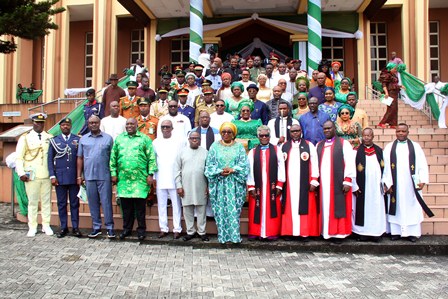
?Rivers State Governor, Sir Siminalayi Fubara, has called on the people of the State to remain united, peaceful and committed to the service of God for the continued development and prosperity of the State.
Fubara made the call during an Inter-Denominational Church Service held to commemorate Nigeria’s 66th Independence Anniversary at the Cathedral Church of St. Paul, Rebisi, in Port Harcourt on Sunday.
?Represented by his deputy, Prof. Ngozi Odu, the governor urged the Rivers people to pray for unwavering commitment, enduring peace and unity, stressing the need for the people to remain united and speak with one voice.
?According to him, continued dedication to God and unity among the people would contribute significantly to the State’s development and human prosperity.
?Fubara also prayed that God would continue to bless and keep the people of Rivers State in peace, assuring that the State would continue to witness greater developmental achievements.
?In his Sermon, Dean, Church of Nigeria, Archbishop, Province of Niger Delta and Bishop of Ikwerre Diocese, the Most Revd. Blessing Enyindah, urged Nigerians to remain hopeful, insisting that God has not forgotten the country despite its challenges, struggles and setbacks.
?Drawing inspiration from Isaiah 49:14-15, where the prophet assured the people of Israel of God’s unfailing love and remembrance, Enyindah noted that the biblical message remained relevant to Nigeria.
?According to him, “God is saying to Nigeria and Nigerians, I will not forget you. God has not forgotten Nigeria,” he declared.
?He said Nigerians must examine their character, promote honesty and integrity, improve productivity and contribute meaningfully to the development of the country.
The United Nations International Children’s Emergency Fund (UNICEF), Nigeria’s Enugu Field Office, in collaboration with the Abuja Front Office, has vowed to strengthen public health emergency preparedness and health security systems, with particular focus on flood and cholera preparedness across 10 UNICEF-supported states.
The 10 targeted states are Rivers, Benue, Delta, Enugu, Anambra, Imo, Abia, Ebonyi, Cross River and Kogi.
The three-day multi-sectoral meeting held from 21–23 September 2026 at the Golden Tulip Hotel, Port Harcourt, brought together representatives from State Ministries of Health, State Primary Health Care Development Agencies/Boards, State Emergency Management Agencies and other relevant MDAs, alongside UNICEF, the Nigeria Centre for Disease Control and Prevention (NCDC), National Emergency Management Agency (NEMA) and WHO.
The Permanent Secretary, Rivers State Ministry of Health, Dr. Vincent Worgu Wachukwu, delivered the welcome address, while Dr. Joy Wihioka, representing the Rivers State Primary Health Care Management Board, also addressed participants.
Opening remarks were delivered on behalf of the UNICEF Chief of Field Office, Enugu, Juliet Chiluwe, by Dr. Hilary Ozoh.
Technical sessions were facilitated by NCDC, NEMA and UNICEF, represented by Mr. Paul Labaran Majam, Mr. Chidi Ogundu, Dr. Eghe Abe, Dr. Ifeyinwa Anyanyo, Dr. Hilary Ozoh and Maureen Zubie-Okolo.
Sessions covered multi-hazard preparedness, outbreak investigation and response, Incident Management Systems, PHEOC coordination, risk assessment, flood and cholera preparedness, multisectoral coordination and emergency response planning.
A key feature was a tabletop simulation of a flood-triggered public health emergency, which tested coordination, information sharing, escalation and response arrangements involving health authorities, SEMA, State PHEOCs, other MDAs, communities, and traditional and religious leaders.
The exercise highlighted the importance of timely information sharing, early partner engagement, effective logistics and referral systems, and rapid access to emergency funds and supplies.
Participants identified critical gaps in emergency planning, PHEOC and Rapid Response Team capacity, laboratory systems, emergency stockpiles, logistics, and coordination between disaster management and public health structures.
The affected states committed themselves to strengthening surveillance and early warning, multi-sectoral coordination, flood and cholera preparedness, community engagement, continuity of essential health services and domestic financing for emergency preparedness and response.
As a key next step, participating states will develop costed and time-bound preparedness action plans with clearly defined responsibilities, resource requirements, timelines and monitoring mechanisms.
Meanwhile, regular progress reviews will support implementation, accountability and sustained improvements in public health emergency preparedness and health security.
-
 Education4 days ago
*RSU Champions Urban Greening to Tackle Heat, Air Pollution in Port Harcourt*
-
 Oil & Energy4 days ago
Nigeria Needs $410bn Additional Investment To Achieve Net-Zero Pathway —– Presidency
-
 Maritime4 days ago
NPERA Task On Port Regulation To Unlock Nigeria’s Fisheries, Blue Economy
-
 News4 days ago
NBA Decries Absence Of Substantive Attorney-General In Rivers
-
 Politics4 days ago
Shettima Credits Tinubu With Saving Nigeria From Economic Collapse
-
 Education4 days ago
Staff, Students Protest Alleged Attempt To Arrest – Vc
-
 Nation1 day ago
Amaewhule Family Warns Public Against Ada-Oro Fam Land Transactions
-
 Politics4 days ago
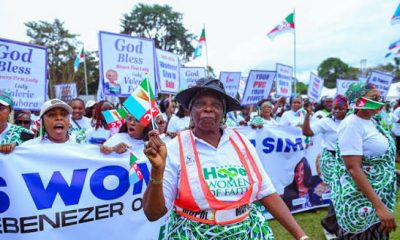
APC SUPPORT GROUP WOMEN STAGE RALLY FOR TINUBU, OTHERS IN RIVERS