
News
Dislodge Illegal Oil Refinery Operators, Wike Tasks Monarchs

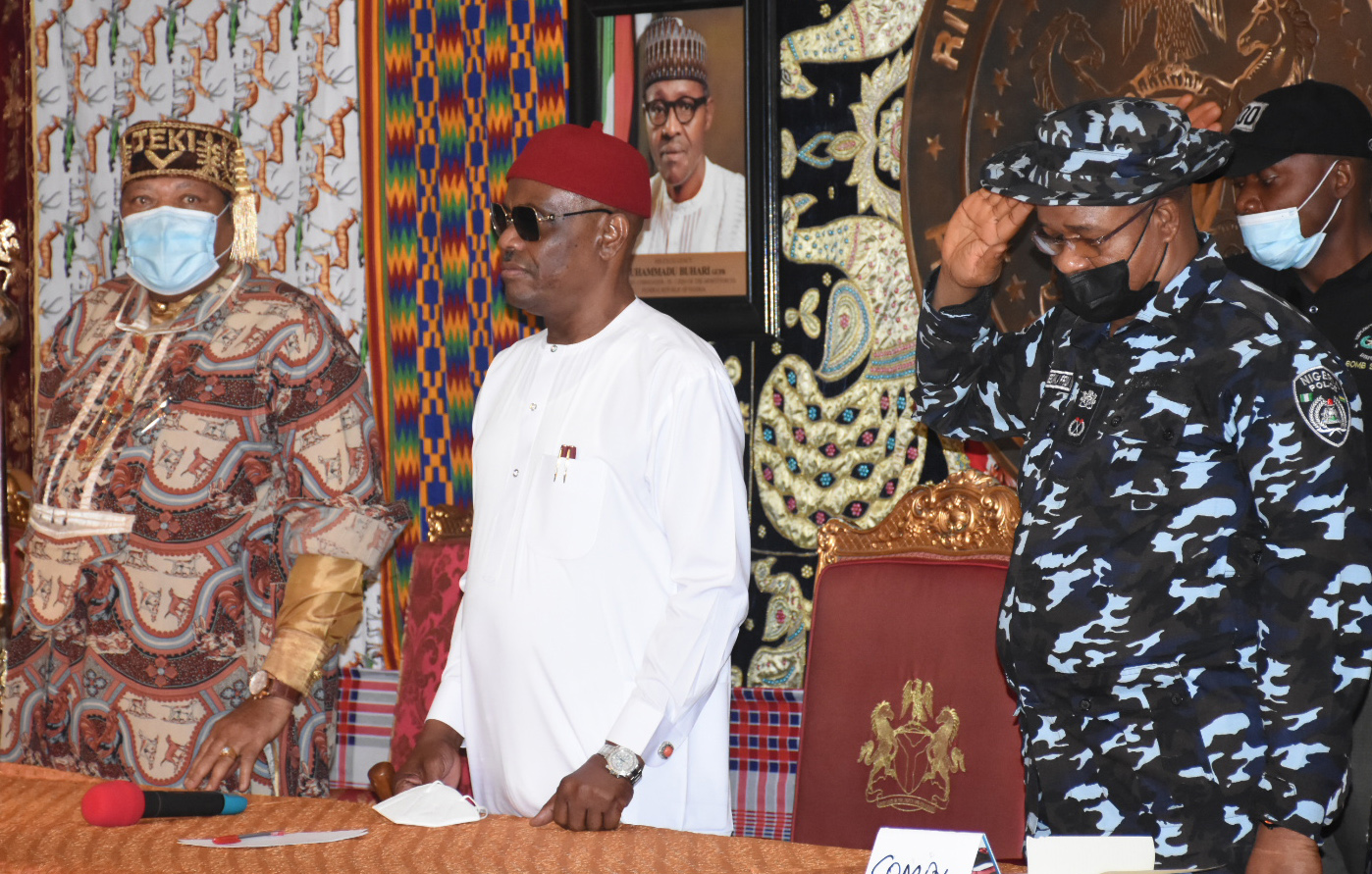
Rivers State Governor, Chief Nyesom Wike has urged traditional rulers in the state not to allow illegal crude oil refining (Kpo-fire) activities to take place in their domains anymore.
Wike gave the charge at a meeting he held with traditional rulers in the state at the Banquet Hall of Government House, Port Harcourt, last Friday.
The meeting was also attended by heads of security agencies and chairmen of the 23local government areas of the state.
Wike told the traditional rulers that those involved in illegal oil refining activities were sabotaging the economy.
He regretted that the Federal Government, which controls the oil industry and the security agencies, has been indifferent to the soot pandemic and the damage it was inflicting on the health of the residents of Rivers State.
“I should think that the way Federal Government intends to fight insurgency is the way they should fight illegal oil bunkering, because it is sabotage on the national economy. Very big sabotage! It affects our own revenue.
“If we are supposed to produce two million barrels, for example, we are now producing 1.2million. And that 1.2million barrels, it affects Rivers State because we are not producing up to the volume we are supposed to produce, and then, we cannot get the money to do whatever you want us to do.”
The governor also said that illegal oil refining activities constitute environmental hazard capable of causing cancer-related illnesses in the state.
According to him, his primary concern was to ensure that the health of residents of the state was not jeopardised.
“It is the responsibility of the Federal Government to see how this thing can be stopped. As I speak to you, nobody has called me from the Federal Government to say how they can support us. But that is not my business. My business is the health of my people. I will not because the Federal Government is not interested to stop it, therefore, my people should die. If everybody dies, who are you going to govern?”
The governor, therefore, urged the traditional rulers not to be less concerned about the activities of illegal oil refinery operators, but to frantically mobilise members of their Community Development Committees (CDCs) and the leadership of their youth groups to work in synergy to dislodge them from their domains.
Wike berated the Nigerian Police for being complicit in the criminal act of illegal oil bunkering, which is why they were not committed to the fight to stop the illicit business.
He also described as embarrassing how officers of the Nigerian Security and Civil Defence Corps (NSCDC) have continued to be complicit in the act and shamelessly involved in sabotaging the national economy.
“I don’t know how I can be a security officer sent to a place to protect people, to protect whatsoever belongs to the Federal Government, at the same time, I’m involved in sabotaging the national economy. I don’t understand how I can wear uniform and be involved in that. If they do not want to support us, we have no choice but to expose all the atrocities that are going on in this state.”
Wike said he recently received intelligence that an Army Major was providing exit services to illegally refined petroleum products, and had to send security personnel to thwart it.
“In fact, I had to send my special security to go and intercept a major who was trying to escort some of these illegal products.”
The governor declared that his administration would not hesitate to expose any security personnel involved in such illegal oil refining activities.
Wike frowned at the inability of the Nigeria Police to arrest Chief W. J. Wocha; Fubara Ohaka; and other members of the illegal bunkering cartel operating at Ibaa community in Emohua Local Government Area.
He said the names of all indicted persons would be published soon and they would be declared wanted.



The 23 For OK & P-BAT Movement, a political pressure group championing the re-election of President Bola Ahmed Tinubu and the governorship ambition of Honourable Ogundu Kingsley Chinda across the 23 Local Government Areas of Rivers State ahead of the 2027 elections, has congratulated both leaders on their victories at the recently concluded All Progressives Congress (APC) primaries.
In a statement issued by the National Coordinator, Amb. Goodluck Braide, who also doubles as the President of the Renewed Hope Multi-Purpose Co-Operative Limited, President Tinubu’s victory at the APC presidential primaries in Rivers State was described as a reflection of his growing popularity and acceptance among Nigerians. The group noted that since assuming office in 2023, the President has implemented bold economic reforms aimed at repositioning the country for sustainable growth, prosperity, and national development.
According to the group, the outcome of the primaries is an indication of what to expect in the 2027 general elections.
The group also congratulated Honourable Ogundu Kingsley Chinda on his emergence as the APC governorship flag bearer in Rivers State, describing the primary election process as peaceful, transparent, free, and fair. It stated that Chinda’s emergence signals increasing political unity among Rivers people across ethnic and political divides.
According to the movement, the APC made a strategic and wise decision in presenting Chinda as its governorship candidate, citing his leadership experience, competence, charisma, and proven capacity as qualities that position the party for victory in the forthcoming governorship election in the state.

Amb. Goodluck Braide, National Coordinator
The statement further acknowledged the role of the Minister of the Federal Capital Territory, Nyesom Ezenwo Wike, praising his political foresight, resilience, and commitment to maintaining unity within the political structure in Rivers State while ensuring the state remains relevant in national politics.
The group equally commended the leadership of the APC National Chairman, Professor Nentanwe Yilwatda, noting that under his leadership since July 2025, the party has witnessed renewed strength, unity, and political growth ahead of the 2027 elections.
It also congratulated the people of Rivers State and Nigerians generally for their continued support and confidence in the Tinubu administration, which it said has made notable progress in promoting national cohesion, social integration, and economic development.
The Rivers State Government has commended the Church of Nigeria (Anglican Communion) for its outstanding contributions to the development of Rivers State, particularly in the areas of peacebuilding, education, healthcare, and moral development.
Governor of Rivers State, Siminalayi Fubara, stated that the Church has remained a dependable partner in promoting peace, unity, justice, moral discipline, and social harmony across society.
The Governor, who was represented by the Secretary to the State Government, Dr. Dagogo Wokoma, made the remarks during the thanksgiving service marking the 30th Anniversary and First Session of the 11th Synod of the Diocese of Niger Delta North, held at St. Peter’s Anglican Church on Sunday.
Governor Fubara described the Synod’s theme, “Kingdom Advancement: The Priority of Every Believer,” as timely and relevant, considering the prevailing realities in society.
According to him, the Church continues to play a vital role in shaping societal values and inspiring hope among citizens.
“The Church remains a vital partner in promoting peace, unity, justice, and moral discipline. Its role in shaping values and inspiring hope cannot be overemphasized,” he stated.
The Governor further acknowledged the Anglican Communion’s contributions in education, healthcare delivery, youth empowerment, humanitarian services, and spiritual guidance across communities in Rivers State.
“The Rivers State Government appreciates the invaluable contributions of the Anglican Communion in education, healthcare, youth development, humanitarian support, and spiritual guidance. Your impact across communities in Rivers State continues to strengthen families and promote peaceful coexistence among our people,” he added.
Governor Fubara reaffirmed his administration’s commitment to building a peaceful, united, and prosperous Rivers State where all citizens can thrive irrespective of religion, ethnicity, or social background.
He also urged the Synod to continue praying for sustainable development and progress in Rivers State and Nigeria at large.
Earlier in his sermon, the Guest Minister, Joseph Olushola, spoke on the topic, “Kingdom Investment and Internal Rewards,” urging Christians to remain faithful stewards of God’s blessings and committed to advancing God’s kingdom through service and generosity.
The cleric emphasized that believers are custodians of the virtues and resources entrusted to them by God, stressing that divine rewards are based on faithfulness and impact rather than material possessions.
The Shell Nigeria Gas Limited, in partnership with the Manufacturers Association of Nigeria (MAN), has reaffirmed support for efforts to expand gas distribution infrastructure in Rivers State as part of initiatives aimed at improving access to affordable, cleaner and more reliable energy for industries across the South-South region.
The commitment was highlighted during the SNG–MAN Business Forum held in Port Harcourt, where stakeholders from the industrial and public sectors examined the role of natural gas in driving industrialisation, boosting local production and strengthening energy security.
Speaking at the forum on behalf of the Managing Director of Shell Nigeria Gas Limited, the company’s Head of Gas Distribution, Mr. Chukwuka Amos Ejesi, described natural gas as a critical component of Nigeria’s energy mix and a key driver of sustainable industrial growth.
According to him, Nigeria’s gas development agenda has reached a stage where policy direction must be matched with practical implementation capable of addressing the energy challenges confronting manufacturers.
He noted that pipeline gas offers industries a cleaner, more dependable and cost-effective energy alternative capable of supporting uninterrupted operations, reducing emissions and improving production efficiency.
“Gas is the backbone of manufacturing, and we are encouraged by the growing recognition among stakeholders of the need for cleaner and more reliable energy solutions,” he said.
Ejesi stressed the need for sustained collaboration among energy providers, government institutions and industrial stakeholders to maximise the country’s gas resources for economic development.
He added that improved gas infrastructure would strengthen manufacturing value chains, enhance productivity and promote more competitive industrial operations across Rivers State and the wider South-South region.
Participants at the forum also emphasised the importance of expanding energy infrastructure as a pathway to unlocking industrial capacity, reducing operating costs and promoting sustainable industrial development.
Representing Governor Siminalayi Fubara, the Director-General of the Rivers State Investment Promotion Agency, Dr. Chamberlain Peterside, reaffirmed the state government’s commitment to partnering with private sector investors to revitalise industrial activities in the state.
He identified key projects targeted under the initiative to include the revival of the Ahoada Industrial Park, the New Port City project and the proposed Bonny Industrial Park, all aimed at stimulating economic growth and expanding industrial opportunities along the Bonny corridor.
According to the governor, the long-term vision is to position Rivers State as a leading manufacturing hub in Southern Nigeria through strategic public-private partnerships.
Governor Fubara also commended Shell Nigeria Gas and MAN for sustaining engagements geared towards improving industrial energy access, noting that gas infrastructure development remains central to the state’s economic recovery plans.
He further observed that the gas sector presents enormous opportunities for economic growth, especially as global energy systems continue to shift towards cleaner energy sources.
The governor called on stakeholders to work collectively towards developing a practical and sustainable gas framework capable of supporting the state’s industrial and energy development objectives.
By; Kevin Nengia

