
Niger Delta
Gas Flare Falls 0.33% In Q1 2021 To 45.33BCF

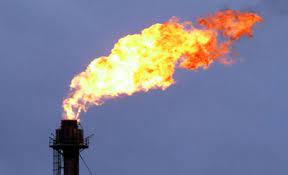
Gas flare in Nigeria’s oil fields fell by 0.33 per cent in the first quarter of 2021 to 45.33billion cubic feet, BCF, compared to 45.48BCF of gas flared in the fourth quarter of last year; latest data from the industry have shown.
Data also showed that on a year-on-year basis, gas flare dropped by 21.75 per cent in the first quarter of 2021 from the 57.93BCF recorded in the first quarter of 2020.
According to the Nigerian National Petroleum Corporation (NNPC), monthly report for February, 2021, data also showed that in 24 months, from March, 2019 to February, 2021, a total of 430.97BCF of gas have been flared.
This is equivalent to 1,720 Giga Watts of power lost in two years, according to power generation expert, Dr Stephen Ogaji of the Niger Delta Power Holding Company Limited.
As part of the effort to curb gas flaring in the country, the Federal Government in December, 2016, launched the Nigerian Gas Flare Commercialisation programme.
The NGFCP was designed as the strategy to implement the policy objectives of the government for the elimination of gas flares with potentially enormous multiplier and development outcomes for Nigeria.
The objective of the NGFCP is to eliminate gas flaring through technically and commercially sustainable gas utilization projects developed by competent third-party investors who will be invited to participate in a competitive and transparent bid process for flare sites.
The Department of Petroleum Resources (DPR), which manages the programme, in a statement explained that the commercialisation approach has been considered from legal, technical, economic, commercial and developmental standpoints.
“It is a unique and historic opportunity to attract major investment in economically viable gas flare capture projects whilst permanently addressing a 60-year environmental problem in Nigeria.
“The NGFCP has offered flare gas for sale through a transparent and competitive bidding process.
“A structure has been devised to provide project bankability for the Flare Gas Buyers, which is essential to the success of the programme”.
Latest data from the programme, according to the Department of Petroleum Resources (DPR), showed that so far 203 companies have been awarded the right to process flared gas from the 178 gas flared sites.
Speaking on the programme at the weekend, the Permanent Secretary, Ministry of Petroleum Resources, Mr BitrusNabasu, noted that despite the slow pace of progress, the Federal Government was determined to end gas flares in the country.
“The process is still on and our intention is to reduce gas flaring as much as possible so that the environment will be safe for us. The process is on and very soon it will be concluded”, he explained.
DPR in its gas flare regulation stated that “flare payments shall apply to any natural gas that is flared and/or vented at the production facilities of the producers”.
Figures from the 2019 Oil and Gas Audit Report of the Nigeria Extractive Industries Transparency Initiative (NEITI), showed that companies paid $307,591 in 2019 as gas flare penalties in the country.
In an interview with newsmen, GNPC Petroleum Commerce Chair in Oil and Gas Studies, University of Cape Coast, Ghana, Prof. WumiIledare, said a lot of investment was needed to end gas flaring in the country.
Iledare, however, observed that gas flaring has gradually gone down in the past few years, accounting for less than 10 per cent of total gas production.
He explained that “there are some gas flaring that cannot be eliminated if you have to keep things running but we must give credit to the Department of Petroleum Resources with respect to gas flaring.
“It is below 10 per cent right now. I still understand that is still the equivalent of about 3,000megawatts of electricity generation”.
He noted that “the investment required to be able to get gas to end-users is massive and it is going, to begin with, a good perception of public policy.
“Unfortunately, the perception of the Public Policy Index, PPI, is still very low. And until governance of the oil and gas industry is properly defined and all these amorphous regulatory agencies well defined, a risk-averse person will not invest in this type of business environment.
“This gas flaring that people are talking about, the opportunity cost to taking the gas to end-users is massive and there must be guarantee return on investment. If it is not there nobody will invest”, he added.
Speaking on the gas flare situation, the President of the Nigerian Association of Energy Economics (NAEE), Prof YinkaOmorogbe, noted that the Federal Government must demonstrate the political will to end gas flaring in the country by first ending the use of gas flare penalty as a source of revenue.
Omorogbe stated that the penalty must be seen as a punitive measure and strong enough to deter companies from flaring gas.
According to her, “We have to have the political will to not flare gas even if it means shutting down certain fields that are producing right now.
“Secondly, you have to seriously pursue your gas utilization projects and ensure that the gas utilization projects are using up associated gas that would otherwise be flared.
“Thirdly, you need to ensure that you don’t turn the associated gas penalties into money-making ventures but instead make them incredibly punitive. So punitive that it is better to shut down than to flare.
“So, the first thing is the political will to say I really don’t want this flaring anymore. Once you do that everything else will fall into place.
“It is going to cost us something first in the beginning but there has to be the determination to end it. It will also help us to reduce carbon emission on one side to offset emission on another side”, she explained.
On his part, the Director, Centre for Petroleum, Energy Economics and Law, University of Ibadan,Prof. AdeolaAdenikinju, also stated that the Federal Government must demonstrate the will to end gas flaring in the country.
Adenikinju held that once there is political will and clear policy to end gas flare, it would create incentives for investment because it will create opportunities for infrastructure that would utilize the gas.
“The government must create incentives for private capital to go in and create investments that would support infrastructure and utilization of the gas because it doesn’t pay you to shut down production and get zero production because you are flaring. So, you have to create solutions and those solutions are created by the market.
“So once, the policy is there and there is the conviction that the policy is not going to be reversed it automatically generates incentives for private capital investments and infrastructure that will also follow. That is the starting point, we must be ready to want to end gas flaring”, he stressed.



-

 Editorial3 days ago
Enough Of Xenophobic Attacks On Nigerians
-

 Nation3 days ago
RSU, Otonti Nduka Foundation Holds Centenary Conference, Unveil Book on Values in Nigeria
-

 Education3 days ago
UNIPort Senate Grants Two-Year Amnesty to U2010–U2018 Students
-

 Oil & Energy3 days ago
Rivers PETROAN Elects 12-Member Executive
-

 Sports3 days ago
Oparaodu Urges Rivers United To Win Katsina United
-
Politics3 days ago
APC Group Protests Ex–Presidential Aspirant’s Disqualification From Rivers Senatorial Race
-

 Sports3 days ago
” Nigeria’s best domestic players are not in NPFL”
-
Politics3 days ago
Reps Speaker Secures APC Return Ticket For Fifth Term