
Sports
Coach Solicits Inclusion Of Grassroots Football In Budget

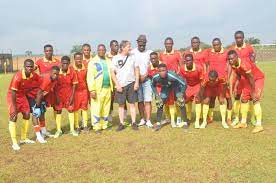
The Head Coach of Diamond Football Academy of Port Harcourt, Ben Peters, has appealed to the Rivers State Government to include grassroots football coaches in the state budget yearly.
He disclosed that, almost all the grassroots football coaches were suffering because they were spending their time and money on the youth by bringing them into the football world.
Peters, who is popularly called, “Coach Nanaa,” made the appealed on Wednesday in an exclusive interview with Tidesports just after the Bright Stars football academy defeated his boys 3-0 at the ongoing Sir P Under-13 football competition, at the Rumuwoji football pitch in Port Harcourt.
He stated that, as grassroots coaches, what they were doing was to see how they can cut off the youth from restiveness and become useful to the society.
“ What we are doing as grassroots coaches is to see how we can get the children out of the street and they become useful to society.
We need the presence of the government, by including the grassroots football coaches in their budget yearly; that will further motivate us to carry out our duty efficiently.
As growing children, they need our support and advice.
We spend our time and money on these children because when they were not energized, they are bound to involve themselves in different activities that will not yield good results.
The government itself is not trying, almost all the grassroots coaches are suffering.
Coach Nanaa, who was also head coach of the disbanded Eleme United FC, further explained that, grassroots football academy is dying because of lack of sponsorship.
“We need sponsorship in the grassroots team, because today, a lot have gained from the system,” he said.
By: Kiadum Edookor



Only Denmark, ranked 21st globally, sits higher among nations that failed to qualify for the tournament, which is being co-hosted by the United States, Mexico and Canada.
England and Chelsea legend John Terry was among those to voice his disappointment, describing Nigeria as a significant loss to a tournament that features 48 nations for the first time.
“Nigeria will be a big miss. This is a World Cup for participants who haven’t had the opportunity to play in the tournament. I would have loved to see a top team like Nigeria there because they’ve got some great individuals. They’re a great nation,” Terry said during a virtual roundtable session organised by SuperSport.
“I think they are a big miss because Nigeria probably would have gone further in the competition, but unfortunately, one side’s loss is another’s gain,” the former England captain added.
Eric Chelle’s side finished second in Group C of the CAF World Cup qualifiers behind South Africa, who secured automatic qualification. Nigeria kept their hopes alive with a playoff semi-final victory over Gabon before falling to the Democratic Republic of Congo on penalties in the decisive playoff final — their second successive absence from the World Cup after also missing the 2022 tournament in Qatar.
The Nigeria Football Federation later challenged DR Congo’s qualification, alleging the use of ineligible players during the campaign, but the appeal was dismissed.
Despite missing the World Cup, the Super Eagles remain Africa’s 3rd highest-ranked team behind Morocco, who sit seventh in the world, and Senegal. Algeria and Egypt complete the continent’s top five.
Defending champions Argentina enter the tournament as the world’s top-ranked side, ahead of Spain, France, England and Portugal. Brazil are sixth, followed by Morocco, the Netherlands, Belgium and Germany.
The next FIFA World Ranking will be released on July 20, a day after the World Cup final.

Chima Akachukwu and Miracle Akhigbe are among the 16 notable stars picked by the Nigeria Cricket Federation (NCF) for the forthcoming Namibia Tour, where the YellowGreens will compete in a T20 and 50-Over Tri-Series, featuring hosts Namibia and Hong Kong China.
Both players make their way back into the YellowGreens fold after periods away from the side and will be eager to contribute their experience and quality as Nigeria pursues success in Namibia.
The NCF said yesterday that the squad, which departs Nigeria today, forms part of the national team’s continued preparations for future international assignments as the YellowGreens seek to build on recent performances and strengthen their standing on the global stage.
Leading the squad is Captain Sulaimon Runsewe, who will spearhead Nigeria’s campaign against two formidable opponents in what promises to be a highly competitive series.
The selected squad combines experienced internationals with emerging talents, providing the technical crew an opportunity to assess player development and team combinations in both the T20 and 50-over formats.
The team will be led on tour by Coaches Leke Oyede and Tamuno John, who will oversee preparations and match operations during the opening phase of the series.
Joining the squad later in Namibia will be the newly appointed Head Coach and High Performance Manager, Stephen Magongo, whose arrival marks another significant step in the Federation’s commitment to strengthening the national team structure and enhancing player development pathways.
Supporting the coaching staff are Team Analyst Jamal Okechukwu, Strength and Conditioning Coach Seye Olympio, and Team Physiotherapist Timothy Adesomowo, forming a well-rounded technical crew focused on maximising player performance and welfare throughout the tour.
The NCF views the Namibia Tri-Series as an important platform for the continued growth of the national team, offering valuable international exposure and competitive match experience against quality opposition. The series will provide the players and technical crew with another opportunity to evaluate progress, fine-tune strategies, and build momentum ahead of future international competitions.
The YellowGreens will face Namibia and Hong Kong China in both T20 and 50-over contests, with the matches expected to test the team’s adaptability, discipline, and resilience in challenging conditions.

Blessing Otu on Monday overcame hard-fighting Kelvin Bebe- Emmanuella in two sets of 6-1, 6-3 to qualify for the second round of the women’s singles of the ongoing 47th Central Bank of Nigeria Senior Tennis Championship, held at the Tennis Courts of the package “B” of the Moshood Abiola National Stadium, Abuja.
Speaking after the round of 32 game, Otu, who will be 19 years old in September, said she capitalised on her opponent’s weaknesses to gain victory, having studied her game very well.
“Bebe is a very good and tough player. But I studied her game and did the job well.
“Although she tried to come back in the second set, I punctured all her tricks to win the match and move on. I wish I could continue like this in the rest of my games,” she said.
Another member of the Otu family, John Out, was also victorious as he defeated Mohammed Abdusalam 2-1 (6-2, 6-7, 6-1) in the men’s singles category to advance into the round of 32.
But the third Otu in the game, Thomas, was not that lucky as he lost by 6-0, 7-5 in two straight sets to Danjuma Isaac.
In other matches, Michael Emmanuel defeated Ibrahim Aminu to advance, while Drimiya Mevi outclassed Seyi Ogunsakin by beating him 2-1 (6-7, 6-3, 6-1). Action continues tomorrow when other top players, including the men’s singles top seed, Abua Cannice, join the chase for honours.
-

 Niger Delta2 days ago
Warri Airport Manager Disputes Air Peace Bird Strike Claim
-

 News2 days ago
Nigeria Won’t Surrender Any Territory To Criminals -Tinubu
-

 News2 days ago
FG Begins Trial Of Over 600 Terrorism Suspects
-

 Rivers2 days ago
79th IAUE Inaugural Lecture: Prof Anero Advoctes Tuition-Free Education For Children
-

 Politics2 days ago
Parties’ Deregistration: How Justice Lifu Overruled Appeal Court Justices
-

 News2 days ago
Rivers Judges Commence Annual Vacation, July 20
-

 Politics2 days ago
ADC: Okonkwo Rejects Amaechi As Presidential Running Mate, Withdraws Support
-

 Politics2 days ago
2027: Tinubu’s Projects Give APC Edge In South East – Yilwatda