
Editorial
Task Before New EFCC Chairman

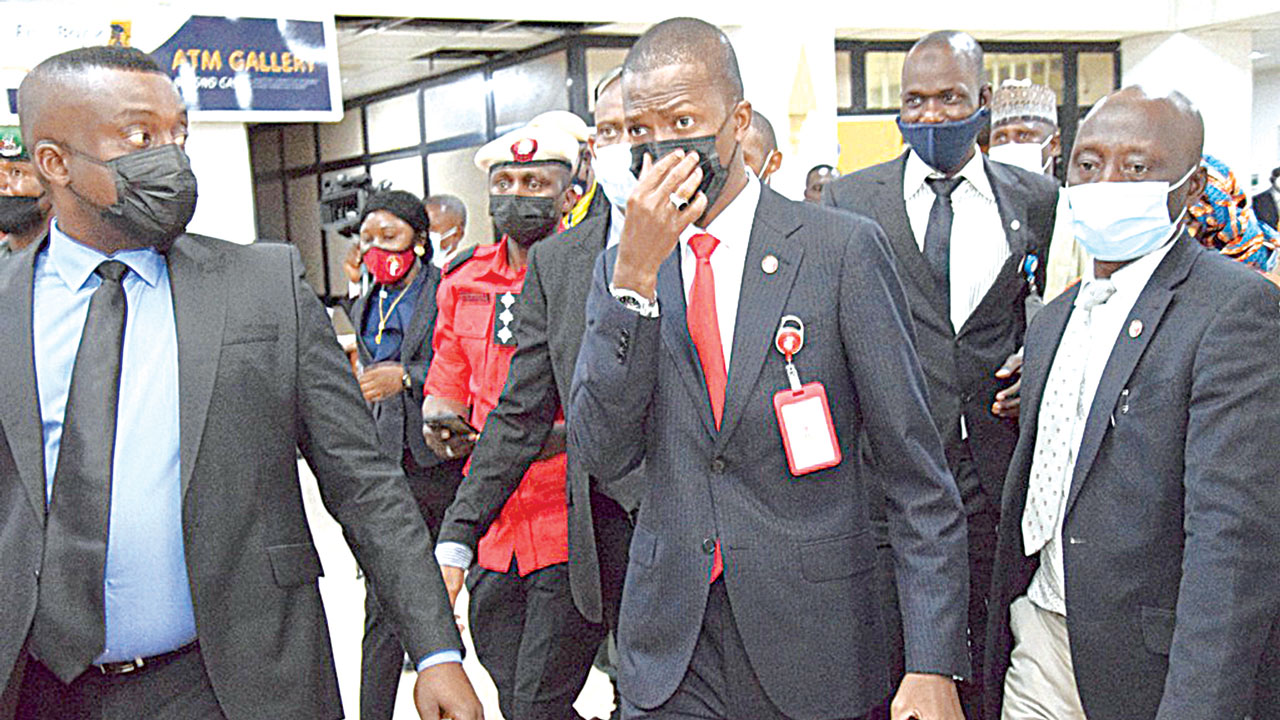
To the relief of Nigerians, a new substantive helmsman, Abdulrasheed Bawa, was confirmed for the Economic and Financial Crimes Commission (EFCC) by the Senate on February 24 this year following his nomination on February 16 by President Muhammadu Buhari. Born on April 30, 1980, Bawa who holds degrees in Economics and International Affairs and Diplomacy joined the EFCC as a cadet Assistant Detective Superintendent in 2004 and rose to Deputy Chief Detective Superintendent before his appointment.
In the about 18 years of the anti-graft agency’s existence, the new boss is the 6th in line and not just the youngest but also the only one from the ranks of the organisation and without a police background to head the agency.
Against the backdrop of the fact that one of his predecessors, Ibrahim Magu, who acted as chairman for five years and had his confirmation rejected by the Senate twice, Bawa’s smooth confirmation by the upper legislative chamber could be interpreted as a vote of confidence by the Nigerian people on his capacity and competence to steer the ship of the arrowhead of the anti-corruption war in the country.
With a track record of hardwork, diligence and high level performance on the job, the feeling in many quarters is that Bawa is the man for the assignment to lead the agency at this moment in time.
At just 40 years of age, the new anti-corruption czar’s appointment represents a confidence vote on the youth and their competence to contribute significantly to the development of the nation. While this vote also represents a test of the younger generation’s ability to take responsibility, it as well places a burden on the youth to determine the economic health of the nation going forward. Bawa, therefore, owes his generation a duty to discharge.
As a Certified Fraud Examiner (CRE); Certified Anti-Money Laundering Specialist (CAMS) who has received training from various institutions such as the United States Federal Bureau of Investigation (FBI), United States Financial Crimes Enforcement Network (FINCEN); the World Bank; the United Nations Office of Drug and Crimes and the United Kingdom’s Global Training Consulting, among others, Bawa’s technical and professional competence can be said to be solid. What is, however, needed of him is the skill to manage the men and materials at his disposal, majority of whom are police officers, to achieve set goals.
Though the EFCC may not be said to have failed in delivering on its mandate, the perception among many Nigerians is that it could do better, especially in such areas as being accountable to the public, management of resources and political interference in its affairs. Under Bawa, the EFCC must be re-organised and refocused to achieve results rather than playing to the gallery with emphasis on trying suspects in the media.
Especially in the last five years or so, the commission had been plagued with some issues bordering on reputation with cases of conflict of interest among staffers. Bawa will have to put his feet down to enforce strict discipline among his operatives and also refuse to be used by politicians to witch hunt political opponents.
It is on record that none of his predecessors lasted a full term in office in substantive capacity. The new EFCC boss must do well to change that narrative. To achieve this, he must be independent-minded and avoid getting too close or familiar with politicians. To achieve desired results, Bawa must also remain resolute and refuse to pander to sectional interests or such other considerations that will compromise his integrity.
To this end, he must continue on the path of pursuing corrupt politicians, the recovery of stolen assets and conviction of tainted government officials and their allies with even renewed vigour and determination. Nobody should be considered too big or too powerful for the EFCC to investigate and prosecute whenever there is a need for it. The EFCC must be built into an organisation that sends shivers down the spine of corrupt-minded Nigerians, irrespective of their status and position in the society.
The expectation among Nigerians is that Bawa will not rest on his laurels as the head of the EFCC’s investigations of Diezani Allison-Madueke (from 2015 till date) that recovered millions of dollars’ worth of property in Nigeria, the United Kingdom, USA and UAE; supervision of the investigations of Atlantic Energy Group that led to the recovery of assets in Nigeria, the UK, USA, Switzerland, the UAE and Canada and such other successes.
It has been observed that corruption might kill Nigeria if nothing is done to kill it and even though President Muhammadu Buhari made it a cardinal objective to fight corruption to a standstill, there is a preponderance of evidence that the effort of his administration has not yielded heart-warming results. Only in January this year, Transparency International published a report indicating that Nigeria recorded a decline in her Corruption Perception Index for the year 2020. Out of 180 countries, Nigeria came a dismal 149, grossing merely 25 points out of 100.
From government Ministries, Departments, Agencies and Parastals to the private sector, it is widely believed that corruption still pervades the system in the country while there is very little being done to reverse the trend. It is also a commonly held view that the government of the day is either shielding corrupt officials from prosecution or simply lacks the will to walk its talk of fishing out and bringing corrupt personnel to book.
Finally, The Tide thinks that, to make the desired impact of reducing corruption in Nigeria, Bawa’s EFCC must initiate and promote measures to prevent corruption in addition to detecting and sanctioning corrupt officials and their activities.
There is no doubt that the fight against corruption in Nigeria is a herculean one but with the requisite political will, courage, determination and channelling of needed resources, the Leviathan can be contained and Nigerians given a fresh lease of life. Bawa stands at the threshold of history of giving his compatriots an anti-graft agency they can be proud of.




Nigeria stands at a critical juncture as the world marked World Press Freedom Day (WPFD) on May 3. This annual observance is a reminder that a free press is central to democratic life, good governance, and public accountability. For Nigeria, it is also a moment for sober reflection on how far the country has come and how far it still has to go in safeguarding the independence of its media.
World Press Freedom Day exists to highlight the fundamental importance of freedom of expression and to honour journalists who risk their lives in pursuit of truth. It underscores the idea that without a free press, societies cannot function transparently, nor can citizens make informed decisions. In countries like Nigeria, where democracy continues to evolve, the observance carries particular urgency.
This year’s theme, “Shaping a Future at Peace: Promoting Press Freedom for Human Rights, Development and Security”, places journalism at the heart of global stability. It emphasises that a peaceful society cannot be built on silence, fear, or manipulated information. Rather, it depends on the free flow of accurate, timely, and independent reporting.
At its core, the theme highlights the role of journalism in fostering accountability, dialogue, and trust. These are not abstract ideals. In Nigeria, where public confidence in institutions is often fragile, the media remains one of the few platforms through which citizens can question authority and demand transparency. When press freedom declines, so too does public trust.
Journalism serves as a foundation for peace, security, and economic recovery. Countries with robust media systems tend to attract greater investment, maintain stronger institutions, and resolve conflicts more effectively. Nigeria’s economic challenges, ranging from inflation to unemployment, require open scrutiny and informed debate, both of which depend on a free press.
However, the issue of information integrity has become increasingly complex in the digital age. Artificial Intelligence (AI) and online platforms have amplified the spread of misinformation and disinformation. In Nigeria, where internet penetration has grown rapidly, false narratives can travel faster than verified facts. This makes the role of credible journalism more vital than ever.
The challenge is not only technological but also ethical. AI-driven manipulation of information threatens to distort public discourse, influence elections, and deepen social divisions. In such an environment, professional journalism must act as a stabilising force, ensuring that truth prevails over sensationalism and propaganda.
Equally troubling is the safety of journalists. Across Nigeria, reporters face growing levels of online harassment, judicial intimidation, and physical threats. Self-censorship is becoming more common, as media practitioners weigh the risks of reporting sensitive issues. This trend undermines the very essence of journalism.
A particularly alarming incident involved a serving minister in the present administration, who openly threatened to shoot a journalist during a televised exchange. Such conduct, broadcast to the public, sends a dangerous signal that hostility towards the press is acceptable. It erodes the norms of democratic engagement and places journalists in harm’s way.
This year’s theme aligns closely with the United Nations Sustainable Development Goal (SDG)16, which promotes peace, justice, and strong institutions. Freedom of expression is a cornerstone of this goal. Without it, institutions weaken, corruption thrives, and justice becomes elusive. Nigeria’s commitment to SDG 16 must therefore include genuine protection for the media.
Historically, the Nigerian press has been a formidable force. From resisting colonial rule to challenging military dictatorships, our journalists have played a central role in shaping the nation’s political landscape. Today, however, that legacy appears to be under strain, as the media operates under what can best be described as a veneer of freedom.
Beneath this facade lies a troubling reality. Journalists are routinely harassed, detained, and prosecuted for performing their constitutional duties. Reports from media watchdogs indicate that dozens of Nigerian journalists face legal threats or arrest each year, often for exposing corruption or criticising those in power.
The Cybercrimes (Prohibition, Prevention, etc.) Act of 2015 has become a focal point of concern. Originally intended to combat cyber threats, it has increasingly been used to silence dissent. Sections 24 and 27(1)(b), in particular, have been invoked to target journalists, bloggers, and social commentators.
Although amendments introduced in February 2024 were meant to safeguard journalists, concerns persist. The law continues to be wielded in ways that stifle investigative reporting and restrict freedom of expression. Legal reforms must go beyond cosmetic changes to address the root causes of misuse.
To safeguard the future of journalism in Nigeria, decisive action is required. The Cybercrimes Act must be revisited to ensure it cannot be weaponised against the press. Law enforcement agencies must operate free from political influence, upholding the rule of law and protecting journalists’ rights. Civil society and international partners must also strengthen independent media through funding, training, and platforms for wider reach.
In this rapidly evolving world shaped by artificial intelligence and digital innovation, Nigeria faces a clear choice. It can either allow press freedom to erode under pressure, or it can champion a truly independent media landscape. The path it chooses will determine not only the future of journalism, but also the strength of its democracy and the peace it seeks to build.
-
 Editorial4 days ago
Enough Of Xenophobic Attacks On Nigerians
-

 Sports4 days ago
Oparaodu Urges Rivers United To Win Katsina United
-

 Education4 days ago
UNIPort Senate Grants Two-Year Amnesty to U2010–U2018 Students
-

 Nation4 days ago
RSU, Otonti Nduka Foundation Holds Centenary Conference, Unveil Book on Values in Nigeria
-

 Oil & Energy4 days ago
Rivers PETROAN Elects 12-Member Executive
-
Politics4 days ago
APC Group Protests Ex–Presidential Aspirant’s Disqualification From Rivers Senatorial Race
-

 Sports4 days ago
” Nigeria’s best domestic players are not in NPFL”
-
Politics4 days ago
Reps Speaker Secures APC Return Ticket For Fifth Term