
Editorial
FG’s Rueful Narrow Gauge Rail Line

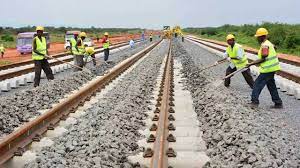
President Muhammadu Buhari lately flagged off the reconstruction of the much-awaited
Nigeria’s Eastern rail line, a 1,443 km narrow gauge rail line spanning from Port Harcourt in the South-South zone to Maiduguri in the North-East zone with new branch lines to Owerri, Imo State, and Damaturu, Yobe State.
The project is to be co-financed through a loan from a syndicate of Chinese financiers with the Federal Government’s contribution of 15% project cost. The undertaking includes the Bonny Deepsea Port and Railway Industrial Park, Port Harcourt, and will be developed through direct funding by the conglomerate led Messrs CCECC Nigeria Limited.
When completed, the trains from Port Harcourt to the Maiduguri Eastern narrow gauge railway will run at 60 to 80 kilometres per hour Kph and 80 to 100 kilometres per hour Kph, respectively. Through his virtual speech, the President informed Nigerians that the purpose of the project was to revive the once vibrant rail transport in Port Harcourt — Maiduguri, the country’s Eastern rail corridor.
Justifying the narrow gauge rail line for the Eastern corridor, the Minister of Transportation, Rotimi Amaechi, explained that the Federal Government opted for a single track for the Port Harcourt – Maiduguri rail line because of lack of funds for the construction of a standard gauge. According to Amaechi, the six geo-political zones would be covered. It would go through several states including Rivers, Abia, Imo, Enugu, Ebonyi, Anambra, Benue, Nasarawa, Plateau, Bauchi, Gombe and Yobe.
He said the Eastern rail line was designed to have both narrow and standard gauge, “but as it stands now, due to the cost of the standard gauge and what is feasible to do within the limited time frame, it is cheaper to rehabilitate the narrow gauge which will cost about $3.2 billion and can be delivered within the approved time frame.”
The minister also said a standard gauge line was to cost between $11 billion and $14 billion to construct, and getting the funds within the limited time was not feasible because of other projects that were waiting to be funded. Explaining further, the minister said, “the only difference with the two lines is the speed. The standard gauge is 120km per hour. If you take off with the standard gauge, let’s say to Damaturu, you will arrive 20 minutes before me that uses the narrow gauge.
“The narrow gauge is cheaper at $3 billion. Why we did not get the approval for the narrow gauge on time was because the President insisted on the standard gauge from Port Harcourt to Maiduguri. My argument is that if I can achieve the same length of rail with $3 billion, why not take that first until when we get money, we can now go for the standard gauge. If we continue to wait until we get the $11 billion to $14 billion, we may not be able to construct the Eastern flag before we leave government.”
This project is highly appreciated for its economic viability and ability to reduce vehicular movement on the road. However, the rehabilitation of rail lines in the country has been a major concern, especially as many in the South-East and South-South regions have been deliberately neglected by the President; whereas he has been busy building thousands of kilometres of rail lines in the North and South-West: Abuja – Kaduna; Lagos – Ibadan; Kano-Katsina-Maradi in the Niger Republic, among others.
The need for a functional rail line on the Eastern corridor persists and remains compelling as the supply chain for products and services on this corridor vanishes and articles and items such as petroleum products, iron and steel, minerals, livestock and poultry products availability were drastically reduced giving rise to the high cost of products.
However, we think that because of the busy nature of the Eastern corridor, a standard gauge would have been more appropriate as rehabilitation of the old narrow-gauge line would amount to a waste of resources. The government should have perhaps utilised the available resources to construct the kilometres that could be covered while the next administration completes the work.
As the region that produces the nation’s wealth, we should have been given priority in terms of quality of the project. Why is cost not an issue when building the standard gauge in other parts of the country? Sadly, it is only when it has to do with the Niger Delta that cost is an impeding factor. Hence, we stand with the Rivers State Governor, Chief Nyesom Wike, in describing the narrow gauge rail line as inferior, sub-standard, slower, and outdated compared to the standard gauge rail line. We deserve the best.
While it is understandable that the project possesses high economic viability, create employment, and grow the economy through transportation, the question is, why is it coming now when the government has a brief time to be in power? Can the work be completed within the remainder of the administration’s lifespan?
Moreover, given its penchant for abandoning projects, the Federal Government cannot be trusted to deliver the narrow gauge rail project according to schedule. For instance, there are about 9,000 abandoned projects awaiting completion in the Niger Delta alone. The East-West Road has been lying fallow for many years, seeking attention. Numerous others are scattered all over the country many of which are at various stages of incompleteness.
A good number of projects in the area are not pursued with vigour. There are no good roads yet. The East-West Road has been abandoned. The water is polluted and electricity supply is still a luxury in the area where it exists at all. Schools are badly funded. In other words, the people of the Niger Delta remain impoverished.
What is more, why, with all the monies already spent, are there no landmark projects in the area? There are no monuments in the Niger Delta to the huge wealth derived from there. Indeed, all the organisations in the nation’s oil sector, including the Nigerian National Petroleum Corporation (NNPC) headquarters are not even located in the Niger Delta. Things cannot continue in this way. Enough is enough.




Nigeria stands at a critical juncture as the world marked World Press Freedom Day (WPFD) on May 3. This annual observance is a reminder that a free press is central to democratic life, good governance, and public accountability. For Nigeria, it is also a moment for sober reflection on how far the country has come and how far it still has to go in safeguarding the independence of its media.
World Press Freedom Day exists to highlight the fundamental importance of freedom of expression and to honour journalists who risk their lives in pursuit of truth. It underscores the idea that without a free press, societies cannot function transparently, nor can citizens make informed decisions. In countries like Nigeria, where democracy continues to evolve, the observance carries particular urgency.
This year’s theme, “Shaping a Future at Peace: Promoting Press Freedom for Human Rights, Development and Security”, places journalism at the heart of global stability. It emphasises that a peaceful society cannot be built on silence, fear, or manipulated information. Rather, it depends on the free flow of accurate, timely, and independent reporting.
At its core, the theme highlights the role of journalism in fostering accountability, dialogue, and trust. These are not abstract ideals. In Nigeria, where public confidence in institutions is often fragile, the media remains one of the few platforms through which citizens can question authority and demand transparency. When press freedom declines, so too does public trust.
Journalism serves as a foundation for peace, security, and economic recovery. Countries with robust media systems tend to attract greater investment, maintain stronger institutions, and resolve conflicts more effectively. Nigeria’s economic challenges, ranging from inflation to unemployment, require open scrutiny and informed debate, both of which depend on a free press.
However, the issue of information integrity has become increasingly complex in the digital age. Artificial Intelligence (AI) and online platforms have amplified the spread of misinformation and disinformation. In Nigeria, where internet penetration has grown rapidly, false narratives can travel faster than verified facts. This makes the role of credible journalism more vital than ever.
The challenge is not only technological but also ethical. AI-driven manipulation of information threatens to distort public discourse, influence elections, and deepen social divisions. In such an environment, professional journalism must act as a stabilising force, ensuring that truth prevails over sensationalism and propaganda.
Equally troubling is the safety of journalists. Across Nigeria, reporters face growing levels of online harassment, judicial intimidation, and physical threats. Self-censorship is becoming more common, as media practitioners weigh the risks of reporting sensitive issues. This trend undermines the very essence of journalism.
A particularly alarming incident involved a serving minister in the present administration, who openly threatened to shoot a journalist during a televised exchange. Such conduct, broadcast to the public, sends a dangerous signal that hostility towards the press is acceptable. It erodes the norms of democratic engagement and places journalists in harm’s way.
This year’s theme aligns closely with the United Nations Sustainable Development Goal (SDG)16, which promotes peace, justice, and strong institutions. Freedom of expression is a cornerstone of this goal. Without it, institutions weaken, corruption thrives, and justice becomes elusive. Nigeria’s commitment to SDG 16 must therefore include genuine protection for the media.
Historically, the Nigerian press has been a formidable force. From resisting colonial rule to challenging military dictatorships, our journalists have played a central role in shaping the nation’s political landscape. Today, however, that legacy appears to be under strain, as the media operates under what can best be described as a veneer of freedom.
Beneath this facade lies a troubling reality. Journalists are routinely harassed, detained, and prosecuted for performing their constitutional duties. Reports from media watchdogs indicate that dozens of Nigerian journalists face legal threats or arrest each year, often for exposing corruption or criticising those in power.
The Cybercrimes (Prohibition, Prevention, etc.) Act of 2015 has become a focal point of concern. Originally intended to combat cyber threats, it has increasingly been used to silence dissent. Sections 24 and 27(1)(b), in particular, have been invoked to target journalists, bloggers, and social commentators.
Although amendments introduced in February 2024 were meant to safeguard journalists, concerns persist. The law continues to be wielded in ways that stifle investigative reporting and restrict freedom of expression. Legal reforms must go beyond cosmetic changes to address the root causes of misuse.
To safeguard the future of journalism in Nigeria, decisive action is required. The Cybercrimes Act must be revisited to ensure it cannot be weaponised against the press. Law enforcement agencies must operate free from political influence, upholding the rule of law and protecting journalists’ rights. Civil society and international partners must also strengthen independent media through funding, training, and platforms for wider reach.
In this rapidly evolving world shaped by artificial intelligence and digital innovation, Nigeria faces a clear choice. It can either allow press freedom to erode under pressure, or it can champion a truly independent media landscape. The path it chooses will determine not only the future of journalism, but also the strength of its democracy and the peace it seeks to build.
-
 Editorial1 day ago
Enough Of Xenophobic Attacks On Nigerians
-

 Nation1 day ago
RSU, Otonti Nduka Foundation Holds Centenary Conference, Unveil Book on Values in Nigeria
-

 Oil & Energy1 day ago
Rivers PETROAN Elects 12-Member Executive
-

 Environment1 day ago
MOSOP – Tinubu Not Sincere With Ogoni People For Oil Resumption
-
Politics1 day ago
APC Group Protests Ex–Presidential Aspirant’s Disqualification From Rivers Senatorial Race
-

 News1 day ago
Fubara, Wife Hail Tinubu’s Renewed Hope Initiative …As Over 6,800 Families Benefit From Largesse In Rivers
-
Politics1 day ago
Reps Speaker Secures APC Return Ticket For Fifth Term
-

 Maritime1 day ago
Products, Others, To Arrive Lagos Ports Today — MPA