Connect with us

Business

Rivers Traders Lament Hike In Prices Of Food Stuffs

Published

on

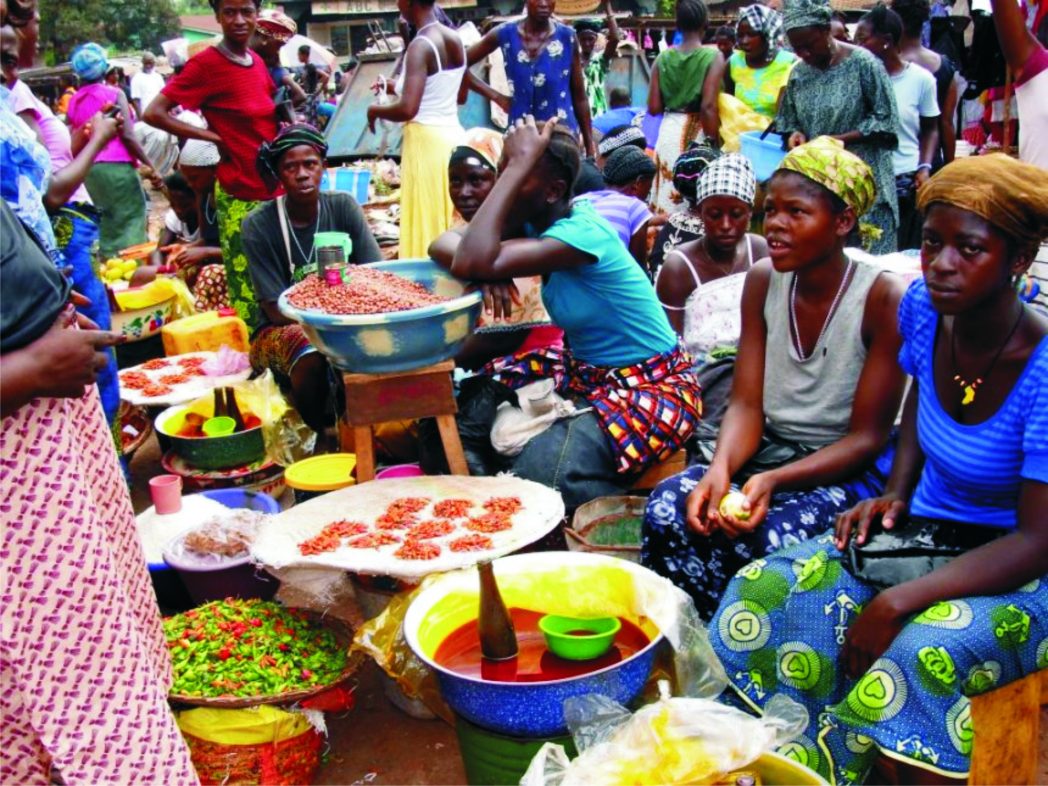
Some traders at the popular Rumuomasi market in Port Harcourt, Rivers, yesterday decried hike in prices of foodstuff, attributing it to the outbreak of COVID-19 in the country.
Some of the traders who spoke with newsmen during a market survey in Port Harcourt said that the rate of increase in prices of food items may soon kick them out of business and bring more hunger in the country.
Mrs Edna Offong, one of the traders who sells bags of rice in the market said that the rate of increase in the price of rice is alarming.
Offong stated that the price of rice had gone up twice in the market before the outbreak of the pandemic.
“The rate of increase in the prices of food is alarming, and I am afraid I don’t know how we are going to survive in this business.
“The price of 50kg bag of foreign rice which we sold at N26,000 before COVID-19, is now N39,000 while a bag of 50kg local rice that we were selling at N17,000 is now N29,000,” she said.
Similarly, Mrs Faith Emezie, another trader who sells bags of beans, said that prices of food stuff in the market are outrageous.
Emezie lamented that the increase in prices has made her to lose her business capital and slowed down patronage from her customers.
“I am just here because I don’t want to sit at home and see my children cry from hunger, I have lost my capital.
“This is because when I finished selling and I went back to market to restock, the price has increased more than the money I brought. I ended up buying small quantity of beans which I struggled hard to resell due to the increase in price.
“Remember that children have been out of school since the outbreak of COVID-19 pandemic, eating more than when they were going to school.
“This also contributes to the loss in my capital because I feed them from my sales, and I am sure other families are experiencing the same thing as well.
“Honestly, I am pleading with our government to control prices of goods in the markets, so that people will not be selling anyhow they like, not minding if it is suitable or not for buyers and sellers,” she pleaded.
Miss Marian Felix, another trader, who sells condiments attributed the high cost of spaghetti and macaroni pasta, tomato paste, and edible oil in the market to the shutdown by companies during the pandemic.
Felix said that a packet of pasta sold at N200 now sells for N250, while a sachet of tomato paste sold at N50 is currently sold for N120.
She said 4 litres of vegetable oil sold at N3,500 is now N5,000 and 4 litres of red oil sold at N1,500 now sells for N2,500.
“I pray that God Almighty will help our country to come out of this trying times for us to continue to live better as we have been living before the pandemic,” Felix said.

Continue Reading

Business

Nigeria’s ETF correction deepens as STANBICETF30, VETGRIF30 see 50% decline in a week

Published

on

Nigeria directs all oil, gas revenues to federation account in sweeping reform
Nigerian President Bola Tinubu has signed an order directing that all oil and gas revenues owed to the government be paid directly into the federation account, in sweeping reforms aimed at boosting public finances, the presidency said on Wednesday.
Under the law, the Nigerian National Petroleum Corporation keeps 30% of oil and gas profits for frontier exploration in inland basins. The presidency said those funds will now be paid into the federation account and appropriated by the government.
The Reuters Power Up newsletter provides everything you need to know about the global energy industry. Sign up here.
NNPC also retains 30% of oil and gas sales as operational costs and receives 30% of proceeds from Production Sharing Contracts. Under the new directive, all revenues under these arrangements will flow directly to the federation account, while the company will instead receive appropriated management fees.
Royalty payments, petroleum profit taxes and other statutory revenues previously collected and retained by the Nigerian Upstream Petroleum Regulatory Commission (NUPRC) will also be paid directly into the Federation Account. The Nigerian Midstream and Downstream Petroleum Regulatory Authority (NMDPRA) will likewise remit its revenues in full, with its cost of collection to be funded through appropriation.
Tinubu’s office said deductions enabled by the law had sharply reduced net oil inflows and contributed to fiscal strain across federal, state and local governments. The president also ordered a review of the law and established an implementation committee to enforce the changes.
Continue Reading

Business

BOI Introduces Business Clinic 

Published

on

The Bank of Industry (BoI) has introduced a business clinic model designed to diagnose, treat and rehabilitate the Micro, Small and Medium Enterprises (MSMEs) to ensure long-term growth and sustainability.
The Divisional Head, Business Development, BoI, Dr Obaro Osah, made this known at the bank’s Thrive Summit with the theme: “Driving Growth through Innovation and Financial Empowerment” on Tuesday in Lagos.
Osah noted that traditional banking often treated businesses as mere account opening and management relationships.
He said the BoI business clinic model was created to reimagine the essence of a bank as a specialised teaching hospital.
According to him, just as a hospital requires a thorough diagnosis before service treatment/surgery, the bank must analyse the structural health of a small business before injecting capital.
“Financial distress is often just a symptom, the disease lies in operations and adopted philosophy, strategy, or governance,” he said.
Osah noted the many MSMEs, in spite of their potential, suffer from recurring ailments: restricted cash flow, poor operational structure, lack of proper packaging and market access, poor management among others.
He said the bank’s triage and vital signs included screening SMEs by maturity stage, pulse check to assess cash flow and liquidity and market temperature to evaluate competitive landscape.
Osah said after these evaluation, advanced diagnostics, prescriptions, surgical interventions and recovery and rehabilitation would be carried out where necessary.
“Prescription without diagnosis is malpractice and the Thrive Summit ensures we treat the root cause, not just the symptoms,” he said.
The Chief Strategy and Development Officer, BoI, Dr Isa Omagu, noted that MSMEs needed more than finance to succeed.
Omagu said they needed structure, advisory, capacity building, governance, digital readiness, access to market information and the right business infrastructure to operate and scale effectively.
He said as part of the bank’s 2025-2027 Corporate Strategy, the business clinic would expand BoI’s value proposition to broaden its products and services to better reach target segments.
Omagu said by offering structured business advisory and project development support, the clinic would enable the bank deliver deeper, more holistic value to MSMEs beyond financing.
“This vision of a structured, holistic business clinic; one that strengthens MSMEs across all core business functions and makes them more bankable, competitive, digitally enabled, and sustainable, is fully aligned with our strategic initiative to develop and roll out non-financial product offerings.
“Through this initiative, BoI commits to providing business advisory for MSMEs and project lifecycle support for enterprises, and the business clinic serves as the practical platform through which this commitment comes to life,” he said.
Omagu urged MSMEs to apply the guidance received to strengthen structure, governance, and financial management.
He added that they must adopt digital tools and improve internal processes to boost competitiveness while engaging BoI as a long-term partner in building a resilient, scalable business.
Mrs Eniola Akinsete, Divisional Head, Sustainability, BoI, said adopting Environmental, Social and Governance (ESG), principles often led to business prosperity.
Akinsete, however, noted that in spite of the benefits, adoption challenges persisted.
She affirmed BoI’s support on the adoption of ESG Practices by the MSMEs.
Earlier, the Executive Director, Corporate Finance, Sustainability and Investments, BoI, Mr Rotimi Akinde, said the summit represented a shared commitment to building a stronger, more resilient business ecosystem in Nigeria.
Akinde stated that the business clinic created a platform for practical knowledge sharing where entrepreneurs and small business owners could gain actionable insights to overcome challenges and seize opportunities.
He said discussions would focus on critical areas that drive sustainable growth, including branding and marketing, financials and activities, human rights, human resources, raising capital for equity and technology.
Continue Reading

Business

Dangote signs $400 mln equipment deal with China’s XCMG to speed up refinery expansion

Published

on

Nigeria’s Dangote Group has signed a $400 million equipment deal with China’s Xuzhou Construction Machinery Group to speed up the expansion of its oil refinery toward a planned 1.4 million barrels per day, the company said on Tuesday.
The additional equipment is expected to support major projects under construction across refining, petrochemicals, agriculture and infrastructure.
Dangote said the XCMG agreement would allow it to acquire a wide range of new heavy-duty machinery to complement existing assets deployed for the refinery build?out, which the company expects to complete within three years.
As part of the expansion, polypropylene capacity will rise to 2.4 million tons per year from 900,000 tons. Urea production in Nigeria will triple to 9 million tons per year, alongside an existing 3 million-ton plant in Ethiopia, positioning the conglomerate as the world’s largest urea producer, the company said.
The output of linear alkyl benzene – a key raw material for detergents – will increase to 400,000 tons annually, making Dangote the biggest supplier in Africa. Additional base-oil capacity is also planned in the programme.
Dangote Group described the equipment deal as a strategic investment aligned with its ambition to become a $100 billion enterprise by 2030.
“The additional equipment we are acquiring under this partnership will significantly enhance execution across our projects,” it said in a statement.
Owned by Nigerian billionaire Aliko Dangote, the $20 billion refinery began operations in 2024 after years of delays. Once fully operational, it is expected to reduce Nigeria’s heavy dependence on imported refined fuel and reshape fuel supply across West and Central Africa.
Reporting by Isaac Anyaogu; Editing by Anil D’Silva
The Nigeria-Slovenia Chamber of Commerce on Thursday urged the Nigerian business community to explore business opportunities in Slovenia to widen their horizons.
The Tide source reports that the chamber made the call at its 2025 Last Quarter Business Forum held in Lagos State.
The forum is the chamber’s routine session aimed at informing businesses about the latest opportunities of mutual benefit between both countries, encouraging people to explore them to improve their livelihoods.
Speaking at the event, which was attended by businessmen and trade regulatory agencies, the Director-General of the Nigeria-Slovenia Chamber of Commerce, Mr Uche Udungwor, described the relationship between the two countries as a bilateral economy.
Udungwor said the body, established to build, promote and facilitate trade and investment activities between Nigeria and Slovenia, had positively impacted both nations.
He said the mandates of the chamber include: “To provide a forum representative of Nigeria and Slovenia’s interests for the development and improvement of commerce and industry between the two countries.
“Also, to create, promote and sustain broad exchanges and interactions in commercial, industrial and economic fields between the countries.
“To promote cooperation on technical and scientific innovations between institutions of the countries through the exchange of regular information on trade and investment opportunities.
“To advise members on opportunities, challenges, legislation or otherwise arising from the pursuit of trade between Nigeria and Slovenia, and to encourage the exchange of ideas and views on trade matters within the context of trade promotion between both countries.”
According to him, Slovenia’s major imports include organic chemicals, agro products such as cocoa beans, iron and steel/metal scraps, wood, and mineral fuels/petroleum products.
He said the trade balance between Slovenia and Nigeria is “not quite encouraging”, citing United Nations COMTRADE data indicating that Slovenia’s imports from Nigeria in 2022 amounted to $5.7 million.
Udungwor described the Republic of Slovenia, located in Central Europe with about 2.1 million inhabitants, as a promising business frontier for Nigerians.
He noted that the country features Alpine mountains, thick forests and a short Adriatic coastline.
“Slovenia, which borders Italy to the west, Austria to the north, Croatia to the south and southeast, and Hungary to the northeast, has a 2024 GDP of 72.49 billion dollars, a sound economy and a low-risk business environment.
“Slovenia has been a member of the European Union since 2004 and of the Schengen Group since 2007. It is also a member of the Organisation for Economic Co-operation and Development (OECD).
“Slovenia today is a stable, vibrant democracy that offers a stimulating business environment and represents a bridge between the Balkan, Central European and Western European countries.
“The Nigeria-Slovenia Chamber of Commerce is at your service to provide up-to-date information and advice about Slovenia’s economy, business opportunities, companies, products and services for the mutual benefit of all,” he said.
A participant, Mr Muyiwa Ajose, said his partnership with the chamber had bolstered his agro exports to Slovenia.
Continue Reading

Trending