
Featured
Buhari Addresses Nigerians At 60th Independence Anniversary

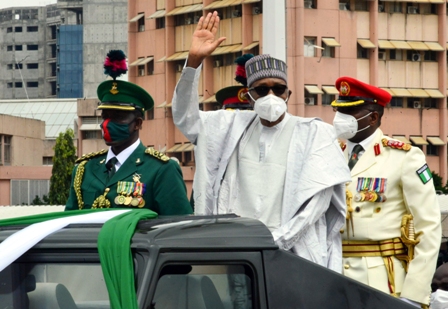
Full Speech: Independence Day Address By President Muhammadu Buhari
Fellow Nigerians
I speak to you today as your President and fellow citizen on this epoch occasion of our country’s 60th independence Anniversary. As President, I wish to renew my appreciation to Nigerians for entrusting me with your hopes and aspirations for a better and greater Nigeria.
Today, it is my unique privilege to re-commit myself to the service of this great country of great people with profound diversities and opportunities. We are bound by destiny to be the largest and greatest black nation on earth.
At this stage in our nationhood it is important that we reflect how we got here to enable us work TOGETHER to get to where we aspire to be as a strong indivisible nation, united in hope and equal in opportunity.
On October 1st, 1960, when Prime Minister Alhaji Abubakar Tafawa Balewa received the constitutional instruments symbolizing Nigeria’s independence, he expressed his wish that having acquired our rightful status as an independent sovereign nation, history would record that the building of our nation proceeded at the wisest pace.
This optimism was anchored on the peaceful planning, full and open consultation and harmonious cooperation with the different groups which culminated in Nigeria emerging as a country without bitterness and bloodshed.
Our founding fathers understood the imperative of structuring a National identity using the power of the state and worked towards unification of Nigerians in a politically stable and viable entity.
That philosophy guided the foundation that was laid for our young nation of 45 million people with an urban population of approximately 7million occupying an area of 910,768 square kilometers. These demographics led to development challenges for which major efforts were made to overcome.
Today, we grapple with multiple challenges with a population exceeding 200million occupying the same land mass but 52% residing in urban areas.
Sixty years of nationhood provides an opportunity to ask ourselves questions on the extent to which we have sustained the aspirations of our founding fathers. Where did we do the right things? Are we on course? If not where did we stray and how can we remedy and retrace our steps?
Upon attaining independence, Nigeria’s growth trajectory was anchored on policies and programmes that positively impacted on all sectors of the economy. However, this journey was cut short by the 30-months of civil war.
We came out of the civil war with a focus on reconstruction, rehabilitation and reconciliation that enabled the country to put in place world class development structures and a strengthened public service that well served the government. This positive trajectory continued with a return to democratic government which was truncated by another round of military rule.
For a cumulative 29 of our 60 years existence as a nation, we have been under military rule.
My summary of our journey so far as a nation is necessary to appropriately chart where we need to go and how to get there TOGETHER.
Today, I am aware that our economy along with every single economy in the world is in crisis. We still face security challenges in parts of the country, while our society suffers from a high loss of moral rectitude which is driven by unbridled craving for political control.
An underlying cause of most of the problems we have faced as a nation is our consistent harping on artificially contrived fault-lines that we have harboured and allowed unnecessarily to fester.
In addition, institutions such as civil service, police, the judiciary, the military all suffered from a general decline.
We need to begin a sincere process of national healing and this anniversary presents a genuine opportunity to eliminate old and outworn perceptions that are always put to test in the lie they always are.
The stereotype of thinking of ourselves as coming from one part of the country before seeing ourselves as Nigerians is a key starting point to project us on the road to our deserved nation’s evolution and integration.
To start this healing process, we are already blessed with the most important asset any nation requires for such – OUR PEOPLE – and this has manifested globally in the exploits of Nigerians in many fields.
It has been demonstrated time and time again that Nigerians in the diaspora frequently excel in science, technology, medicine, sports, arts and many other fields.
Similarly, the creativity, ingenuity and resourcefulness of the Nigerian at home have resulted in globally recognized endeavours.
I am convinced that if we pursue our aspirations TOGETHER we would be able to achieve whatever we desire. That informed our adopting the theme TOGETHER to mark this epochal event.
Together we can change our condition for the better and more importantly, together we can do much more for ourselves and for our country.
I chose the path of self-reflection because this is what I do on a daily basis and I must confess that at most times, I always felt the need for a collective reflection as I know that the foundation for a solid future which this administration is laying can only be sustainable if there is a collective commitment by Nigerians.
Nigeria is not a country for Mr. President, any ruling or opposition party but a country for all of us and we must play our part, irrespective of challenges we face, to make this country what we desire.
To achieve this, we must focus our minds, TOGETHER as a people, on ways of resolving the identified critical challenges that underlie our present state. These include:
a. Evolving and sustaining a democratic culture that leaves power in the hands of the people;
b. Supporting the enthronement of the rule of law, demanding accountability of elected representatives and contributing to good governance;
c. Increasing our commitment to peaceful co-existence in a peaceful, secure and united Nigeria;
d. Harnessing and Optimizing our tremendous human and natural resources to attain our goal of being in the top twenty economies of the world and in the process;
e. Lifting 100 million Nigerians out of poverty in 10 years;
f. Strengthening institutions to make them stronger in protecting National Interests; and
g. Imbibing tolerance in diversity.
I am a firm believer in transparent, free, fair and credible elections as has been demonstrated during my period as a democratically elected President.
The recent build-up and eventual outcome of the Edo State elections should encourage Nigerians that it is my commitment to bequeath to this country processes and procedures that would guarantee that the people’s votes count.
The problems with our electoral process are mainly human induced as desperate desire for power leads to desperate attempts to gain power and office.
Join our facebook group for further trending and breaking news.
?
https://www.facebook.com/groups/312196093158394/
Democracy, the world over and as I am pursuing in Nigeria, recognizes the power of the people. However, if some constituencies choose to bargain off their power, they should be prepared for denial of their rights.
This call is made more urgent if we realise that even after a transparent, free, fair and credible election, desperation leads to compromising the judiciary to upturn legitimate decisions of the people.
It is necessary to, therefore support the enthronement of the rule of law by avoiding actions which compromise the judiciary.
Fellow Nigerians, our history has shown that we are a people that have the capacity to live peacefully with one another.
As a government, we remain committed to our constitutional oath of securing the lives and properties of the citizenry. I, however, call on the citizenry to also support government by providing the necessary community level intelligence in addressing these challenges.
In moving forward together, it is important to strengthen our economy to provide sustainable means of livelihood for as many Nigerians as possible so as to eradicate absolute poverty from our midst.
I want to re-emphasize my dedication and commitment, a dedication and commitment that propelled my public service career and informed my quest to continually seek for an opportunity to improve the lives of Nigerians, set the country on the path of prosperity and lead the country to a better future.
This administration has been focused on rebuilding and laying the foundations for a sustainable Nigeria. Of course, we have met and are still meeting the challenges inherent in any rebuilding initiative – more so that of a nation like Nigeria that has undergone avoidable levels of deprivation – but can be surmounted if we all work together.
I wish to re-iterate that our people and our spirit of excellence remains our most important asset.
In this wise, the need to return to our age-old ethical and high moral values would be necessary and this informed my launching of the National Ethics and Integrity Policy on Monday 28th September, 2020.
The policy would not implement itself and the first contact of the visibility of its implementation is the Public Service whose on-going reforms would be expected to be sustainable and give a radical re-direction in providing services to all Nigerians.
Fellow Nigerians, in addition to public health challenges of working to contain the spread of the Coronavirus, we have suffered a significant drop in our foreign exchange earnings and internal revenues due to 40 per cent drop in oil prices and steep drop in economic activities, leading to a 60 per cent drop in government revenue.
Our government is grappling with the dual challenge of saving lives and livelihoods in face of drastically reduced resources.
In this regard, sustaining the level of petroleum prices is no longer possible. The government, since coming into office has recognized the economic argument for adjusting the price of petroleum. But the social argument about the knock-on effect of any adjustment weighed heavily with the government.
Accordingly, in the last three years, we have introduced unprecedented measures in support of the economy and to the weakest members of our society in the shape of:
a. Tradermoni
b. Farmermoni
c. School Feeding Programme
d. Job creation efforts
e. Agricultural intervention programmes
No government in the past did what we are doing with such scarce resources. We have managed to keep things going in spite of the disproportionate spending on security. Those in the previous Governments from 1999 – 2015 who presided over the near destruction of the country have now the impudence to attempt to criticize our efforts.
In the circumstances, a responsible government must face realities and take tough decisions.
Petroleum prices in Nigeria are to be adjusted. We sell now at N161 per litre. A comparison with our neighbours will illustrate the point;
a. Chad which is an oil producing country charges N362 per litre
b. Niger, also an oil producing country sells 1 litre at N346.
c. In Ghana, another oil producing country, petroleum pump price is N326 per litre.
Further afield, Egypt charges N211 per litre. Saudi Arabia charges N168 per litre. It makes no sense for oil to be cheaper in Nigeria than in Saudi Arabia.
Fellow Nigerians, to achieve the great country we desire, we need to solidify our strength, increase our commitment and encourage ourselves to do that which is right and proper even when no one is watching.
Fellow Nigerians, let us collectively resolve to continue our journey beyond the sixty years on the clear understanding that as a nation we are greater together than being smaller units of nationalities. By the special grace of God we shall come through any transient challenges.
It is my sincere hope that by the end of this anniversary on September 30th 2021, we will all be proud of taking this individual and collective self-assessment for the progress of our great Nation.
Long Live the Federal Republic of Nigeria.
God Bless us all. Thank you.



Governor of Rivers State, Sir Siminalayi Fubara, has reaffirmed the unwavering commitment of his administration to peace, unity, security, and inclusive development as Rivers State marked its 59th anniversary, last Wednesday.
In a goodwill message issued on Wednesday to commemorate the anniversary, Governor Fubara stated that despite the challenges faced over the years, the people of Rivers State have continued to demonstrate resilience, strength, and an enduring spirit of unity that has sustained the state since its creation.
The Governor noted that the strong bond of brotherhood among the various ethnic nationalities of the state, including the Ijaw, Ikwerre, Ogoni, Etche, Ekpeye, Andoni, Kalabari, and others, remains one of Rivers State’s greatest strengths and a critical foundation for peace, stability, and progress.
He further observed that Rivers State has remained a major driver of Nigeria’s economy for decades, not only because of its abundant oil and gas resources, but also because of the exceptional contributions of its people across diverse sectors including academia, jurisprudence, business, entertainment, public service, and sports.
Governor Fubara assured the people that his administration will continue to prioritize policies and programmes that promote peace, protect lives and property, and expand development across all parts of the state. He emphasized that governance must be people centered and impactful, with equal attention given to every Local Government Area of the state.
The Governor also paid tribute to the elders and founding leaders of the state for preserving the spirit of unity and coexistence over the years, while urging the youths to remain hopeful, responsible, and actively committed to building a greater Rivers State through innovation, hard work, and patriotism.
He equally acknowledged the invaluable role of women in strengthening families, communities, and society, describing them as indispensable partners in the continued growth and stability of the state.
Governor Fubara called on all Rivers people to use the occasion of the anniversary as a moment of reflection and renewed commitment to peaceful coexistence, mutual respect, dialogue, and collective progress, stressing that the unity and future of Rivers State must always rise above personal interests and political differences.
Rivers State was created on May 27, 1967, by General Yakubu Gowon.


The Rivers State Government has distributed science equipment and materials to all senior secondary schools across the state to support students during the ongoing West African Examinations Council exams and to strengthen practical learning.
Flagging off the distribution at the Rivers State Senior Secondary Schools Board premises in Port Harcourt, on Monday, the State Commissioner for Education, Dr. Peters Nwagor, said the move demonstrates Governor Siminalayi Fubara’s commitment to improving education standards in the State.
Nwagor said the materials were approved and provided by the state government specifically to boost the teaching and learning of science subjects, describing science education as the foundation for technological advancement, innovation, and national development.
“No society can compete globally without deliberate investment in science and technology,” the Commissioner stated.
He commended the governor for consistently prioritising the education sector by providing tools needed for effective teaching and hands-on learning.
The Commissioner directed principals to ensure that the equipment are used strictly for practical lessons in their schools, warning that any principal or administrator found diverting, hoarding, or selling the materials wil face disciplinary action under public service regulations.
Nwagor also warned against examination malpractice, saying any principal found aiding or encouraging malpractices will be decisively sanctioned.
“We must collectively restore the dignity and credibility of our educational system,” he said.
Also speaking, Chairman, Rivers State Senior Secondary Schools Board, Tony Egwurugwu, urged school heads to make judicious use of the materials for students’ benefit.
He thanked the State Government for providing the resources, and assured that monitoring mechanisms would be put in place to ensure the materials serve their intended purpose.
In his own remarks, a Board Member for Technical Education, Nwisabari Bani Samuel, expressed appreciation to the governor for prioritising education and acknowledged the Commissioner’s role in advancing education development in the State.
He said the distribution covers all senior secondary schools in the State and is intended to improve students’ performance in both internal and external science examinations.
Akujobi Amadi
-
News2 days ago
Obuah’s Victory Excites Former Lawmaker as APC Primaries Conclude in Rivers West
-

 Politics4 days ago
APC PRIMARIES: FUBARA’S WITHDRAWAL, HISTORIC SACRIFICE FOR NATIONAL STABILITY ……. GROUP
-

 News4 days ago
Court Sentences Seven To Death Over Murder Of Cleric In Rivers
-
News2 days ago
105 Nigerians Killed In S/Africa In Seven Years
-

 Sports4 days ago
PH Arsenal Community Set For Streets Procession, Saturday
-

 Niger Delta2 days ago
Royal Father Endorses PH Arsenal Community, Pledges To Support
-

 Politics4 days ago
IPAC Flays INEC Over Election Guidelines Judgement
-

 Politics4 days ago
NDC To Adopt Electronic Voting For Future Primaries