
Business
FG Refineries Post N406.62bn Loss In Two Years

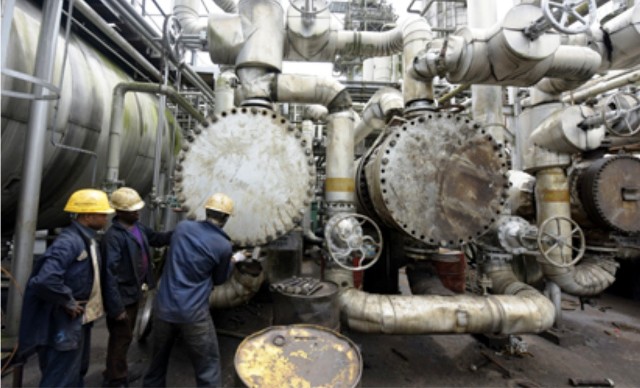
The four refineries owned by the Federal Government made a total loss of N406.62bn in two years, the latest audited financial statements of the plants have shown.
The refineries, which are located in Port Harcourt, Kaduna and Warri, have a combined installed capacity of 445,000 barrels per day but have continued to operate far below the installed capacity.
The country relies largely on importation for refined petroleum products as its refineries have remained in a state of disrepair for many years despite several reported repairs.
The Kaduna refinery recorded a loss of N64.34bn in 2018, down from N111.89bn in 2017, according to its financial statement.
Warri refinery posted a loss of N44.44bn in 2018, compared to N84.60bn in the previous year, while Port Harcourt lost N55.76bn in 2017 and N45.59bn in 2018.
The Group Managing Director, NNPC, Mallam Mele Kyari, said last week that the refineries were all idle.
At a summit organised by Seplat, he had said, “Today, unfortunately, all our four refineries are down.
“In Nigeria today, we are importing practically every petroleum product that we consume in this country.
“We are working to make sure that we are able to fix our refineries.”
In the first term of the President, Major General Muhammadu Buhari (retd), the NNPC had planned to rehabilitate the refineries to attain a minimum of 90 per cent capacity utilisation.
The plan was to use third-party financiers and the original refinery builders to provide the requisite funding and technical support.
However, after over one and a half years, negotiations with financiers were stalled in December 2018 due to varying positions on key commercial terms.
Kyari, who took over the NNPC leadership in July 2019, had reiterated his plan to revamp the refineries and end fuel importation by 2023.
The NNPC said in April that it had secured funding for the rehabilitation of the ailing refineries.
Kyari said the corporation was pursuing “a different model” for the refineries, including the type used by the Nigeria LNG Limited.
The NLNG is jointly owned by the Federal Government, represented by the NNPC (49 per cent), and three international oil companies, namely Shell (25.6 per cent), Total (15 per cent) and Eni (10.4 per cent).
Kyari said the corporation would no longer be involved in running the refineries after their rehabilitation.
He added that upon completion of the ongoing rehabilitation, the services of a company would be procured to manage the plants on an operations and maintenance basis.
The NNPC boss said last month that the issues around market structure had prevented private investors from building refineries in the country.
He said with the deregulation of the downstream petroleum sector, companies would be able to invest in the construction of refineries.
While 44 refinery licences have been given to private investors over the years, only a few projects, including the one being built by Dangote Industries Limited in Lagos, are underway.
There are a total of 38 proposed modular refineries with capacity ranging from 5,000 barrels per day to 30,000bpd, and six conventional plants with a total capacity of 1.35 million bpd, according to the Department of Petroleum Resources.
Aliko Dangote, Africa’s richest man, is building a refinery with a capacity of 650,000bpd, described as the world’s biggest single-train facility.


-

 Education5 days ago
Elga boss tasks law students on academics strides
-

 News2 days ago
Amend Constitution To Accommodate State Police, Tinubu Tells Senators
-
 Politics2 days ago
Senate Urges Tinubu To Sack CAC Boss
-

 News2 days ago
Disu Takes Over As New IGP …Declares Total War On Corruption, Impunity
-
Business2 days ago
President Tinubu Extends Raw Shea Nuts Export Ban To 2027
-
Business2 days ago
Crisis Response: EU-project Delivers New Vet. Clinic To Katsina Govt.
-
Business2 days ago
President Tinubu Approves Extension Ban On Raw Shea Nut Export
-

 Business2 days ago
PENGASSAN Rejects Presidential EO On Oil, Gas Revenue Remittance … Seeks PIA Review