
Sports
Why Nigeria Failed At WAFU Cup – Boboye

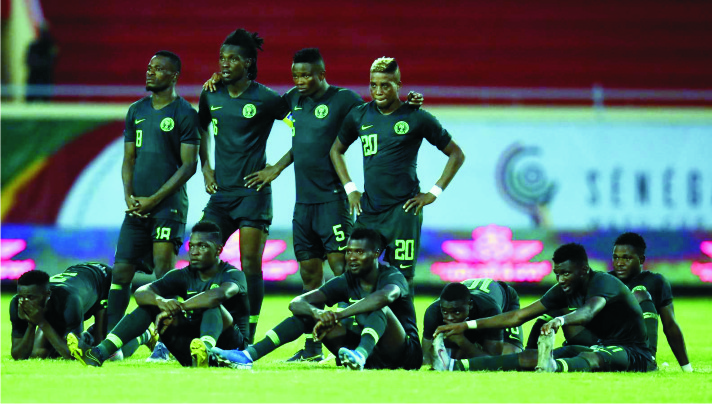
Nigeria’s assistant coach Kennedy Boboye is unimpressed by the team’s performance at the 2019 West Africa Football Union Cup of Nations and admitted it as a failure.
The Super Eagles did not win a game in Senegal before they were knocked out of the biennial competition after defeats to Togo and Cape Verde.
The early exit came as a disappointment for Nigeria who were finalists in the 2017 edition in Ghana.
Boboye described the country’s outing in Thies as awful and he cited various reasons for the underwhelming display.
“It was awful because we came here with the thinking of getting something in this tournament but it didn’t work out the way we planned,” Boboye told Tidesports source.
“I think it is a learning process for us to go back and re-strategise in many aspects of the department that we failed. For me, as far as I am concerned, I think we failed in this tournament.
“The reason we find ourselves in this position was because we did not take our chances in front of goal because we missed so many chances and we conceded some stupid goals that we are not supposed to, which cost us dearly.
“First thing is most of the players are making their first appearance in a big tournament like this. It is a different thing being in a club and being in the national team.
“You can not bring the club attitude to the national team. The tournament is once you are out, you are out it is unlike a league where you can still play the same opponent again. I think we did not take our chances and we were wasteful in front of goal”, he said.
A 2-1 loss to Togo in their opening fixture condemned Nigeria to the quarter-final of the plate competition.
However, they were stunned by Cape Verde who held them to a 1-1 draw at the end of regulation time and later came out victorious with a 3-2 win via penalty shoot-out.
He said: “Anybody that watched the game would know that Cape Verde were no match to the Nigeria team,” the former Sunshine Stars and Plateau United coach continued.
“We played better and we were in control of the game until that equaliser came in.
“Sometimes you lose grip, you cannot be on top of your feet for the whole of 90 or 120 minutes. Sometimes you make mistakes and when it happens, they punish you for it.”
Following the Super Eagles’ defeat to Togo on September 29, head coach Imama Amapakabo revealed the objective in Senegal was to build a team for the future.
The team is largely dominated by the Olympic Eagles who are preparing for the Africa U-23 Cup of Nations in Egypt next month and Boboye is optimistic they will fly the country’s flag high in years to come.
“We’ve got some quality players from this tournament that we think in the next three of four years, they will be better players in the national team. Sometimes, the biggest problem from where we come from is patience,” he said.
“We don’t have patience in building with one instant result. Most of the teams in this tournament have been together for quite some time. We just assembled these players in two or three months and where we come from, they still want magic. These players are like tomorrow’s players for the Super Eagles.”
The early exit might come as a blessing in disguise for Nigeria who now have time to prepare for the return fixture of their clash against Togo on October 18, after a 4-1 loss in Lome last month.
Boboye, a former Nigeria Professional Football League title-winning coach, revealed the tasks ahead of the team as they look to make fans happy again.
“We have two tasks ahead of us now. We lost to Togo in Lome and we have the return leg next week. That is a must-win game for us to take us back to CHAN,” he added.
“The second one is for us to go to Egypt for the U23 Afcon and make sure we qualify for the Olympic. Those are two big tasks for us and I don’t think we will have any distraction than to go back and prepare very well.”



The Nigerian, who arrived in China fresh from winning gold at the African Senior Athletics Championships in Ghana earlier on Wednesday, clocked a season’s best of 12.41s behind Olympic champion Masai Russell and Bahamian star Devynne Charlton.
Russell produced a dominant display to win the race in a meeting record and world-leading time of 12.25s, improving on her previous world lead of 12.40s.
Charlton, the reigning world indoor champion, finished second in 12.38s in one of her strongest outdoor performances to date.
Amusan, whose world record of 12.12s remains the fastest time ever run in the event, improved significantly from her previous season’s best of 12.84s set during her victorious outing at the African Championships in Accra.
The 29-year-old was competing in a stacked field that included reigning world champion Ditaji Kambundji of Switzerland, Jamaican pair Megan Simmonds and Ackera Nugent, China’s Wu Yanni and Americans Tonea Marshall and Danielle Williams.
Kambundji, who won the world title in Tokyo last year with a Swiss record 12.24s, finished fifth in 12.82s, while Jamaica’s Nugent placed sixth in 12.98s.
Marshall and Williams failed to finish the race.
Following Amusan’s victory in Accra, the three-time Diamond League final winner expressed gratitude to her supporters while insisting she remained determined to achieve more success this season.
“Beyond grateful to God, my team, supporters, and everyone who continues to believe in me through every season. Historic feeling. Still hungry for more. The mission continues,”

The 10-time African champions are scheduled to take on the Teranga Lionesses on June 5 and 8 at the Remo Stars Stadium in Ikenne, Ogun State, in what will form a key part of their build-up to July’s continental tournament.
The fixtures were confirmed on social media platform X by Super Falcons Show, which announced the details of the encounter and venue.
“Nigeria’s senior women’s national team, the Super Falcons, will take on Senegal Women’s National Team in a double-header international friendly scheduled for June 5 and 8,” the post read.
“Both matches will be played in Ikenne, Nigeria.”
The friendlies come after Nigeria’s proposed training tour of the United Kingdom, which included a planned match against Jamaica, was cancelled due to scheduling complications linked to FIFA’s official women’s international window. The timing meant clubs would not have been obliged to release players.
With that tour shelved, the Senegal fixtures now offer a timely opportunity for coach Justine Madugu and his technical team to assess squad options, test tactical systems and strengthen team cohesion ahead of the WAFCON campaign and longer-term qualification targets for the 2027 FIFA Women’s World Cup in Brazil.
Senegal are expected to provide a competitive regional test, with their physical style and disciplined organisation likely to offer Nigeria a different tactical challenge across both matches.
The Super Falcons, who have dominated African women’s football for decades, will be aiming to use the double-header to fine-tune preparations as they pursue another continental title in Morocco next year.

Dr Bojuwoye, a seasoned medical professional with extensive experience in road running events across Nigeria, is expected to bring added value to the race through his expertise.
As medical director, his responsibilities will include overseeing emergency medical response, coordinating first aid stations along the course, ensuring athlete safety, and supervising medical volunteers and paramedics.
His role is critical in safeguarding the health of both elite and recreational runners, as well as spectators.
In addition to unveiling its new medical director, the organisers also announced five corporate partners for the 2026 edition.
The Development Bank of Nigeria (DBN), Petralon Energy, Razzl Drink, Dan Oil, and Carloha Motors have joined as sponsors, reflecting the race’s growing appeal across diverse sectors of the Nigerian economy.
The Okpekpe race, organised by Pamodzi Sports Marketing Company, has steadily risen in prominence since becoming the first road race in Nigeria to earn World Athletics label status in 2015.
It has since advanced to Gold Label Race status, attracting elite athletes from around the world and cementing its reputation as one of Africa’s benchmark road-running competitions.
Edo State, under the leadership of Governor Monday Okpebolo, has reaffirmed its commitment to supporting the race, citing its role in promoting tourism, community pride, and international recognition for the region.
Race Director Zack Amodu noted that the new partnerships underscore the event’s stature and its impact beyond sport.
We are delighted to welcome DBN, Petralon, Razzl, and Carloha Motors as partners for the 11th edition. Their support, alongside the backing of Edo State, not only strengthens the race but also reinforces its role as a platform for promoting excellence, youth empowerment, and community development,’ Amodu said.
Beyond its sporting significance, the Okpekpe International 10km Road Race has become a catalyst for social, health, and economic benefits.
It encourages fitness and healthy lifestyles, fosters social cohesion by bringing communities together, and generates economic activity through tourism, hospitality, and local commerce.
The event also showcases Edo State’s cultural vibrancy while contributing to Nigeria’s growing reputation in global athletics.
The 11th edition is expected to draw elite athletes, local participants, and international attention, further consolidating Nigeria’s place on the global athletics calendar.
-

 Editorial1 day ago
Enough Of Xenophobic Attacks On Nigerians
-

 Nation1 day ago
RSU, Otonti Nduka Foundation Hold Centenary Conference, Unveil Book on Values in Nigeria
-

 Oil & Energy1 day ago
Rivers PETROAN Elects 12-Member Executive
-

 Environment1 day ago
MOSOP – Tinubu Not Sincere With Ogoni People For Oil Resumption
-
Politics1 day ago
APC Group Protests Ex–Presidential Aspirant’s Disqualification From Rivers Senatorial Race
-

 News1 day ago
Fubara, Wife Hail Tinubu’s Renewed Hope Initiative …As Over 6,800 Families Benefit From Largesse In Rivers
-
Politics1 day ago
Reps Speaker Secures APC Return Ticket For Fifth Term
-

 Maritime1 day ago
Products, Others, To Arrive Lagos Ports Today — MPA