
Featured
Military Operation Violates Nigerians’ Rights, Reps Tell Buhari

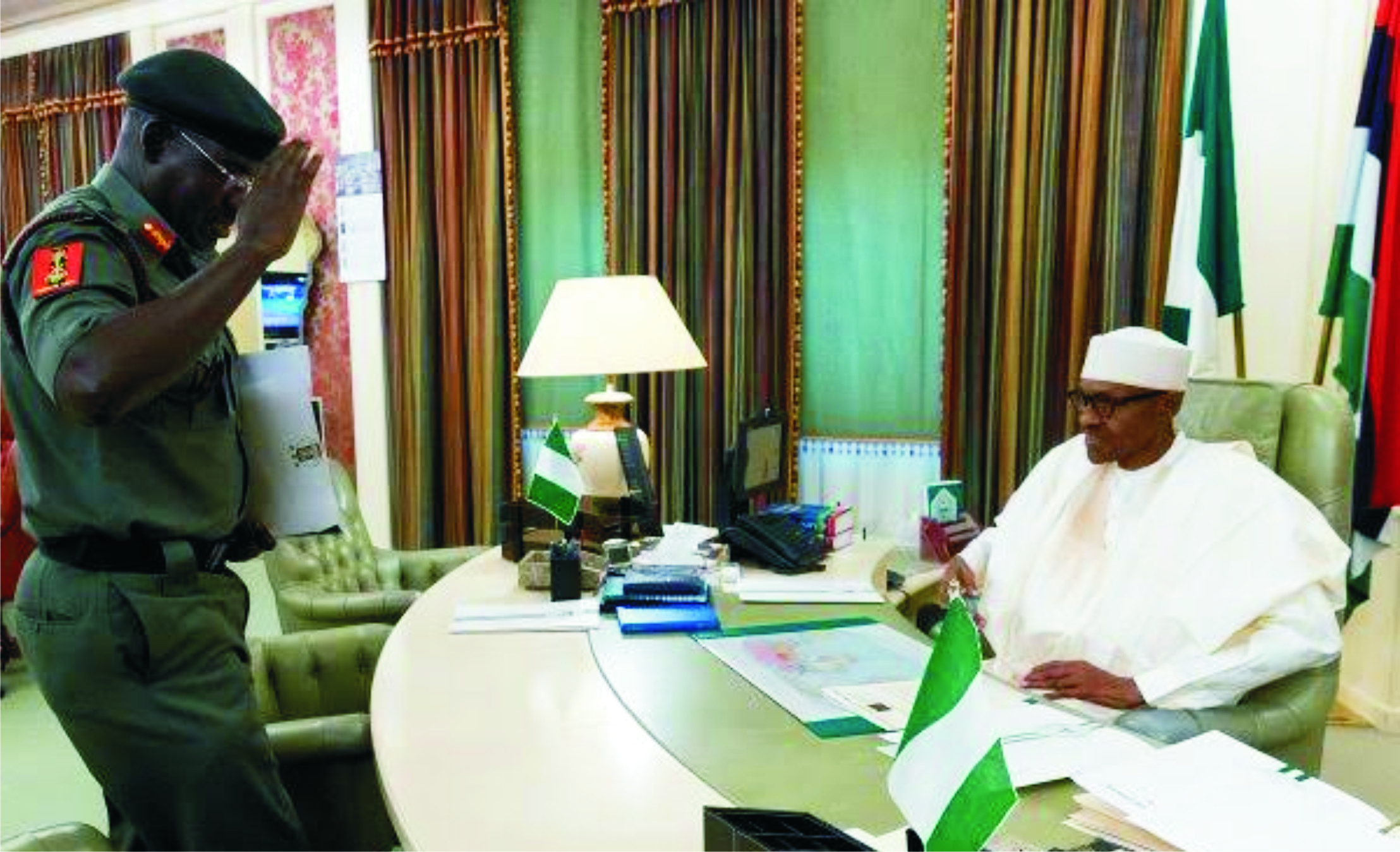
The House of Representatives, yesterday, called on President Muhammadu Buhari to stop the planned Operation Positive Identification by the military.
The decision followed a motion of Urgent Public Importance moved by the Minority Leader, Hon Ndudi Elumelu, at the plenary session presided over by the Speaker, Hon Femi Gbajabiamila.
OPI is an operation the military claims would allow Nigerians to provide documentary proof of identity to separate citizens from aliens and to checkmate bandits, kidnappers, armed robbers, ethnic militias and other criminal elements in the society.
Elumelu described the proposed operation as “infringement on the rights of Nigerians.
“It will be an indirect state of emergency if allowed to take place and the plan contravenes Section 217 sub 2(c, d) of the 1999 Constitution.
“The section reads: The Federation shall, subject to an Act of the National Assembly made in that behalf, equip and maintain the armed forces as may be considered adequate and effective for the purpose of — “(b) maintaining its territorial integrity and securing its borders from violation on land, sea, or air; (c) suppressing insurrection and acting in aid of civil authorities to restore order when called upon to do so by the President, but subject to such conditions as may be prescribed by an Act of the National Assembly; and (d) performance such other functions as may be prescribed by an Act of the National Assembly.”
Also, the Deputy Minority Leader, Hon Toby Okechukwu (PDP-Enugu) said the proposed plan was not within the mandate of the Army.
“It is not part of their mandate, we have the National Identity Management Commission and we have the security apparatus. Unfortunately, we have been under siege by Boko Haram.
“They are simply belaboring themselves with jobs that do not concern them. We have to interrogate this through the committee on Army.”
Also supporting the motion, Hon Ahmadu Jaha (APC-Borno) proposed that the Army commence “offensive attacks against Boko Haram and bandits in North-East and North-West.”
“From Abuja to Maiduguri is 14 hours under normal circumstances; if you ask for identification at every checkpoint, how many days will it take before passengers get to their destination?”
The House unanimously supported the motion.





Rivers State Governor, Sir Siminalayi Fubara, has charged the newly appointed Secretary to the State Government (SSG) and Chief of Staff (CoS) to carry out their duties with discipline, loyalty and a firm commitment to the success of the administration and the wellbeing of the people of Rivers State.
The governor warned that any involvement in unauthorised nocturnal meetings or any conduct capable of embarrassing the government will attract immediate dismissal.
Fubara gave the warning yesterday shortly after the newly appointed Secretary to the State Government (SSG), Dr Dagogo S.A. Wokoma and the new Chief of Staff (CoS), Barrister Sunny Ewule, were sworn in at the Executive Council Chambers of Government House, Port Harcourt.
As part of the ceremony, the Chief Registrar of the State High Court, David Ihua-Maduenyi administered the Oath of Allegiance and Oath of Office on the duo before the governor gave his charge.
Addressing the appointees, Fubara reminded them that their elevation to the new positions was a call to service and not a platform for political grandstanding or the pursuit of personal ambition.
He stressed that their foremost responsibility should be to themselves and to the people of Rivers State, stressing that their conduct must always reflect integrity, restraint and dedication to public good.
Speaking directly to Dr. Wokoma, whom he described as an accomplished academic and mathematician, the governor expressed confidence in his intellectual depth and capacity to deliver on the new assignment.
The office of the Secretary to the State Government, Fubara stressed, demands thoroughness, discipline and a deep sense of responsibility. He charged the SSG to represent the State with honour at all times.
“Your duty includes representing the state government. You need to represent us in a way and manner that will bring honour to us.
“What is important to this administration is to see that the good works that we started and the ones that we met, are concluded in a way that will bring progress and development to our dear state,” he stated.
Turning to the new Chief of Staff, the governor explained that he is expected to ensure smooth administrative coordination, managing official engagements effectively and safeguarding the image of the Government House.
He underscored the sensitive and personal nature of the role and emphasised that the position operates strictly under the authority of the governor.
Fubara stressed that the role does not permit independent political engagements or private strategy meetings without his knowledge and consent.
“Let me sound it here very clearly. Your duty is to make sure that you handle the administrative duties and image making roles perfectly well, liaising with whoever is coming for any official assignment here.
“If you involve yourself in nocturnal meetings and all those things, I will sack you. I’m very serious. What is important to me today is peace, progress and prosperity of this state. I’m not going to compromise anything for it,” he said.
The governor cautioned that involvement of the new appointees in any action capable of bringing the government or his office to disrepute would attract appropriate sanctions.
While congratulating the new appointees, Fubara expressed optimism that they would justify the confidence reposed in them.
He called on all public officials to work together in unity, observing that collective success is stronger and more enduring than individual achievement.
The governor who also addressed the Permanent Secretaries present at the ceremony, directed those of them who have reached retirement age to start preparing their handover notes without delay.
The notice, he said, was not intended to scare anybody but to prepare their minds towards the inevitability of exiting the service one day and to pave way for an orderly transition.
He warned against any attempt to engage in financial misconduct or last-minute irregularities, stressing that he was closely monitoring the system to ensure strict enforcement of accountability rules.

Rivers State Governor, Sir Siminialayi Fubara, has dissolved the State Executive Council.
The governor announced the cabinet dissolution yesterday in a statement titled ‘Government Special Announcement’, signed by his new Chief Press Secretary, Onwuka Nzeshi.
Governor Fubara directed all Commissioners and Special Advisers to hand over to the Permanent Secretaries or the most Senior officers in their Ministries with immediate effect.
He thanked the outgoing members of the State Executive Council for their service and wished them the best in their future endeavours.
The three-paragraph special announcement read, “His Excellency, Sir Siminalayi Fubara, GSSRS, Governor of Rivers State, has dissolved the State Executive Council.
“His Excellency, the Governor, has therefore directed all Commissioners and Special Advisers to hand over to the Permanent Secretaries or the most Senior officers in their Ministries with immediate effect.
“His Excellency further expresses his deepest appreciation to the outgoing members of the Executive Council wishing them the best in their future endeavours.”
The Independent National Electoral Commission (INEC) yesterday told the National Assembly that it requires N873.78bn to conduct the 2027 general elections, even as it seeks N171bn to fund its operations in the 2026 fiscal year.
INEC Chairman, Prof Joash Amupitan, made the disclosure while presenting the commission’s 2026 budget proposal and the projected cost for the 2027 general elections before the National Assembly Joint Committee on Electoral Matters in Abuja.
According to Amupitan, the N873.78bn election budget covers the full conduct of national polls in 2027.
An additional N171bn is needed to support INEC’s routine activities in 2026, including bye-elections and off-season elections, the commission stated.
The INEC boss said the proposed election budget does not include a fresh request from the National Youth Service Corps seeking increased allowances for corps members engaged as ad-hoc staff during elections.
He explained that, although the details of specific line items were not exhaustively presented, the almost N1tn election budget is structured across five major components.
“N379.75bn is for operational costs, N92.32bn for administrative costs, N209.21bn for technological costs, N154.91bn for election capital costs and N42.61bn for miscellaneous expenses,” Amupitan said.
The INEC chief noted that the budget was prepared “in line with Section 3(3) of the Electoral Act 2022, which mandates the Commission to prepare its election budget at least one year before the general election.”
On the 2026 fiscal year, Amupitan disclosed that the Ministry of Finance provided an envelope of N140bn, stressing, however, that “INEC is proposing a total expenditure of N171bn.”
The breakdown includes N109bn for personnel costs, N18.7bn for overheads, N42.63bn for election-related activities and N1.4bn for capital expenditure.
He argued that the envelope budgeting system is not suitable for the Commission’s operations, noting that INEC’s activities often require urgent and flexible funding.
Amupitan also identified the lack of a dedicated communications network as a major operational challenge, adding that if the commission develops its own network infrastructure, Nigerians would be in a better position to hold it accountable for any technical glitches.
Speaking at the session, Senator Adams Oshiomhole (APC, Edo North) said external agencies should not dictate the budgeting framework for INEC, given the unique and sensitive nature of its mandate.
He advocated that the envelope budgeting model should be set aside.
He urged the National Assembly to work with INEC’s financial proposal to avoid future instances of possible underfunding.
In the same vein, a member of the House of Representatives from Edo State, Billy Osawaru, called for INEC’s budget to be placed on first-line charge as provided in the Constitution, with funds released in full and on time to enable the Commission to plan early enough for the 2027 general election.
The Joint Committee approved a motion recommending the one-time release of the Commission’s annual budget.
The committee also said it would consider the NYSC’s request for about N32bn to increase allowances for corps members to N125,000 each when engaged for election duties.
The Chairman of the Senate Committee on INEC, Senator Simon Along, assured that the National Assembly would work closely with the Commission to ensure it receives the necessary support for the successful conduct of the 2027 general elections.
Similarly, the Chairman of the House Committee on Electoral Matters, Bayo Balogun, also pledged legislative support, warning INEC to be careful about promises it might be unable to keep.
He recalled that during the 2023 general election, INEC made strong assurances about uploading results to the INEC Result Viewing portal, creating the impression that results could be monitored in real time.
“iREV was not even in the Electoral Act; it was only in INEC regulations. So, be careful how you make promises,” Balogun warned.
The N873.78bn proposed by INEC for next year’s general election is a significant increase from the N313.4bn released to the Commission by the Federal Government for the conduct of the 2023 general election.
-
Maritime5 days ago
Nigeria To Pilot Regional Fishing Vessels Register In Gulf Of Guinea —Oyetola
-

 Sports5 days ago
Gombe-Gara Rejects Chelle $130,000 monthly salary
-
Maritime5 days ago
Customs Declares War Against Narcotics Baron At Idiroko Border
-

 Sports5 days ago
TEAM RIVERS SET TO WIN 4×400 ” MORROW” …Wins Triple jump Silver
-

 Sports5 days ago
NPFL Drops To 91st In Global League Rankings
-
Maritime5 days ago
NIMASA,NAF Boost Unmanned Aerial Surveillance For Maritime Security
-

 Sports5 days ago
NIGER DELTA GAMES PANACEA TO YOUTH DEV”
-

 Sports5 days ago
NPFL Impose Fines On Kwara United Over Fans Misconduct