
Featured
RSG Didn’t Demolish Any Mosque, Wike Insists …Assures Rivers Of Sustained Performance

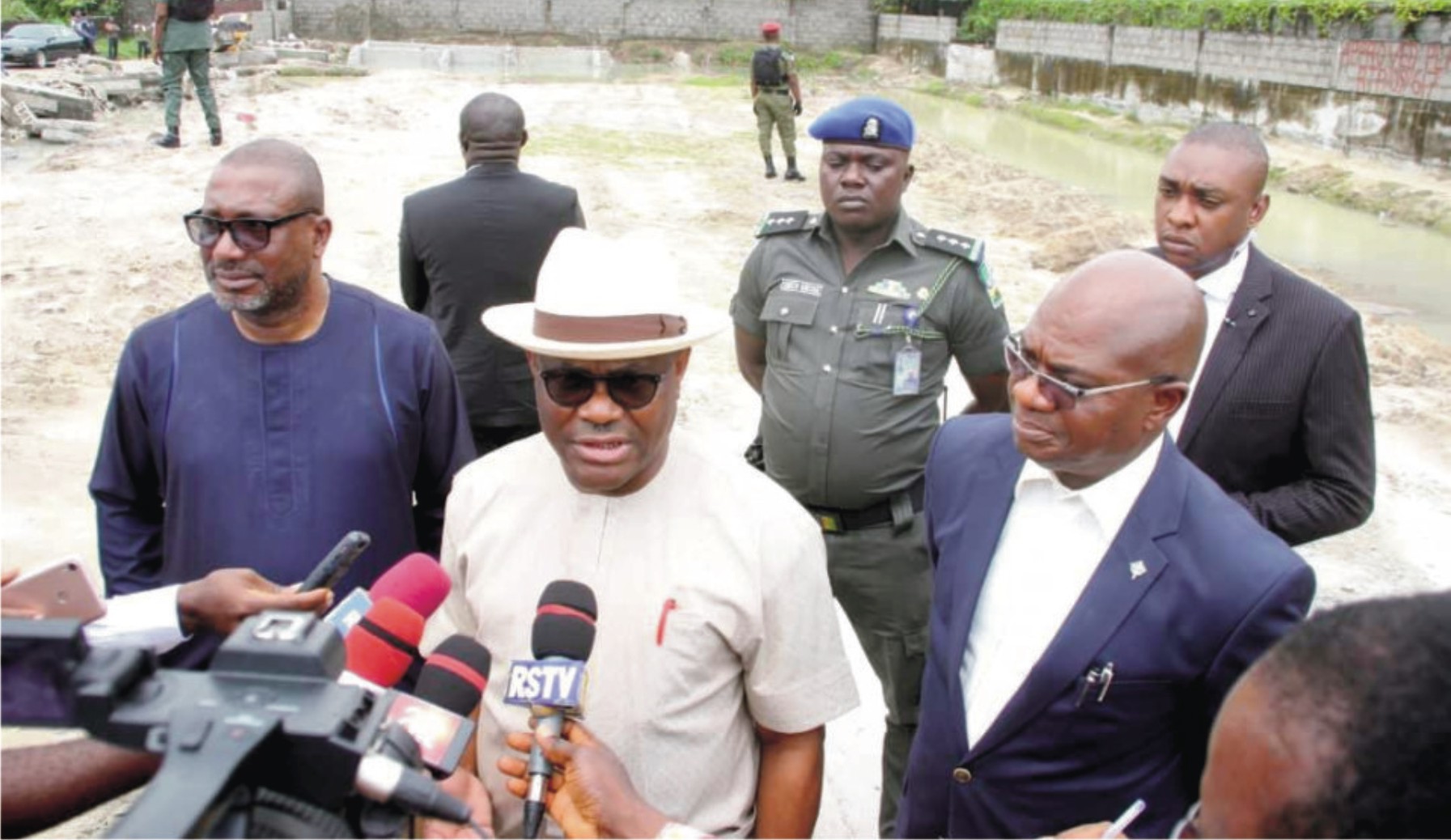
The Rivers State Governor, Chief Nyesom Wike has described as unfortunate the false information being circulated that the state government demolished a mosque in Port Harcourt, saying that the false report was planted by mischief makers to create disaffection.
Addressing journalists at the location on Biambo Street, Off, School Road by Mami Market Junction, near Rainbow Estate, last Monday, Wike said there was no mosque on ground, hence, nothing was demolished.
He said: “I received calls from several prominent Nigerians on the fake news being circulated online. I have come here with reporters and you can see there was no mosque here.
“It is most unfortunate that fickle-minded persons will claim that a mosque was demolished at this place, when no mosque existed here. The story was concocted by mischief makers to score cheap practical points”.
Wike explained that some persons started erecting illegal foundation at the disputed land, even though they had no approval to embark on any construction work.
“They came here to erect illegal structure. There was no approval from the state government for any structure to be erected here.
“The persons who started the foundation had already dragged the state government to court on the disputed land. The Rivers State Government won the case. What they attempted to do was to start the illegal construction to tie the hands of the state government”, he said.
The governor urged the Muslim community in Rivers State to show him where a mosque was demolished in the state, and advised them not to allow themselves to be used by politicians to peddle false stories against the Rivers State Government.
Wike said that the state government operates within the rule of law, adding that the state government would not be distracted by the illegal circulation of fake reports.
He stated that several mosques constructed on the approval of the state government exist across Port Harcourt and other major towns of Rivers State, without the state government demolishing them.
“The government gave them notice not to do anything on the land. But they went ahead with the illegal foundation and the relevant agency stopped them.
“Why would we want to bring down any mosque, when there are other Mosques across the state? What is the special interest on this one?, the government asked.
Earlier on Monday, the Islamic human rights organisation, the Muslim Rights Concern (MURIC) had alleged that the state government had demolished the Trans Amadi Central Mosque in Port Harcourt, Rivers State, penultimate Tuesday.
A statement signed by the Director, Muslim Rights Concern (MURIC), Prof Ishaq Akintola, last Monday, claimed that the allegation was based on information provided by some Muslim leaders in the state.
According to MURIC, the demolition is allegedly the most insidious attack on an Islamic landmark in that part of the country in recent times.
MURIC said, “This demolition exercise is illegal, unlawful and unconstitutional. It is an exhibition of gross, undiluted Islamophobia and the most odious and insidious attack on an Islamic landmark in that part of the country in recent times.
“Both the Chief Imam of Trans-Amadi Central Mosque, Alhaji Haroon Muhammed and the Secretary, Alhaji Aliyu Sadiq, have provided evidence proving that due process was followed in purchasing the land. Yet, the state government has been harassing the mosque management for years. The mosque has been demolished twice in the past.
“The Muslims had no option than to approach the court. Two cases were instituted at the state High Court. One was to restrain the government from taking over the land and the other was for compensation for the loss incurred by the Muslims for the damages done to their properties (the building that was demolished and the properties in the mosque damaged as a result of the demolition).
“The Muslims won both cases. The court judgement in favour of the Muslims was given on 2nd November, 2017. Though the government appealed against the second case which is about compensation for damages, and the case is still ongoing at the Appeal Court, it did not appeal the one restraining it from taking over the land. The Muslims of Rivers State are, therefore, the bona fide owners of that land.
“It proves beyond any reasonable doubt that the demolition of Tuesday, 20th August, 2019, was done in contempt of court. A mosque is demolished while there is a case on it at an appellate court.
“It is interesting to note that the Divisional Police Officer (DPO) of that area challenged the task force on the ground that he was not aware of any demolition order.
“They replied that the order was from the state Government House but they had to withdraw because they could not produce a written order when the DPO requested for it. This happened twice: 29th July and 16th August, 2019, before they eventually came for the demolition on 20th August, when they returned with more touts, fake mobile policemen and bulldozers.
“This demolition was executed without any formal notice despite the fact that the mosque has an approved building plan. The only thing that was heard was that the papers had not been revalidated whereas the mosque management made several moves to revalidate ownership. They even paid a visit to the permanent secretary to complain when officials in the Ministry of Lands and Housing refused to attend to them.
“This illegal demolition has deprived more than 10,000 worshippers of a place of worship. Members of the armed forces, oil company workers and other residents who are Muslims attend the mosque.
“Contrary to Section 10 of the 1999 Constitution of the Federal Republic of Nigeria which says, ‘The Government of the Federation or of a State shall not adopt any religion as State religion’ Wike has declared on three different occasions that Rivers State is a Christian State, and no one has deemed it fit to caution him, not the state assembly, nor the Senate.
“Paradoxically, Rivers State citizens are everywhere in the country, particularly in Muslim-controlled parts of Northern Nigeria as well as Muslim-majority parts of the South-West.
“To the Muslims of Rivers State, we send to you this strong message of solidarity. ‘Believers are all brothers’ (Qur’an 49:10 Inamal muminuun ikhwah). We assure you that you are not alone. We feel the heat as you pray under the burning sun. We share the cold and wetness when you pray in the rain. We charge Muslims in Rivers State to remain steadfast in faith and in resolution.
“We caution Muslims against taking the law into their hands. They must resolutely pursue the legal angle to a logical conclusion. We also advise that they continue to observe their weekly Jumu’ah service on the ruins of the multi-million naira mosque”, the MURIC statement added.
But dismissing the claims as misdirected, a Muslim residing in Port Harcourt, Musa Ahmed, said that the false alarm was a deliberate propaganda designed to tarnish the image of the Rivers State Government.
He said, “As a Muslim who stays in old Port Harcourt Township, I was very unhappy when I read in ‘The Nation’ newspaper that a mosque was allegedly demolished by the state government. I made enquiries from fellow Muslims throughout the weekend, and discovered it was a pure lie.
“Because of the story, I was at our mosque in a heavily populated area of Port Harcourt on Sunday and heard the true story,” Ahmed said.
According to him, “Some persons near Rainbow Estate in Port Harcourt were building an illegal structure. They were told to stop by the Ministry of Urban Development, but they were headstrong and continued.
“I have been in Port Harcourt for 10 years; nobody has harassed me as a Muslim. We have mosques built in different parts of the town and they have government approval. I usually pray at the mosque around Lagos Street in Port Harcourt and the other at Ikwerre Road. These are approved mosques,” he stressed.
Ahmed noted that, “There is another mosque near the newly constructed road at Oil Mill area. In fact, that mosque is by the roadside, yet, it was left untouched by the Ministry of Urban Development.
“I consider this falsehood by ‘The Nation’ newspaper and other politically-minded persons as distasteful.
“Muslims practice their religion without molestation in Rivers State. We thank Governor Nyesom Wike for always carrying Muslims along”, Ahmed added.
Meanwhile, the Rivers State Governor, Chief Nyesom Wike has stated that his administration was committed to making Rivers people happy through the continuous execution of pro-people projects.
Wike also announced that the Rivers State Government would employ additional 450 youths to strengthen the Task Force on Street Trading, Illegal Markets and Motor Parks in the bid to clean up Port Harcourt.
Speaking after inspecting projects that would be commissioned during his first 100 days for the second term, yesterday, Wike assured Rivers people that he would work diligently to surpass his first term achievements.
He said: “I believe that when we celebrate our first 100 days of our second term, the people will know that we are still working.
“I know that Rivers people will be happy at the end of the day. They will see that we have continued to deliver on our campaign promises”.
Wike expressed satisfaction with the quality of work at the Real Madrid Football Academy, adding that the academy would commence operations after it is commissioned as part of the 100 days celebration.
“The Real Madrid Football Academy will help us groom our children who would want to take Football as their career. Today, our kids who won the Channels Kids Cup are heading to Spain. When they return, they will be the first set to be admitted into the academy.
“As part of our first 100 days in office, we will commission the Real Madrid Football Academy and the school will start operations. The standard of the facility is appreciated”, he said.
At the Government Craft Development Centre in Port Harcourt, the governor said that the reconstruction work will re-position the institution.
He said that the quality of work done at the Government Craft Development Centre shows that indigenous contractors also have the capacity to deliver in line with approved specifications.
On the operations of the task force, the governor said the first two days have shown that the task force would be successful in carrying out its legal responsibilities.
“With what we have seen, it means they will do well. We will employ additional 450 youths to be involved in the total operation to clean Port Harcourt. We will not tolerate street trading again.
“Why we have not started arrests and prosecution is to let people know that we are a friendly government. But at the end of the week, we will start arrests and prosecution of offenders. But for now, we are saying, stop that illegal trading and they seem to be complying”, he said.
He said that the focus will not only be on street traders, but those who use umbrellas and people who sell corns will not be allowed to operate.

Featured
JUNE 12: Democracy Remains Nigeria’s Strongest Path To Unity, Progress, Says Fubara ….Extols Abiola, Wife


Governor of Rivers State, Sir Siminalayi Fubara, has reaffirmed that democracy remains the most effective system of government for Nigeria, given the country’s rich diversity of ethnic, religious, and cultural identities.
In a goodwill message to Nigerians on the occasion of the 2026 Democracy Day celebration, Governor Fubara said June 12 represents far more than a historic date; as it embodies the enduring struggle, sacrifice, and collective aspiration of Nigerians for freedom, justice, and representative governance.
The Governor extended warm felicitations to Nigerians at home and in the Diaspora, paying tribute to the heroes and heroines of the democratic struggle, particularly Chief MKO Abiola, his wife, Kudirat Abiola, and countless others whose courage and sacrifices helped secure the democratic freedoms Nigerians enjoy today.
According to him, “June 12 is a reminder of the price paid for the democracy we enjoy today. The sacrifices made by Chief MKO Abiola, Kudirat Abiola, and many other patriots who laid the foundation for the democratic journey we continue to enjoy today. Their commitment to the principle that power must ultimately reside with the people remains a source of inspiration for every generation of Nigerians.”
Governor Fubara noted that thirty-three years after the historic June 12, 1993 election, Nigeria’s democratic experiment has continued to evolve despite challenges and setbacks.
“Our democratic journey has not been without difficulties, but the resilience of our institutions and the determination of our people have kept the nation moving forward. The ability to express differing opinions, engage in constructive debate, and peacefully choose leaders through the ballot remains one of the greatest achievements of our nation,” he said.
Governor Fubara stressed that democracy provides the best framework for managing Nigeria’s diversity and transforming it into a source of national strength.
“Nigeria’s diversity should never be seen as a weakness. Properly harnessed, it is our greatest asset. Democracy offers us the opportunity to build consensus, promote inclusion, strengthen national unity, and create the conditions for sustainable development and shared prosperity,” he said.
Governor Fubara commended President Bola Ahmed Tinubu, for his commitment to the Renewed Hope Agenda and ongoing efforts aimed at economic revitalization, strengthening security, and deepening democratic institutions across the country.
He reiterated the readiness of Rivers State to continue partnering with the Federal Government in advancing policies and programmes that improve the lives of citizens through infrastructure development, job creation, enhanced security, quality education, healthcare delivery, and good governance.
The Governor further called on Nigerians, regardless of political affiliation, ethnic background, or religious belief, to use the occasion of Democracy Day to renew their commitment to the Nigerian project and the ideals that underpin democratic governance.
“Democracy must not be viewed merely as a periodic electoral exercise. It must be reflected in our daily commitment to accountability, transparency, tolerance, justice, respect for the rule of law, and responsible leadership. As citizens and leaders, we all share a collective responsibility to strengthen our democracy and build a nation that future generations will be proud to inherit,” he said.
Governor Fubara expressed optimism about Nigeria’s future, urging citizens to remain united, hopeful, and committed to the values of peace, dialogue, and national development.
“Together, we can build a stronger, more inclusive, and more prosperous Nigeria where every citizen has the opportunity to thrive and contribute meaningfully to national progress,” he said.

Governor of Rivers State, Sir Siminalayi Fubara, has reaffirmed the unwavering commitment of his administration to peace, unity, security, and inclusive development as Rivers State marked its 59th anniversary, last Wednesday.
In a goodwill message issued on Wednesday to commemorate the anniversary, Governor Fubara stated that despite the challenges faced over the years, the people of Rivers State have continued to demonstrate resilience, strength, and an enduring spirit of unity that has sustained the state since its creation.
The Governor noted that the strong bond of brotherhood among the various ethnic nationalities of the state, including the Ijaw, Ikwerre, Ogoni, Etche, Ekpeye, Andoni, Kalabari, and others, remains one of Rivers State’s greatest strengths and a critical foundation for peace, stability, and progress.
He further observed that Rivers State has remained a major driver of Nigeria’s economy for decades, not only because of its abundant oil and gas resources, but also because of the exceptional contributions of its people across diverse sectors including academia, jurisprudence, business, entertainment, public service, and sports.
Governor Fubara assured the people that his administration will continue to prioritize policies and programmes that promote peace, protect lives and property, and expand development across all parts of the state. He emphasized that governance must be people centered and impactful, with equal attention given to every Local Government Area of the state.
The Governor also paid tribute to the elders and founding leaders of the state for preserving the spirit of unity and coexistence over the years, while urging the youths to remain hopeful, responsible, and actively committed to building a greater Rivers State through innovation, hard work, and patriotism.
He equally acknowledged the invaluable role of women in strengthening families, communities, and society, describing them as indispensable partners in the continued growth and stability of the state.
Governor Fubara called on all Rivers people to use the occasion of the anniversary as a moment of reflection and renewed commitment to peaceful coexistence, mutual respect, dialogue, and collective progress, stressing that the unity and future of Rivers State must always rise above personal interests and political differences.
Rivers State was created on May 27, 1967, by General Yakubu Gowon.

-

 Niger Delta24 hours ago
Warri Airport Manager Disputes Air Peace Bird Strike Claim
-

 News1 day ago
Nigeria Won’t Surrender Any Territory To Criminals -Tinubu
-

 News1 day ago
FG Begins Trial Of Over 600 Terrorism Suspects
-

 Rivers24 hours ago
79th IAUE Inaugural Lecture: Prof Anero Advoctes Tuition-Free Education For Children
-

 Politics23 hours ago
Parties’ Deregistration: How Justice Lifu Overruled Appeal Court Justices
-

 Politics23 hours ago
ADC: Okonkwo Rejects Amaechi As Presidential Running Mate, Withdraws Support
-
Politics24 hours ago
2027: Rivers PFN To Mobilise 600,000 Votes
-

 Politics23 hours ago
2027: Tinubu’s Projects Give APC Edge In South East – Yilwatda