
Politics
NEW Rivers: The Beginning Of A Historic Revival

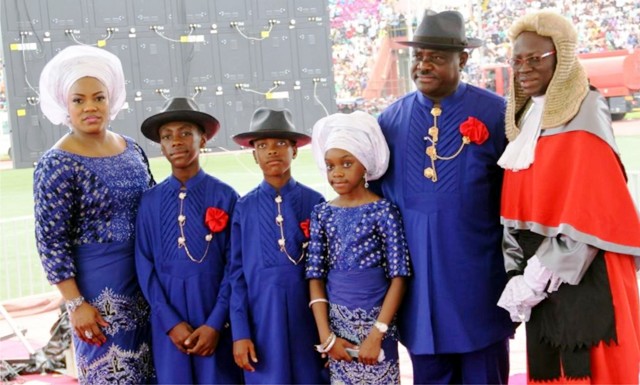
From whatever angle you view the Rivers story, you will eventually come to the conclusion that Rivers State is on the right path, craved by the people when they first opted for Nyesom Ezenwo Wike, as their Governor in 2015.
As a reporter/observer who has witnessed this life-changing relationship between Governor Wike and Rivers people, I will take the next few weeks to discuss key aspects of this phenomenal drive to re-position Rivers State.
It is necessary to start this narration from the beginning. Governor Wike was drafted into the leadership race by Rivers people in response to the worst political and economic treachery against the people by the immediate past APC Administration in the state.
Rivers people co-opted Governor Wike to place a derailed state back on track. Between 2013 and 2015, the failed then outgoing administration had weakened the foundations of governance, destroyed the fabric of brotherhood and sold the soul of Rivers State to external political marauders . Rivers people needed a political tactician and warrior to save the state from total political slavery and economic damnation.
Therefore, the preference of Wike ahead of 16 other Governorship Aspirants was for the reason of rebuilding and re-positioning Rivers State from the ashes of failure imposed on the state by the immediate past APC Administration. From the 23 Local Government Areas of Rivers State, leaders opted to elect Governor Wike and entrench the PDP in the state. They fought against the huge financial war-chest of the immediate past APC Administration.
On December 8, 2014, PDP Delegates from all the 23 Local Government Areas of Rivers State unanimously voted for Barrister Nyesom Ezenwo Wike as the party’s governorship candidate for the 2015 election in the state. On April 11, 2015, the good people of Rivers State overwhelmingly voted for Nyesom Ezenwo Wike as their governor. He polled 1,029,102 votes.
This was fundamentally the people’s project. It has always been driven by the people. That is why the entire structure is impregnable from within and without. True, some political engineering has been deployed, but the strength of Rivers people is deep and solid. It cannot be swept away easily.
Once the Rivers decide to flow, no quantum of machinations, no matter how well crafted can stop the flow. In the beginning, Rivers people set on a mission in one voice and they have remained undefeated ever since.
In the decision to create a new Rivers State, people came from the 23 Local Government Areas. They defied the riverine and upland divide and placed Rivers ahead of other reasons. They refused to hand their destiny into the hands of a treacherous few. Collectively, Rivers people became their own godfather. They handed over the state to God on the platform that: “the voice of the people is the voice of God “.
Despite the overwhelming victory in 2015, officials of the defeated APC moved from court to court shopping for illegal injunctions to stop the oath taking ceremony. Where ever they went, the hand of God frustrated Governor Wike’s first duty after taking over the reins of governance on May 29, 2019 was to restore the institutions of governance and democracy destroyed by the immediate past APC Administration. This is one of the most vital actions taken to kick-start the process of development in Rivers State.
Governor Wike re-opened the courts and appointed an Acting Chief Judge and Acting President of the State Custumary Court of Appeal. The Judiciary which was castrated by the past administration was revived. The Rivers State House of Assembly which relocated to the Government House, Port Harcourt under the previous administration was duly proclaimed and given the rightful autonomy to carry out its legislative functions.
According to the Former Rivers State Governor, Chibuike Rotimi Amaechi, the State had collapsed irretrievably at the time Governor Wike was handed the mandate by Rivers people.
Amaechi said, ‘’ I’m not joking, we have no money anywhere. In Rivers State, no money. I think Nyesom Wike is coming, we are waiting. He will look for money for salary; there is none. So, he will have to manage. But when he pays out salary, we will see whether they can build the schools, the roads, even to get a loan”.
Governor Wike inherited four months of unpaid salaries and three months of unpaid pensions. Governor Wike cleared these salary and pension arrears. The weakened economy was duly reflated, with mass economic activities set in motion.
Ever since, the Rivers economy has been on the ascendancy. It is a given that workers and pension welfare take precedence over other considerations .
Steps were taken to revive the state’s security architecture which was destabilised by the failure of the immediate past APC Administration to fund monthly financial obligations for security operations. With this, Governor Wike rebuilt the security infrastructure of Rivers State.
After reviving the state, Governor Wike set out to implement the New Rivers Development Blueprint. His careful implementation of this programme has seen Rivers State emerge as the country’s headquarters of projects and progress.
The Wike administration ended the misery of Rivers people and set the people on the path of development.
He has used Rivers mandate to create an atmosphere of hope where the people genuinely yearn for more. In every community, Rivers people have keyed into the season of stability, prosperity , new vision, new thinking, and better possibilities.
Governor Wike has planted the process of purposeful and rewarding leadership propelled by a dynamic team.
He has delivered on the social contract he entered with Rivers people in 2015. The people have renewed his mandate because they want him to Consolidate on the gains of his first term. We shall provide details of his outstanding accomplishments in his first term .
Nwakaudu is Special Assistant to Rivers State Governor on Electronic Media.
Simeon Nwakaudu


Rt Hon. Abbas secured the party’s ticket through an affirmation exercise conducted across the 13 electoral wards in the constituency.
The wards involved include Kwarbai A, Kwarbai B, Limancin-Kona, Unguwar Fatika, Unguwar Juma, Dutsen Abba, Gyallesu, Kufena, Dambo, Wuchichiri, Tudun Wada, Tukur-Tukur, and Kaura.
The exercise, which began simultaneously in all wards at about 10 a.m., recorded large turnout of APC members who gathered at various party offices across the constituency.
At Kwarbai B Ward, the Speaker’s ward, the process was conducted peacefully under the supervision of the ward APC Returning Officer, Malam Iliyasu Muhammad Balarabe, in the presence of Rt Hon. Abbas.
According to the ward APC secretary, Nafiu Sabo, the ward has over 10,000 registered members, but 220 members were accredited for the exercise.
Before the affirmation, Mallam Balarabe informed members that Rt Hon Abbas was the only aspirant who purchased nomination forms, underwent screening, and was cleared by the APC national leadership to contest the Zaria Federal Constituency seat.
Following a voice vote by accredited members, the Speaker was affirmed as the party’s candidate in the ward, a process replicated across the remaining 12 wards.
At the constituency collation centre, the APC Returning Officer for the House of Representatives primary in Zaria Federal Constituency, Dr. Hamisu Ibrahim Kubau, announced that 1,376 APC members across the 13 wards endorsed Rt Hon. Abbas as the party’s flag bearer.
He explained that although thousands of party members participated in the exercise, only accredited delegates were allowed to vote.
Dr. Kubau declared: “There are 13 wards in Zaria Federal Constituency, and only one aspirant purchased a form, was screened, and cleared. He is Rt. Hon. Abbas Tajudeen. After due process, we conducted affirmations across all wards.”
He added that the process was peaceful and monitored by officials of the Independent National Electoral Commission (INEC) and party representatives.
Chairman of the APC House of Representatives Primary Elections in Kaduna State, Senator Yakubu Oseni, described the outcome as a reflection of the Speaker’s popularity and acceptance among constituents.
He expressed confidence that Rt Hon Abbas would secure victory in the 2027 general elections.
Speaking after his declaration, Rt Hon. Abbas expressed appreciation to APC members for reaffirming their confidence in him.
The incumbent Reps including Emily Inyang and Godwin Offionio, in separate interviews
protested the handling of the primaries conducted by the leadership of the party in the state, saying it was skewed against them.
The aspirants further described the primaries as a charade and an embarrassment to the state.
According to them, the House of Representatives primaries fell short of the provisions of both the Electoral Act as amended in 2026 and the party’s constitution.
They accused the leadership of the party in the state, backed by Governor Bassey Otu, of violating the party’s constitution in the conduct of the House of Representatives primaries across the state on Saturday.
Hon. Godwin Offiono, representing Ogoja/Yala Federal Constituency, particularly expressed disappointment with the primary that allegedly disenfranchised registered members of the party in his constituency.
Hon. Offiono asserted that having failed to arrive at a consensus, the party leadership opted for a direct primary to decide the candidate for the 2027 election.
“But what I witnessed today was not only alarming, but quite disheartening that our electoral system have not shown any improvement, especially now that we have a man of God in the person of the governor as the leader of the party.
“How do you declare a result by 9:00am even when the electoral materials were yet to arrive at Yala.
“As an aspirant, I couldn’t even vote or see the materials for my own primary at my Okuku ward in Yala Local Government Area, where I come from. But no matter what happens I am still in the race and have not stepped down for anybody.
“The governor had all the time in the world to drive the process of consensus but he never did. As a representative, I cannot even see my governor. I called, no response. I sent text no reply. I am treated as an out cast,” he lamented.
In an emotion laden tone during a telephone interview, Hon. Offiono further said: “I could not believe that first term NASS members like me can be treated in this shoddy manner even when I don’t know my offence.
“I have been a loyal party man. I appeal to the governor to do the right thing, follow the Electoral Act and party constitution in electing representatives.”
Similarly, Hon. Emil Inyang of Akamkpa/Biase Federal Constituency said he still remained in the race and had not stepped down for anybody.
According to him, “If this shenanigan called primary is allowed to stand, it would affect the party’s fortune in the general elections.
“My appeal to the governor is to allow the people to decide. And if they so voted against me, I will rest and not fight over anything.
“There was no stakeholders meeting held to decide on anything before now, and someone can not be unilaterally imposed on us all in the name of compromised primary,” he stated.
A coalition of support groups within the All Progressives Congress (APC) has protested the disqualification of former presidential aspirant, Mr Tein Jack-Rich, from the Rivers West Senatorial race ahead of the party’s primaries for the 2027 general elections.
The groups, in a statement issued on Saturday morning in Abuja, described the action of the party’s screening committee as unjust and capable of worsening internal divisions within the APC in Rivers State.
The statement, signed by the coalition’s National Coordinator, Dr. Bilal Galadima, and General Secretary, Hon. James Ogenyi, accused the party leadership in Rivers State of favouring politicians loyal to the Minister of the Federal Capital Territory, Chief Nyesom Wike, while sidelining long-standing members of the APC.
The coalition alleged that only aspirants aligned with Chief Wike were cleared to contest for elective positions in the state.
“How can our party allow only one man who is not a member of our party to make decisions or dictate the direction of our party?”, the group queried.
The coalition specifically faulted the exclusion of Mr Jack-Rich, describing him as a loyal party member who had supported the APC for more than 13 years and previously contested the party’s presidential ticket.
It also questioned the alleged clearance of Chief Felix Obua, whom it described as a recent entrant into the party and an ally of Chief Wike.
“How can our party disqualify Jack-Rich, a former presidential aspirant who has been loyal and supported our party for the last 13 years, only for our party to choose Felix Obua, a Wike loyalist who only joined the party three months ago?”, the statement read.
The group warned that failure by the APC leadership and National Working Committee (NWC) to address the matter as it could weaken the party’s structure in Rivers State ahead of the 2027 elections.
It called on party leaders to uphold internal democracy, reward loyalty and ensure a level playing field for all aspirants.
INEC TO BEGIN MEMBERSHIP VERIFICATION AS POLITICAL PARTIES SUBMIT REGISTER
All 22 registered political parties have successfully submitted their membership registers to the Independent National Electoral Commission (INEC) in compliance with the Electoral Act 2026, the Commission has said.
In a statement issued on Friday, Chairman, Information and Voter Education Committee, Mr Mohammed Haruna, said the submission followed the extension granted by the Commission after political parties raised concerns during a meeting on Tuesday, March 24, 2026, regarding the timeline provided in the Revised Timetable and Schedule of Activities for the 2027 general elections.
He said, “The Commission is pleased to note that all registered parties submitted their registers as of 8th May 2026, two days before the extended deadline.”
He recalled that following a meeting with political parties, the Commission, in a statement issued on the 27th of March, 2026, adjusted the deadline for the submission of party registers from 21st April 2026 to 10th May 2026 to align with the provisions of Section 77(4) of the Electoral Act 2026 and the actual dates fixed by political parties for their primaries.
Mr Haruna noted that political parties were accordingly allowed to conduct their primaries within the approved period from 23rd April 2026 to 30th May 2026, while the register of party members was required to be submitted to the Commission not later than 21 days before the conduct of their respective primaries.
He added, “INEC wishes to state that all registered political parties complied with the requirement within the extended timeframe and will subject the submitted registers to the necessary verification processes in line with the law.”
The Commission restated its commitment to the conduct of free, fair, credible and inclusive elections.