
Politics
Reps Okay Bill To Plug Revenue Leakages In Oil Sector

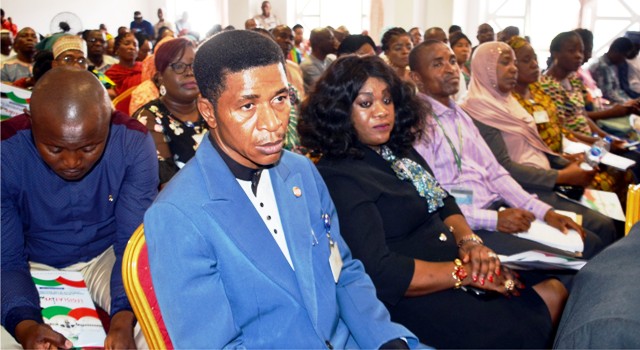
The House of Representatives, last Wednesday, passed a bill seeking to help plug leakages in government’s streams of income in the oil sector for second reading.
This followed a motion by the Deputy Majority Leader, Ahmed Wase, at plenary, presided over by Speaker Yakubu Dogara in Abuja.
Moving the motion, Wase (APC-Plateau) noted that as a result of lack of amendment of the Act, government has lost 21 billion dollars since 2008 when its review was due.
“Government loses about 8 million dollars daily as a result of lack of review,” he said.
According to him, a Bill for an Act to amend the Deep Offshore and Inland Basin Production Sharing Contracts Act, 1999, will help to provide more efficient methods of computing accruable revenue of government.
“It will improve the revenue of the government of the federation.
“Such additional revenue can adequately fund part of our budget deficit, boost the economy and improve living conditions of Nigerians.
“It will improve the petroleum industry governance,” he said.
According to the lawmaker, the bill seeks to effect an amendment in the Principal Act (Deep Offshore and Inland Basin Production Sharing Contracts Act, 1999) in order to plug leakages in government revenue streams and ensure the Federal Government maximises sufficient royalties from Production Sharing Contracts (PSC) between NNPC and International Oil Companies (IOCs).
“PSC was widely introduced in 1993 to address some of the issues faced by the Joint Operating Agreement (JOA) between the NNPC and IOCs and also to provide a suitable agreement structure for encouraging foreign investment in offshore acreage.
“Under these arrangements, the NNPC is the holder of the concession while the IOC is the contractor.
“In 1993, the NNPC entered into PSCs with eight IOCs and Nigeria is believed to have attracted much needed additional foreign investment as a result.
“These new PSCs attracted IOCs due to their favourable fiscal and legal regimes, as IOCs were given a higher profit share for the more marginal and high risk projects off shore,” he explained.
Wase said in 2000, eight new deep water licenses were offered, of which the terms of the PSC were considered to be tougher for IOCs.
He said the reduced risks involved in finding larger deep water reserves was the main reason for tougher profit oil splits in the 2000 PSC terms.
“In 2005, 14 deep water licenses were offered, of which certain alterations were again made to the PSC model contract,” he said.
He said Sections 16 of the Principal Act was amended by adding a new subsection (3) immediately after subsection (2) of the Principal Act.
Wase pointed out that: “Section 16 (3) In accordance with the provisions of subsection (1) stipulated that a royalty rate by price of 50 per cent should be for the additional revenue in the contract area of the Production Sharing Contracts under this Act.
“And the additional revenue shall be determined by the product of the volume of crude oil or condensate sold and the difference between the actual nominal sales price of the oil or condensate and the nominal value of $20 per barrel, (1993 real terms), at the time of sales, provided that the value of $20 per barrel (1993 real terms) shall be determined based on relevant US All Items Consumer Price Index (CPI) as published by the US Bureau of Labour Statistics,” he said.
He said the amendment was imperative to improving government’s revenue for the overall interest of the people.
“I therefore urge this Honorable House to consider it for passage,” he enjoined.
After a debate on the motion, the speaker, put it on a voice vote and the lawmakers unanimously supported it.
He then referred the bill to the House Committee on Petroleum Upstream for further legislative action.



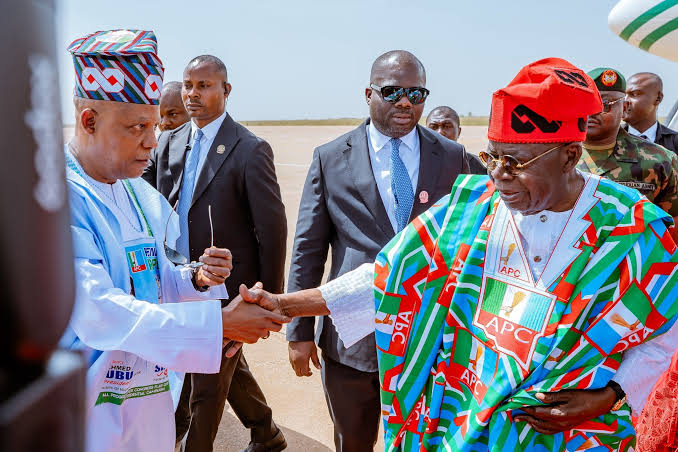
The campaign rally, held at the Kaduna Township Stadium, attracted Vice-President Kashim Shettima, APC governors, party leaders, federal and state lawmakers, political stakeholders and supporters from across the country.
The flag-off marks the beginning of the APC’s drive to secure a second presidential term for President Tinubu, with the party expected to promote its achievements, defend its economic reforms and outline its policy priorities under the proposed Renewed Hope 2.0 agenda.
Kaduna’s selection for the campaign launch underscores the strategic importance of the North-West, a region with a substantial voting population and considerable influence on presidential election outcomes.
The APC faces a significant challenge in Kaduna, where the Peoples Democratic Party’s presidential candidate, Alhaji Atiku Abubakar, defeated President Tinubu in the 2023 election. The rally therefore provides the ruling party an opportunity to strengthen its grassroots structures and regain electoral support in the state.
Addressing supporters, Vice-President Shettima appealed to Northern voters, highlighting President Tinubu’s political relationships with prominent Northern leaders, including Alhaji Abubakar, Mallam Nuhu Ribadu and the late President Muhammadu Buhari.
The Vice-President’s appeal reflects the APC’s determination to consolidate its support in the North as the party intensifies preparations for the presidential contest.
The Renewed Hope 2.0 agenda is expected to feature prominently in the campaign, providing a platform for President Tinubu to explain his administration’s economic policies and outline plans for another term.
However, the President’s record on economic reforms, rising living costs, petrol prices, employment, infrastructure and insecurity is expected to attract considerable scrutiny during the electioneering period.
-

 Education1 day ago
FCE Yola Graduates 3,555 Teachers , Seeks Upgrade to University
-

 Sports1 day ago
Nigerian Trio Target Titles At PFL Africa Finals
-

 Niger Delta2 days ago
Diri Restates Stance On Lagos-Calabar Coastal Highway
-

 Niger Delta2 days ago
C’River, NUJ Pay Tribute To Late Guardian Editor
-

 News2 days ago
NDLEA Recovers Tons Of Illicit Drug Consignments In Nine States
-

 Opinion2 days ago
Checking Voter Apathy In Nigeria’s Electoral Process
-

 Politics1 day ago
2027: DICKSON’S EX-ALLY VOWS TO WORK AGAINST NDC INTEREST IN BAYELSA
-

 Politics1 day ago
2027: GROUP PLEDGES 40,000 SUPPORTERS FOR COALITION CANDIDATES IN RIVERS