
Sports
Eke, YSFON And Grassroots Football

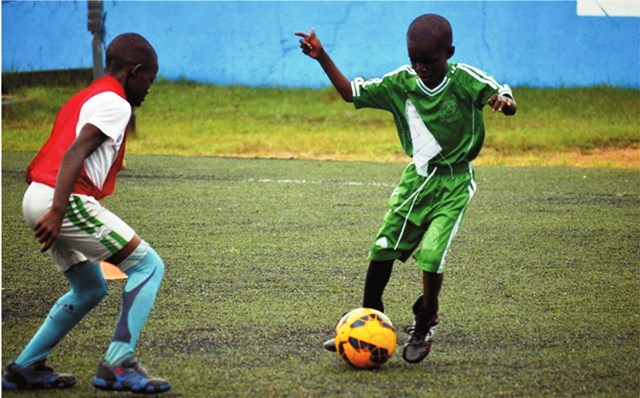
I have not seen any Nigerian dead or alive, who had painstakingly devoted his entire life to the development of youth football than Tony Eke. He was excellent and elegant, a complete football aficionado of extraordinary savvy. He combined a rare administrative ingenuity in football management with patriotic fervor in raising the standard of football from grassroots level and became an apostle of youth soccer development in the last five decades in Nigeria.
No one could fault Tony Eke’s genuine love for youth football development programme right from his childhood days in Ajegunle, the cradle of modern day footballers. He got involved in football matters as a teenager in 1965 when Youth Sport Federation of Apapa (YSFA) was formed by Chief Israel Adebajo, who was also the founder of the famous Stationery Stores Football Club of Lagos as a breeding ground for the would-be Lagos darling club.
Tony was in his early 20’s when the likes of Avi Awotoro and Sam Nwobum were being urged to sign for Stores, but it was only petit Awotoro that was preferred to the bulky, stout and lanky Nwobum. At that period, YSFA was firmly under the supervision of former Nigeria national team manager, Major Ibikunle Armstrong, an indigene of Ilaro in Ogun State, whilst millionaire business Kano-born Garba Nautan Hamza was the chairman. Patiently but painstakingly, Tony Eke learnt the ropes and became a popular figure in football circles in Lagos State, making Ajegunle his base for youth soccer revolution.
At the age of 19 in 1970, Tony Eke had already become familiar with some top brass of the Nigeria Military like Col.Sule Apollo, Major-General Joseph Garba and General Benjamin Adekunle, who had been keeping the youth club going, since the death of Mr Israel Adebajo in 1969. The trio formed a remarkable partnership with Garba Hamza from early 1970 till 1976 when the military coup that toppled General Murtala Mohammed began to have adverse effect on the day-to-day running as financial straits crippled the activities of the body.
Imbued with a burning patriotic fervor, Tony Ossai Eke, a young Nigerian of Delta State extraction, born in 1950 in the heart of Ajegunle, in Ajeromi Ifelodun Local Government of Lagos State, took up the challenge to expand the financial base of YSFA when he approached the management of VONO Nigeria Ltd to sponsor the first RAMAT Cup in Lagos State in 1977. The request was granted and Lagos was privileged to host the maiden edition of General Murtala Ramat Mohammed U-16 Boys soccer championship at St. Gregory’s College, Obalende, where Chief M.K.O. Abiola, a personal friend of Murtala Mohammed replaced the trophy and took over sponsorship of the yearly RAMAT Cup till 1994, even while in detention mid-way.
It would be pertinent to recall that Tony Eke was the brain behind the transformation of a local football outfit to national spotlight when YSFA (Youth Sport Federation of Apapa) became YSFON (Youth Sport Federation of Nigeria) in 1980.
For the first time, the RAMAT Cup was played in Kano and had eight (8) states from the Federation participating at Sabon Gari Stadium, Kano, it was during that tournament that Tony Eke mooted the idea of changing YSFA to YSFON in order to reflect national outlook. It is also of interest that Tony Eke initiated the moves that culminated into the appointment of Prince Dokun Danquah Abidoye, business mogul and owner of KODA Sports as the National President of YSFON on March 26, 1980 at the Central Working Committee of YSFON meeting held at Tony’s family house at 18, Olowojeunjeje Street, Ajegunle, which served as interim secretariat of the body.
I can also attest to the fact that Tony Eke was the one that first launched Nigeria into global honour when he registered the Nigerian youtyh to take part in a competition organised in Goteborg, Sweden in 1980. Tony Eke singularly recruited a crop of talented youngsters like Tajudeen Disu, Tarila Okorowanta, Paul Okoku, Dipriye Tebowei, Christopher Anigala, Alphonsus Akhahon, Femi Olukanni, Mutiwa Oshuntolu, Felix Egogo, Patrick Udoh, Monday Onyebuchi, Monday Oyarekhua, Gbewuro Amatere, Roland Onyemechi, Lawrence Akufe and Ali Kadri and kept them under the supervision of a football technocrat and former Red Devils goal-poacher “Diamond-toed) Peter “Baby” Anieke of Nigeria’s 1949 U.K. Tourists fame.
Led by the President of YSFON Prince Abidoye and seven other officials, Ben Ekpo, Isaac Eke, Patrick Akpavuerhe, Kayode Abiade and my humble self (the writer of this piece), we arrived Goteborg in Sweden to play against the best Europe could offer in terms of youth soccer. We were simply unstoppable as Tarila Okorowanta and Felix Egogo tantalised and taunted their opponents with sizzling football artistry to win Nigeria’s first soccer laurel at international U-16 stage.
Tony Eke’s record as a football administrator and pathfinder of Youth soccer revolution would be uncompleted without an illusion to the fact that he was truly a national soccer icon who touched all corners of the county, staging soccer contents to immortalise or celebrate those who made the game famous at their time.
For instance, Tony Eke regularly staging football competitions in honour of Kano Ado Bayero, Oba of Benin, U.J. Esuene, M.K.O. Abiola, Lekan Salami, Joe Audu, Dominic Oneya, Muda Lawal and recently the ALL STARS Cup which was his last assignment in October 2018, shortly before his sickness of almost nine years took a dramatic turn.
I would like to recall Tony’s last moments on earth with an agonising feeling. As a friend, colleague and confidant for almost four decades, Tony Eke had been the one always inviting me to his house on issues pertaining to football in Nigeria and other West African countries. In fact, he had told me in September, 2018 that we should arrange a football match to celebrate Chioma Ajunwa’s birthday and also mark her recent promotion by the Police on 25th December, 2018, but for his sickness which relapsed in the early part of December. He called on phone and I noticed that his voice was incoherent. When I got to his Oluwalose residence in Ikotun, Lagos on February 1, 2019, I noticed that Tony Eke was in his last days on earth and I quickly called his lawyer daughter Anthonia, who answered my call from Abuja. However, Tonia later told me she was making arrangement to take her father to their village in Delta and wanted to know whether I would be able to go with the family, which I unhesitatingly gave my nod.
Maybe we procrastinated because it took Tonia another three days to get back to me, and when she did, it was to break the sad news that her father had passed on in the early hours of February 16, 2019. I was devastated.
Meanwhile, the remains of Tony Ossai Eke will be buried on Friday, 1st March, 2019 at Ikoyi Cemetery. There was a wake-keep on Thursday, 28th February (yesterday) at Navy Barracks, Ajegunle, Apapa.
Segun Adenuga



The Nigerian, who arrived in China fresh from winning gold at the African Senior Athletics Championships in Ghana earlier on Wednesday, clocked a season’s best of 12.41s behind Olympic champion Masai Russell and Bahamian star Devynne Charlton.
Russell produced a dominant display to win the race in a meeting record and world-leading time of 12.25s, improving on her previous world lead of 12.40s.
Charlton, the reigning world indoor champion, finished second in 12.38s in one of her strongest outdoor performances to date.
Amusan, whose world record of 12.12s remains the fastest time ever run in the event, improved significantly from her previous season’s best of 12.84s set during her victorious outing at the African Championships in Accra.
The 29-year-old was competing in a stacked field that included reigning world champion Ditaji Kambundji of Switzerland, Jamaican pair Megan Simmonds and Ackera Nugent, China’s Wu Yanni and Americans Tonea Marshall and Danielle Williams.
Kambundji, who won the world title in Tokyo last year with a Swiss record 12.24s, finished fifth in 12.82s, while Jamaica’s Nugent placed sixth in 12.98s.
Marshall and Williams failed to finish the race.
Following Amusan’s victory in Accra, the three-time Diamond League final winner expressed gratitude to her supporters while insisting she remained determined to achieve more success this season.
“Beyond grateful to God, my team, supporters, and everyone who continues to believe in me through every season. Historic feeling. Still hungry for more. The mission continues,”

The 10-time African champions are scheduled to take on the Teranga Lionesses on June 5 and 8 at the Remo Stars Stadium in Ikenne, Ogun State, in what will form a key part of their build-up to July’s continental tournament.
The fixtures were confirmed on social media platform X by Super Falcons Show, which announced the details of the encounter and venue.
“Nigeria’s senior women’s national team, the Super Falcons, will take on Senegal Women’s National Team in a double-header international friendly scheduled for June 5 and 8,” the post read.
“Both matches will be played in Ikenne, Nigeria.”
The friendlies come after Nigeria’s proposed training tour of the United Kingdom, which included a planned match against Jamaica, was cancelled due to scheduling complications linked to FIFA’s official women’s international window. The timing meant clubs would not have been obliged to release players.
With that tour shelved, the Senegal fixtures now offer a timely opportunity for coach Justine Madugu and his technical team to assess squad options, test tactical systems and strengthen team cohesion ahead of the WAFCON campaign and longer-term qualification targets for the 2027 FIFA Women’s World Cup in Brazil.
Senegal are expected to provide a competitive regional test, with their physical style and disciplined organisation likely to offer Nigeria a different tactical challenge across both matches.
The Super Falcons, who have dominated African women’s football for decades, will be aiming to use the double-header to fine-tune preparations as they pursue another continental title in Morocco next year.

Dr Bojuwoye, a seasoned medical professional with extensive experience in road running events across Nigeria, is expected to bring added value to the race through his expertise.
As medical director, his responsibilities will include overseeing emergency medical response, coordinating first aid stations along the course, ensuring athlete safety, and supervising medical volunteers and paramedics.
His role is critical in safeguarding the health of both elite and recreational runners, as well as spectators.
In addition to unveiling its new medical director, the organisers also announced five corporate partners for the 2026 edition.
The Development Bank of Nigeria (DBN), Petralon Energy, Razzl Drink, Dan Oil, and Carloha Motors have joined as sponsors, reflecting the race’s growing appeal across diverse sectors of the Nigerian economy.
The Okpekpe race, organised by Pamodzi Sports Marketing Company, has steadily risen in prominence since becoming the first road race in Nigeria to earn World Athletics label status in 2015.
It has since advanced to Gold Label Race status, attracting elite athletes from around the world and cementing its reputation as one of Africa’s benchmark road-running competitions.
Edo State, under the leadership of Governor Monday Okpebolo, has reaffirmed its commitment to supporting the race, citing its role in promoting tourism, community pride, and international recognition for the region.
Race Director Zack Amodu noted that the new partnerships underscore the event’s stature and its impact beyond sport.
We are delighted to welcome DBN, Petralon, Razzl, and Carloha Motors as partners for the 11th edition. Their support, alongside the backing of Edo State, not only strengthens the race but also reinforces its role as a platform for promoting excellence, youth empowerment, and community development,’ Amodu said.
Beyond its sporting significance, the Okpekpe International 10km Road Race has become a catalyst for social, health, and economic benefits.
It encourages fitness and healthy lifestyles, fosters social cohesion by bringing communities together, and generates economic activity through tourism, hospitality, and local commerce.
The event also showcases Edo State’s cultural vibrancy while contributing to Nigeria’s growing reputation in global athletics.
The 11th edition is expected to draw elite athletes, local participants, and international attention, further consolidating Nigeria’s place on the global athletics calendar.
-

 Editorial4 days ago
Enough Of Xenophobic Attacks On Nigerians
-

 Education4 days ago
UNIPort Senate Grants Two-Year Amnesty to U2010–U2018 Students
-

 Sports4 days ago
Oparaodu Urges Rivers United To Win Katsina United
-

 Nation4 days ago
RSU, Otonti Nduka Foundation Holds Centenary Conference, Unveil Book on Values in Nigeria
-

 Oil & Energy4 days ago
Rivers PETROAN Elects 12-Member Executive
-
Politics4 days ago
APC Group Protests Ex–Presidential Aspirant’s Disqualification From Rivers Senatorial Race
-

 Sports4 days ago
” Nigeria’s best domestic players are not in NPFL”
-
Politics4 days ago
Reps Speaker Secures APC Return Ticket For Fifth Term