
Featured
Saraki, Kwara Gov Defect To PDP …PDP Has Learnt From Mistakes – Saraki …APC Members In Kwara Assembly To Dump Party For PDP

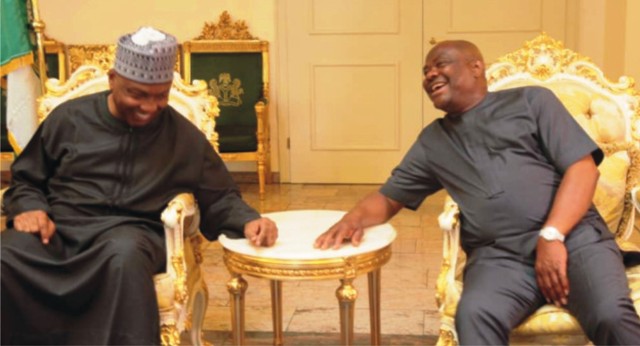
The Senate President, Dr. Bukola Saraki and the Kwara State Governor, Alhaji Abdulfatah Ahmed have dumped the All Progressives Congress (APC), for the Peoples Democratic Party (PDP).
Saraki had made his defection known yesterday through his twitter handle.
Saraki gave his reasons for dumping the APC to include continued persecutions he has been put through in the APC.
“I wish to inform Nigerians that, after extensive consultations, I have decided to take my leave of the All Progressives Congress (APC).
“This is not a decision that I have made lightly. If anything at all, I have tarried for so long and did all that was humanly possible, even in the face of great provocation, ridicule and flagrant persecution, to give opportunity for peace, reconciliation and harmonious existence.
“Perhaps, more significantly, I am mindful of the fact that I carry on my shoulder a great responsibility for thousands of my supporters, political associates and friends, who have trusted in my leadership and have attached their political fortunes to mine.
“However, it is after an extensive consultation with all the important stakeholders that we have come to this difficult but inevitable decision to pitch our political tent elsewhere; where we could enjoy greater sense of belonging and where the interests of the greatest number of our Nigerians would be best served.
“While I take full responsibility for this decision, I will like to emphasise that it is a decision that has been inescapably imposed on me by certain elements and forces within the APC who have ensured that the minimum conditions for peace, cooperation, inclusion and a general sense of belonging did not exist.
“They have done everything to ensure that the basic rules of party administration, which should promote harmonious relations among the various elements within the party were blatantly disregarded.
“All governance principles which were required for a healthy functioning of the party and the government were deliberately violated or undermined. And all entreaties for justice, equity and fairness as basic precondition for peace and unity, not only within the party, but also the country at large, were simply ignored, or employed as additional pretext for further exclusion.
“The experience of my people and associates in the past three years is that they have suffered alienation and have been treated as outsiders in their own party. Thus, many have become disaffected and disenchanted.
“At the same time, opportunities to seek redress and correct these anomalies were deliberately blocked as a government-within-a-government had formed an impregnable wall and left in the cold, everyone else who was not recognized as “one of us”. This is why my people, like all self-respecting people would do, decided to seek accommodation elsewhere.
“I have had the privilege to lead the Nigerian legislature in the past three years as the President of the Senate and the Chairman of the National Assembly. The framers of our constitution envisage a degree of benign tension among the three arms of government if the principle of checks and balances must continue to serve as the building block of our democracy.
“In my role as the head of the legislature, and a leader of the party, I have ensured that this necessary tension did not escalate at any time in such a way that it could encumber Executive function or correspondingly, undermine the independence of the legislature.
“Over the years, I have made great efforts in the overall interest of the country, and in spite of my personal predicament, to manage situations that would otherwise have resulted in unsavoury consequences for the government and the administration. My colleagues in the Senate will bear testimony to this.
“However, what we have seen is a situation whereby every dissent from the legislature was framed as an affront on the executive or as part of an agenda to undermine the government itself. The populist notion of anti-corruption became a ready weapon for silencing any form of dissent and for framing even principled objection as “corruption fighting back”.
“Persistent onslaught against the legislature and open incitement of the people against their own representatives became a default argument in defence of any short-coming of the government in a manner that betrays all too easily, a certain contempt for the Constitution itself or even the democracy that it is meant to serve.
“Unfortunately, the self-serving gulf that has been created between the leadership of the two critical arms of government based on distrust and mutual suspicion has made any form of constructive engagement impossible.
“Therefore, anything short of a slavish surrender in a way that reduces the legislature to a mere rubber stamp would not have been sufficient in procuring the kind of rapprochement that was desired in the interest of all.
“But I have no doubt in my mind, that to surrender this way is to be complicit in the subversion of the institution that remains the very bastion of our democracy. I am a democrat. And I believe that anyone who lays even the most basic claim to being a democrat will not accept peace on those terms; which seeks to compromise the very basis of our existence as the parliament of the people.
“The recent weeks have witnessed a rather unusual attempts to engage with some of these most critical issues at stake. Unfortunately, the discord has been allowed to fester unaddressed for too long, with dire consequences for the ultimate objective of delivering the common good and achieving peace and unity in our country.
“Any hope of reconciliation at this point was therefore very slim indeed. Most of the horses had bolted from the stable. The emergence of a new national party executives a few weeks ago held out some hopes, however slender. The new party chairman has swung into action and did his best alongside some of the Governors of APC and His Excellency, the Vice President.
“I thank them for all their great efforts to save the day and achieve reconciliation. Even though I thought these efforts were coming late in the day, but seeing the genuine commitment of these gentlemen, I began to think that perhaps it was still possible to reconsider the situation. However, as I have realized all along, there are some others in the party leadership hierarchy, who did not think dialogue was the way forward and therefore chose to play the fifth columnists. These individuals went to work and ensured that they scuttled the great efforts and the good intentions of these aforementioned leaders of the party.
“Perhaps, had these divisive forces not thrown the cogs in the wheel at the last minutes, and in a manner that made it impossible to sustain any trust in the process, the story today would have been different. For me, I leave all that behind me.
“Today, I start as I return to the party where I began my political journey, the Peoples Democratic Party (PDP). When we left the PDP to join the then nascent coalition of All Progressives Congress (APC) in 2014, we left in a quest for justice, equity and inclusion; the fundamental principles on which the PDP was originally built but which it had deviated from.
“We were attracted to the APC by its promise of change. We fought hard along with others and defeated the PDP.
“In retrospect, it is now evident that the PDP has learnt more from its defeat than the APC has learnt from its victory. The PDP that we return to is now a party that has learnt its lessons the hard way and have realized that no member of the party should be taken for granted; a party that has realized that inclusion, justice and equity are basic precondition for peace; a party that has realized that never again can the people of Nigeria be taken for granted.
“I am excited by the new efforts, which seeks to build the reborn PDP on the core principles of promoting democratic values; internal democracy; accountability; inclusion and national competitiveness; genuine commitment to restructuring and devolution of powers; and an abiding belief in zoning of political and elective offices as an inevitable strategy for managing our rich diversity as a people of one great indivisible nation called Nigeria.
“What we have all agreed is that a deep commitment to these ideals were not only a demonstration of our patriotism but also a matter of enlightened self-interest, believing that our very survival as political elites of this country will depend on our ability to earn the trust of our people and in making them believe that, more than anything else, we are committed to serving the people.
“What the experience of the last three years have taught us is that the most important task that we face as a country is how to reunite our people. Never before had so many people in so many parts of our country felt so alienated from their Nigerianness. Therefore, we understand that the greatest task before us is to reunite the country and give everyone a sense of belonging regardless of region or religion.
“Every Nigerian must have an instinctive confidence that he or she will be treated with justice and equity in any part of the country regardless of the language they speak or how they worship God. This is the great task that trumps all. Unless we are able to achieve this, all other claim to progress no matter how defined, would remain unsustainable.
“This is the task that I am committing myself to and I believe that it is in this PDP, that I will have the opportunity to play my part. It is my hope that the APC will respect the choice that I have made as my democratic right, and understand that even though we will now occupy a different political space, we do not necessarily become enemies unto one another”, Saraki added.
Similarly, the Kwara State Governor, Abdulfatah Ahmed, has dumped the All Progressives Congress (APC).
Ahmed made known his decision just the same time the Senate President, Abubakar Bikola Saraki equally announced he had dumped the APC, yesterday.
In a statement by his media aide, Muyideen Akorede, Governor Ahmed said he decided to dump the APC after consultations with the people of his state.
According to him, “Following due consultations with the people and in response to calls by major stakeholder groups in the state, Kwara State Governor, Alhaji Abdulfatah Ahmed today defected to the People’s Democratic Party (PDP), having realised that the All Progressives Congress (APC) can longer serve as a platform for achieving the aspirations and expectations of his people,” the statement said.



Rivers State Governor, Sir Siminialayi Fubara, has dissolved the State Executive Council.
The governor announced the cabinet dissolution yesterday in a statement titled ‘Government Special Announcement’, signed by his new Chief Press Secretary, Onwuka Nzeshi.
Governor Fubara directed all Commissioners and Special Advisers to hand over to the Permanent Secretaries or the most Senior officers in their Ministries with immediate effect.
He thanked the outgoing members of the State Executive Council for their service and wished them the best in their future endeavours.
The three-paragraph special announcement read, “His Excellency, Sir Siminalayi Fubara, GSSRS, Governor of Rivers State, has dissolved the State Executive Council.
“His Excellency, the Governor, has therefore directed all Commissioners and Special Advisers to hand over to the Permanent Secretaries or the most Senior officers in their Ministries with immediate effect.
“His Excellency further expresses his deepest appreciation to the outgoing members of the Executive Council wishing them the best in their future endeavours.”
The Independent National Electoral Commission (INEC) yesterday told the National Assembly that it requires N873.78bn to conduct the 2027 general elections, even as it seeks N171bn to fund its operations in the 2026 fiscal year.
INEC Chairman, Prof Joash Amupitan, made the disclosure while presenting the commission’s 2026 budget proposal and the projected cost for the 2027 general elections before the National Assembly Joint Committee on Electoral Matters in Abuja.
According to Amupitan, the N873.78bn election budget covers the full conduct of national polls in 2027.
An additional N171bn is needed to support INEC’s routine activities in 2026, including bye-elections and off-season elections, the commission stated.
The INEC boss said the proposed election budget does not include a fresh request from the National Youth Service Corps seeking increased allowances for corps members engaged as ad-hoc staff during elections.
He explained that, although the details of specific line items were not exhaustively presented, the almost N1tn election budget is structured across five major components.
“N379.75bn is for operational costs, N92.32bn for administrative costs, N209.21bn for technological costs, N154.91bn for election capital costs and N42.61bn for miscellaneous expenses,” Amupitan said.
The INEC chief noted that the budget was prepared “in line with Section 3(3) of the Electoral Act 2022, which mandates the Commission to prepare its election budget at least one year before the general election.”
On the 2026 fiscal year, Amupitan disclosed that the Ministry of Finance provided an envelope of N140bn, stressing, however, that “INEC is proposing a total expenditure of N171bn.”
The breakdown includes N109bn for personnel costs, N18.7bn for overheads, N42.63bn for election-related activities and N1.4bn for capital expenditure.
He argued that the envelope budgeting system is not suitable for the Commission’s operations, noting that INEC’s activities often require urgent and flexible funding.
Amupitan also identified the lack of a dedicated communications network as a major operational challenge, adding that if the commission develops its own network infrastructure, Nigerians would be in a better position to hold it accountable for any technical glitches.
Speaking at the session, Senator Adams Oshiomhole (APC, Edo North) said external agencies should not dictate the budgeting framework for INEC, given the unique and sensitive nature of its mandate.
He advocated that the envelope budgeting model should be set aside.
He urged the National Assembly to work with INEC’s financial proposal to avoid future instances of possible underfunding.
In the same vein, a member of the House of Representatives from Edo State, Billy Osawaru, called for INEC’s budget to be placed on first-line charge as provided in the Constitution, with funds released in full and on time to enable the Commission to plan early enough for the 2027 general election.
The Joint Committee approved a motion recommending the one-time release of the Commission’s annual budget.
The committee also said it would consider the NYSC’s request for about N32bn to increase allowances for corps members to N125,000 each when engaged for election duties.
The Chairman of the Senate Committee on INEC, Senator Simon Along, assured that the National Assembly would work closely with the Commission to ensure it receives the necessary support for the successful conduct of the 2027 general elections.
Similarly, the Chairman of the House Committee on Electoral Matters, Bayo Balogun, also pledged legislative support, warning INEC to be careful about promises it might be unable to keep.
He recalled that during the 2023 general election, INEC made strong assurances about uploading results to the INEC Result Viewing portal, creating the impression that results could be monitored in real time.
“iREV was not even in the Electoral Act; it was only in INEC regulations. So, be careful how you make promises,” Balogun warned.
The N873.78bn proposed by INEC for next year’s general election is a significant increase from the N313.4bn released to the Commission by the Federal Government for the conduct of the 2023 general election.

President Bola Tinubu yesterday expressed grief over the death of a former President of the Academic Staff Union of Universities and one of Africa’s foremost literary scholars, Professor Emeritus Biodun Jeyifo.
Jeyifo passed away on Wednesday, drawing tributes from across Nigeria and the global academic community.
In a condolence message to the family, friends, and associates of the late scholar, Tinubu in a statement by his spokesperson, Bayo Onanuga, described Jeyifo as a towering intellectual whose contributions to African literature, postcolonial studies, and cultural theory left an enduring legacy.
He noted that the late professor would be sorely missed for his incisive criticism and masterful interpretations of the works of Nobel laureate, Professor Wole Soyinka.
The President also recalled Jeyifo’s leadership of ASUU, praising the temperance, foresight, and wisdom he brought to the union over the years.
Tinubu said Jeyifo played a key role in shaping negotiation frameworks with the government aimed at improving working conditions for university staff and enhancing the learning environment in Nigerian universities.
According to the President, Professor Jeyifo’s longstanding advocacy for academic freedom and social justice will continue to inspire generations.
He added that the late scholar’s influence extended beyond academia into political and cultural journalism, where he served as a mentor to numerous scholars, writers, and activists.
Tinubu condoled with ASUU, the Nigerian Academy of Letters, the Wole Soyinka Centre for Investigative Journalism, the University of Ibadan, Obafemi Awolowo University, Oberlin University, Cornell University, and Harvard University—institutions where Jeyifo studied, taught, or made significant scholarly contributions.
“Nigeria and the global academic community have lost a towering figure and outstanding global citizen,” the President said.
“Professor Biodun Jeyifo was an intellectual giant who dedicated his entire life to knowledge production and the promotion of human dignity. I share a strong personal relationship with him. His contributions to literary and cultural advancement and to society at large will be missed.”
Jeyifo was widely regarded as one of Africa’s most influential literary critics and public intellectuals. Among several honours, he received the prestigious W.E.B. Du Bois Medal in 2019.
-

 Sports2 days ago
2026 WC: Nigeria, DR Congo Awaits FIFA Verdict Today
-

 Environment2 days ago
Oxfam, partners celebrate 5 years of climate governance programmes in Nigeria
-
Politics2 days ago
ADC, PDP, LP Missing As INEC Set For By- Elections In Rivers
-
Politics2 days ago
FG’s Economic Policies Not Working – APC Chieftain
-

 Politics2 days ago
2027: Diri Unveils RHA LG Coordinators, APC Congress Panel
-

 Politics2 days ago
Reps To Meet,’Morrow Over INEC’s 2027 Election Timetable
-

 Politics2 days ago
Group Continues Push For Real Time Election Results Transmission
-
Sports2 days ago
Sunderland Overcome Oxford Challenge