Connect with us

Business

C’River Votes N1.7bn For Food Bank Commission

Published

on

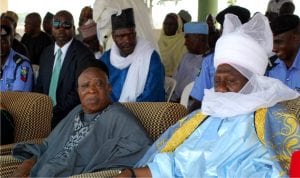
President, National Agricultural Foundation/Chairman Senate Committee on Agriculture, Senator Abdullahi Adamu (left) with Sarkin Keffi III, Alhaji Shehu Yamusa, at the 2016 National Agricultural show in Keffi, Nasarawa orecently.

President, National Agricultural Foundation/Chairman Senate Committee on Agriculture, Senator Abdullahi Adamu (left) with Sarkin Keffi III, Alhaji Shehu Yamusa, at the 2016 National Agricultural show in Keffi, Nasarawa orecently.

The Cross River Gov
ernment has budgeted the sum of N1.7 billion for the establishment of a food bank commission in the state.
This was disclosed by the State Governor, Professor Ben Ayade, while receiving a delegation from HB Heritage Bank led by its Coordinator of the Home Grown School Feeding Programme, Mr. Godwin Ukwat on a courtesy visit in his office in Calabar, Monday.
Ayade said that the Food Bank Commission is structured in a manner that each local government will have a director.
He expressed the willingness of the state government to key into the Home Grown School Feeding Programme on the condition that it is given the free hand to run it.
The governor decried the fact that the practice of agriculture in the country was still at the subsistence level; stating that it was time the country embraced the use of technology in farming.
“We are at a time where agriculture is driven by technology in developed countries; where farming is in the hands of big farmers and infrastructure such as roads, water and power are provided,” he stated.
He argued that it would be counterproductive to encourage farmers to continue with “stone-age” agricultural practices which do not even provide insurance cover for the farmers.
In his presentation, the HB Heritage Bank, Head of Agric-Finance, Mr. Gbenga Awe, said that the home grown school feeding programme is one of the social safety nets of the Federal Government, which seeks to employ 300,000 youths in the country.
He disclosed that the programme is meant to feed school pupils from primary one to six with the aim to encourage learning, asserting that it is usually difficult for a child to concentrate and learn with an empty stomach.
Awe further explained that the scheme would be funded on the basis of 60 per cent for the federal government and 40 per cent for the state governments.
He outlined the benefits to states to include a boost to Internally Generated Revenue as it brings a large population of persons from the informal sector to the formal sector thereby expanding the state access to the tax base.
He listed states that are already signed on to the programme to include, Kaduna, Zamfara, Osun, Oyo, Jigawa, Benue and Enugu states.

Continue Reading

Business

PENGASSAN Rejects Presidential EO On Oil, Gas Revenue Remittance  … Seeks PIA Review 

Published

on

The Natural Gas Senior Staff Association of Nigeria (PENGASSAN) Festus Osifo, has faulted the public explanation surrounding the Federal Government’s recent oil revenue Executive Order(EO).
President of the association, Festus Osifo, argued that claims about a 30 per cent deduction from petroleum sharing contract revenue are misleading.
Recall that President Bola Ahmed Tinubu, last Wednesday, February 18, signed the executive order directing that royalty oil, tax oil, profit oil, profit gas, and other revenues due to the Federation under production sharing, profit sharing, and risk service contracts be paid directly into the Federation Account.
The order also scrapped the 30 per cent Frontier Exploration Fund under the PIA and stopped the 30 per cent management fee on profit oil and profit gas retained by the Nigerian National Petroleum Company Limited.
In his reaction, Osifo, while addressing journalists, in Lagos, Thursday, said the figure being referenced does not represent gross revenue accruing to the Nigerian National Petroleum Company Limited.
He explained that revenues from production sharing contracts are subject to several deductions before arriving at what is classified as profit oil or profit gas.
Osifo also urged President Bola Tinubu to withdraw his recently signed Presidential Executive Order to Safeguard Federation Oil and Gas Revenues and Provide Regulatory Clarity, 2026.
He warned that the directive undermines the Petroleum Industry Act and could create uncertainty in the oil and gas industry, insisting that any amendment to the existing legal framework must pass through the National Assembly.
Osifo argued that an executive order cannot override a law enacted by the National Assembly, describing the move as setting a troubling precedent.
“Yes, that is what should be done from the beginning. You can review the laws of a land. There is no law that is perfect,” he said.
He added that the President should constitute a team to review the PIA, identify its strengths and weaknesses, and forward proposed amendments to lawmakers.
“When you get revenue from PSC, you have to make some deductibles. You deduct royalties. You deduct tax. You also deduct the cost of cost recovery. Once you have done that, you will now have what we call profit oil or profit gas. Then that is where you now deduct the 30 per cent,” he stated..
According to him, when the deductions are properly accounted for, the 30 per cent being referenced translates to about two per cent of total revenue from the production sharing contracts.
“In effect, that deduction is about two per cent of the revenue of the PLCs,” he added, maintaining that the explanation presented in the public domain did not accurately reflect the structure of the deductions.
Osifo warned that removing the affected portion of the revenue could have operational implications for NNPC Ltd, noting that the funds are used to meet salary obligations and other internal expenses.
“That two per cent is what NNPC uses to pay salaries and meet some of its obligations.The one you are also removing from the midstream and downstream, it is part of what they use in meeting their internal obligations. So as you are removing this, how are they going to pay salaries?” he queried.
Beyond the immediate impact on the company’s workforce, he cautioned that regulatory uncertainty could affect investor confidence in the sector.
“If the international community and investors lose confidence in Nigeria, it has a way of affecting investment. That should be the direction. You don’t put a cow before the horse,” he added.
According to him, stakeholders, including labour unions and industry operators, should be given the opportunity to make inputs at the National Assembly as part of the amendment process saying “That is how laws are refined,”
Continue Reading

Business

Nigeria’s ETF correction deepens as STANBICETF30, VETGRIF30 see 50% decline in a week

Published

on

Nigeria directs all oil, gas revenues to federation account in sweeping reform
Nigerian President Bola Tinubu has signed an order directing that all oil and gas revenues owed to the government be paid directly into the federation account, in sweeping reforms aimed at boosting public finances, the presidency said on Wednesday.
Under the law, the Nigerian National Petroleum Corporation keeps 30% of oil and gas profits for frontier exploration in inland basins. The presidency said those funds will now be paid into the federation account and appropriated by the government.
The Reuters Power Up newsletter provides everything you need to know about the global energy industry. Sign up here.
NNPC also retains 30% of oil and gas sales as operational costs and receives 30% of proceeds from Production Sharing Contracts. Under the new directive, all revenues under these arrangements will flow directly to the federation account, while the company will instead receive appropriated management fees.
Royalty payments, petroleum profit taxes and other statutory revenues previously collected and retained by the Nigerian Upstream Petroleum Regulatory Commission (NUPRC) will also be paid directly into the Federation Account. The Nigerian Midstream and Downstream Petroleum Regulatory Authority (NMDPRA) will likewise remit its revenues in full, with its cost of collection to be funded through appropriation.
Tinubu’s office said deductions enabled by the law had sharply reduced net oil inflows and contributed to fiscal strain across federal, state and local governments. The president also ordered a review of the law and established an implementation committee to enforce the changes.
Continue Reading

Business

BOI Introduces Business Clinic 

Published

on

The Bank of Industry (BoI) has introduced a business clinic model designed to diagnose, treat and rehabilitate the Micro, Small and Medium Enterprises (MSMEs) to ensure long-term growth and sustainability.
The Divisional Head, Business Development, BoI, Dr Obaro Osah, made this known at the bank’s Thrive Summit with the theme: “Driving Growth through Innovation and Financial Empowerment” on Tuesday in Lagos.
Osah noted that traditional banking often treated businesses as mere account opening and management relationships.
He said the BoI business clinic model was created to reimagine the essence of a bank as a specialised teaching hospital.
According to him, just as a hospital requires a thorough diagnosis before service treatment/surgery, the bank must analyse the structural health of a small business before injecting capital.
“Financial distress is often just a symptom, the disease lies in operations and adopted philosophy, strategy, or governance,” he said.
Osah noted the many MSMEs, in spite of their potential, suffer from recurring ailments: restricted cash flow, poor operational structure, lack of proper packaging and market access, poor management among others.
He said the bank’s triage and vital signs included screening SMEs by maturity stage, pulse check to assess cash flow and liquidity and market temperature to evaluate competitive landscape.
Osah said after these evaluation, advanced diagnostics, prescriptions, surgical interventions and recovery and rehabilitation would be carried out where necessary.
“Prescription without diagnosis is malpractice and the Thrive Summit ensures we treat the root cause, not just the symptoms,” he said.
The Chief Strategy and Development Officer, BoI, Dr Isa Omagu, noted that MSMEs needed more than finance to succeed.
Omagu said they needed structure, advisory, capacity building, governance, digital readiness, access to market information and the right business infrastructure to operate and scale effectively.
He said as part of the bank’s 2025-2027 Corporate Strategy, the business clinic would expand BoI’s value proposition to broaden its products and services to better reach target segments.
Omagu said by offering structured business advisory and project development support, the clinic would enable the bank deliver deeper, more holistic value to MSMEs beyond financing.
“This vision of a structured, holistic business clinic; one that strengthens MSMEs across all core business functions and makes them more bankable, competitive, digitally enabled, and sustainable, is fully aligned with our strategic initiative to develop and roll out non-financial product offerings.
“Through this initiative, BoI commits to providing business advisory for MSMEs and project lifecycle support for enterprises, and the business clinic serves as the practical platform through which this commitment comes to life,” he said.
Omagu urged MSMEs to apply the guidance received to strengthen structure, governance, and financial management.
He added that they must adopt digital tools and improve internal processes to boost competitiveness while engaging BoI as a long-term partner in building a resilient, scalable business.
Mrs Eniola Akinsete, Divisional Head, Sustainability, BoI, said adopting Environmental, Social and Governance (ESG), principles often led to business prosperity.
Akinsete, however, noted that in spite of the benefits, adoption challenges persisted.
She affirmed BoI’s support on the adoption of ESG Practices by the MSMEs.
Earlier, the Executive Director, Corporate Finance, Sustainability and Investments, BoI, Mr Rotimi Akinde, said the summit represented a shared commitment to building a stronger, more resilient business ecosystem in Nigeria.
Akinde stated that the business clinic created a platform for practical knowledge sharing where entrepreneurs and small business owners could gain actionable insights to overcome challenges and seize opportunities.
He said discussions would focus on critical areas that drive sustainable growth, including branding and marketing, financials and activities, human rights, human resources, raising capital for equity and technology.
Continue Reading

Trending