
Business
Nigeria’s Power Supply: Which Way Forward?

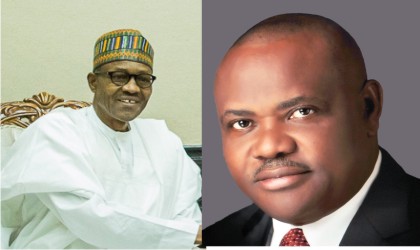
President Muhammadu Buhari and Governor Nyesom Wike of Rivers State
The importance of power
or electricity in the growth of any economy worldwide cannot be under-estimated based on the fact that every other sector depends on the availability of power to function effectively and productively. This understanding prompted President Muhammadu Buhari to single out dwindling power supply as the major cause of the nation’s poor economic performance over the years.
Buhari in his inaugural speech to the people of Nigeria at his swearing-in on Friday, May 29, 2015 at the Eagle Square, Abuja, described as a national shame that an economy of 180 million generates only 4,000MW, and distributes even less. According to him, continuous tinkering with the structures of power supply and distribution and close on 20 billion dollars expanded since 1999 have only brought darkness, frustration, misery and resignation among Nigerians, saying “we will not allow this to go on.”
He noted that careful studies are underway during this transition to identify the quickest, safest and most cost-effective way to bring light and relief to Nigerians.
Sounding similarly, Rivers State Governor, Barrister Ezenwo Nyesom Wike in his inaugural address to Rivers people said “we will seek to enhance our prosperity through power supply and energy security.
He stated that until steady power supply is taken for granted, our development efforts will be in jeopardy and so we will strive to achieve power and energy security for Rivers State in partnership with the private sector and the Federal Government as well as ensure the completion of on-going electrification projects.
“As an initial step towards tackling the challenge of irregular power supply before making fresh investments, we will conduct a forensic audit to find out the reasons behind the failure of the state to reap maximally from the huge investments already committed to the sector by the immediate past administration. “We will also review all issues relating to the secret privatization and or sale of government investments in power and other related projects without due process”, he stressed.
Meanwhile, the new administration of President Muhammadu Buhari is under intense pressure to reverse the privatization of power assets in the country initiated under the out-gone Goodluck Jonathan government. Another task given to the federal government is to increase its equity in the already privatized power assets from 49 to 59 per cent in order to have control in the running of such power assets across the country.
The move has already received endorsement from the National Union of Electricity Employees (NUEE) which called for immediate review of the power sector privatization exercise on the strength of alleged irregularities, fraud and worsening power situation in the country. The NUEE was responding to a statement by the out-gone Minister of Power, Professor Chinedu Nebo that the new government should not tamper with privatisation of the power sector.
According to NUEE, the privatisation of the sector has made the generation and consumption of power in the country to be ineffective, adding that the payment of over N200 billion to the private sector by the government after the privatization exercise leaves much to be desired.
Leaders of the union and General Secretary and factional president of Nigerian Labour Congress (NLC), Comrade Joe Ajaero said there is need for the Buhari presidency to revisits the privatisation because the exercise has not made any positive impact on consumers, months after it was done.
“We want to say, as a union, that the sham called privatization should be revisited. If privatization as we were told, was to bring us heaven-on-earth, and it has not done that, why would we insist on it? Of course, our position as NUEE has been No to privatization, especially given that we are an under-developed economy. It is the function of the state to provide power. Even the so-called privatization you can see that even this year alone, between January and now, they have even given the so-called private sector over N200 billion. So, why fund them if you say that electricity is in the hand of the private sector? That brings you to the fraud on who owns them. Why should you sell your house to somebody and you still give him money to maintain it? So, it’s a fraud,” Ajaero said.
There is a huge cry by electricity consumers nationwide that privatization of the nation’s power assets seem not to have generated the desired results as the power situation in the country continues to dwindle.
Industry sources said that given the flood of complaints by electricity consumers nationwide over constant power outages and huge estimated bills by the private owners of power assets, the new government of President Buhari may decide to take a second look at the entire power privatization process.
According to some industry experts, the new owners of the privatized assets are not helping matters as they are more interested in recovering their investment instead of upgrading dilapidated power facilities. “The new owners are more of financial experts who want to recover their monies so soon,” they said, adding that it is expected that if the Buhari government increases its equity share in the power companies, given its mindset to fight corruption, there would be improvement in power supply in the country.
Also adding their reaction to the attitude and activities of the private power owners the Independent Petroleum Marketers Association of Nigeria (IPMAN), urged the Federal Government to enact laws that would enhance utilization of power-saving technology and moderate electricity wastage.
Its Director of operations, Mike Osatuyi who made the appeal in an interview with newmen said the nation’s epileptic power supply had made it imperative for government to ensure effective power or electricity utilization and energy conservation. As he put it, “there is need for the government to enact a law to checkmate electricity wastage following the nation’s high demand for electricity supply,” pointing out that his company was prepared to partner with government agencies to provide the technology and technologists, equipped with technical know-how in energy conservation techniques.
He noted that the power-saving technology would reduce pressure on generation and eliminate the burden of huge investments on more generating plants by government. Osatuyi emphasised the need to operate an influential state structure for policy realisation in power efficiency and also monitor the activities of the private investors in the power sector.
Also expressing their worry over the poor services of the distribution companies since after the privatisation process, the Managing Director, Energy Solution Nigeria Limited, Mr Yomi Kolawole urged electricity consumers in the country to seek legal action against DISCOs to stop outrageous billing of the customers.
Kolawole said since the Federal Government handed over Power Holding Company of Nigeria (PHCN) to private investors last year, the electricity supply had worsened, while there had been a steady increase in monthly billing. He noted that some consumers have resorted to vandalizing DISCOs’ installations in their communities.
“Now that the power sector has been privatized, the individual companies must be held responsible for their actions.
They cannot continue to give consumers outrageous bills monthly without electricity supply. The Nigeria Electricity Regulatory Commission (NERC) had ordered all DISCOs to provide us with prepaid meters, but till now, they have not given up to 10 per cent of their customers”, Kolawole emphasized.
Some artisans in Lagos recently decried the increase in electricity tariff, saying that it negated the federal government’s policy on inclusive growth and self-employment. NERC chairman, Dr Sam Amadi had explained that the increase was a result of recent rise in the price of gas and other technical losses incurred by the power generation and distribution firms. But a barber interviewed had said it was wrong for NERC to increase tariff now that power was not stable.
A Lagos High Court has, however, stopped NERC from implementing the new tariff.
The way forward in the country’s power supply is in question and it is a herculean task before the present administration of President Muhammadu Buhari and other administrators of this nation.
Shedie Okpara



-
 News4 hours ago
NDLEA Arrests 101-Year-Old Great-Grandma For Selling Drugs In Sachets
-
 Business6 hours ago
FAAN Sack Contract Company Over Illegal Parking Fees
-
 Niger Delta1 hour ago
Fubara Delivers Three Legacy Projects At Elechi Amadi Poly …Advocates Shift To Vocational Education
-
Features5 hours ago
Beyond Tradition As Stakeholders Seek Collaboration To End FGM In Rivers
-
Politics7 hours ago
I Don’t Want To Be Tinubu’s 2027 Campaign DG, Lose Rivers — Wike
-
Nation4 hours ago
Group Pledges 50 Votes Per Polling Unit For APC In Rivers
-
Politics6 hours ago
Duke Attacks Tinubu’s Economic Policies, Says Subsidy Removal Impoverishes Masses
-
 Politics1 hour ago
Publish Political Donation Limits For 2027 Elections, SERAP Tells INEC