
Politics
2015 And Electoral Violence In Nigeria

There is no agreeable
‘definition of electoral violence. This is because of the contentious issue of “violence begets violence” developed by Frantz Fanon in the era of anti-colonial struggles. The Fanonian argument is predicated on the fact that ‘violence provokes violence’. So those who retaliate to the first violence of political opponent do not agree that they are perpetrating violence. They sirnply argue that they are countering violence.
From the array of definitions available, one can glean an operational definition. Operationally, electoral violence connotes all forms of violence (physical, psychological, administrative, legal and structural) at different stages engaged in by particiipants, their supporters and sympathizers (including security and election management body staff) in the electoral process. These forms of violence take place before elections, during elections and after or post-election, and could also be intra- or inter-party.
Since Nigeria became independent on October 1st 1960, the history of election has been written in violence. The Human Rights Watch (2007) in its follow up of post-independence events in Nigeria describes the nation’s post-independence history as being overshadowed by the depredations of a series of corrupt, abusive, and unaccountable governments. This description is apt because it appears that Nigerians seem to have acquired a culture of electoral violence as seven of the eight general elections conducted since independence in 1960 have been violence-ridden -1964/1965,1979,1983,1999,2003, 2007 and 2011.
For example, at independence, the country adopted a parliamentary system of government akin to the British type. The first post-independence election organized by that government led by Prime Minister Tafawa Balewa\President Nnamdi Azikiwe in 1964 and 1965 were characterized by widespread complaints of fraud, violence and intimidation. Protests in the wake of the regional elections, which in some areas degenerated into a violent exercise in competitive rigging, led to widespread violence and inter-communal rioting that claimed more than 200 lives.
Later in January 1966, the military struck and the fledging Nigerian democracy was thwarted by the action of its very own practitioners. From 1966, the military held sway until 1979 when they handed over to another civilian government headed by Alhaji Shehu Shagari of the National Party of Nigeria (NPN). The Shagari-Ied government organized a civilian to civilian transition election but again like its First Republic counterparts, repeated history and massively rigged the 1983 general elections through very violent means in connivance with the election management body, Federal Election Commission (FEDECO) and security forces. That again set the stage for the second wave of military intervention in the nation’s politics on December 31, 1983. The military from then remained in power until May 29, 1999 after, several attempts to democratize.
Suffice it to say that between independence in 1960 and 1999 when civilian rule was restored, Nigeria produced only two elected governments and both were overthrown in military coup de’tats before completing a second term in office. In all, Nigeria’s military ruled the country for nearly 30 of its first 40 years of independence, excluding the three months of short-lived Interim National Government (ING)
Since the restoration of civil rule, attempts have not been made by politicians to deepen and strengthen democracy. Instead, Nigeria has only added to its history fraudulent and violent elections. The 1999, 2003 and 2007 general elections that brought President Olusegun Obasanjo and later late President Umaru Yar’ Adua to power were marred by such widespread violence and fraud.
For example, the US-based Jimmy Carter Centre for Democracy which monitored the 1999 election as an international observer concluded its report on the outcome of the presidential election like the others before it thus: “It is not possible for us to make an accurate judgment about the outcome of the presidential election”. In the same vein, the 2003 elections were more pervasively and openly rigged than the flawed 1999 polls, and far more bloody.
These events set the stage for the 2007 elections which both domestic and foreign observers succinctly described as the worst in Nigeria’s history ranking among the worst conducted anywhere in the world in recent times. For instance, the US-based National Democratic Institute (NDI) stated in its post-election statement that the electoral process “failed the Nigerian people”.
The Human Rights Watch (2007) which monitored the election in its report said the Nigeria’s failed April 2007 polls cast a harsh and very public light on patterns of violence, corruption and outright criminality that have come to characterize Nigeria’s political system-and on the extent to which officials and institutions at all levels of government accept, encourage and participate in those abuses. The 2007 and 2011 general elections had come and gone with some cases still in courts, Nigerians .are afraid of future elections especially the 2015 elections that is a stone throw away.
There are plethora of reasons that account for the causes of electoral violence.
These include rigging, ineffectiveness of security forces and culture of impunity, partisan disposition of the security forces detailed to monitor elections, weak penalties against defaulters and poor handling of election petitions, among others.
It is true that electoral violence has characterized our political elections since independence. This trend can be reversed only if we can change our mindsets on what politics and governance is all about. Politics should not be conceived as the most lucrative industry in Nigeria. It is this mindset that makes aspirant or political office seekers to exhaust “all means” in capturing the position. It should be seen as a service to humanity and protecting the lives and the welfare of our prosperity.
Governance should be transparent at all levels. Electoral rules should be enforced. Political positions should be made unattractive by downward review of their take-home salary/allowances. Within our constituencies, we should be our brothers’ keeper. Electoral officials should devoid themselves of corrupt practices, while law enforcement agents should remain neutral. Politicians found parading thugs should be disqualified from the race. Violence free election is achievable in 2015
Being an excerpt of a public lecture delivered at the sensitisation/awareness campaign by the Rundele Peoples Assembly in Port Harcourt, recently.
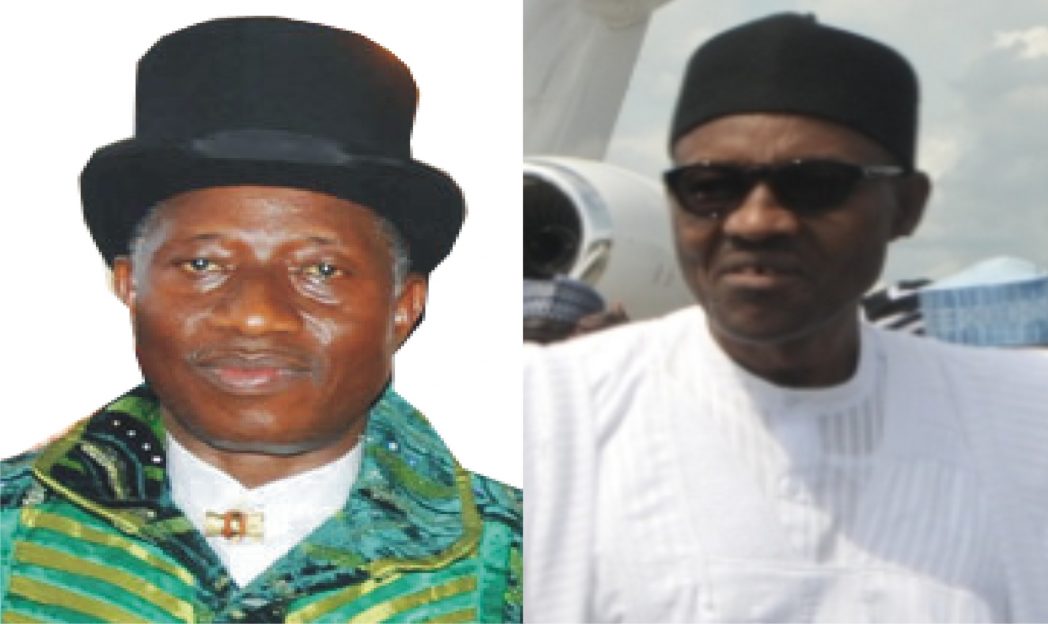
President Goodluck Jonathan and Buhari
Ben Thom-Otuya


Rt Hon. Abbas secured the party’s ticket through an affirmation exercise conducted across the 13 electoral wards in the constituency.
The wards involved include Kwarbai A, Kwarbai B, Limancin-Kona, Unguwar Fatika, Unguwar Juma, Dutsen Abba, Gyallesu, Kufena, Dambo, Wuchichiri, Tudun Wada, Tukur-Tukur, and Kaura.
The exercise, which began simultaneously in all wards at about 10 a.m., recorded large turnout of APC members who gathered at various party offices across the constituency.
At Kwarbai B Ward, the Speaker’s ward, the process was conducted peacefully under the supervision of the ward APC Returning Officer, Malam Iliyasu Muhammad Balarabe, in the presence of Rt Hon. Abbas.
According to the ward APC secretary, Nafiu Sabo, the ward has over 10,000 registered members, but 220 members were accredited for the exercise.
Before the affirmation, Mallam Balarabe informed members that Rt Hon Abbas was the only aspirant who purchased nomination forms, underwent screening, and was cleared by the APC national leadership to contest the Zaria Federal Constituency seat.
Following a voice vote by accredited members, the Speaker was affirmed as the party’s candidate in the ward, a process replicated across the remaining 12 wards.
At the constituency collation centre, the APC Returning Officer for the House of Representatives primary in Zaria Federal Constituency, Dr. Hamisu Ibrahim Kubau, announced that 1,376 APC members across the 13 wards endorsed Rt Hon. Abbas as the party’s flag bearer.
He explained that although thousands of party members participated in the exercise, only accredited delegates were allowed to vote.
Dr. Kubau declared: “There are 13 wards in Zaria Federal Constituency, and only one aspirant purchased a form, was screened, and cleared. He is Rt. Hon. Abbas Tajudeen. After due process, we conducted affirmations across all wards.”
He added that the process was peaceful and monitored by officials of the Independent National Electoral Commission (INEC) and party representatives.
Chairman of the APC House of Representatives Primary Elections in Kaduna State, Senator Yakubu Oseni, described the outcome as a reflection of the Speaker’s popularity and acceptance among constituents.
He expressed confidence that Rt Hon Abbas would secure victory in the 2027 general elections.
Speaking after his declaration, Rt Hon. Abbas expressed appreciation to APC members for reaffirming their confidence in him.
The incumbent Reps including Emily Inyang and Godwin Offionio, in separate interviews
protested the handling of the primaries conducted by the leadership of the party in the state, saying it was skewed against them.
The aspirants further described the primaries as a charade and an embarrassment to the state.
According to them, the House of Representatives primaries fell short of the provisions of both the Electoral Act as amended in 2026 and the party’s constitution.
They accused the leadership of the party in the state, backed by Governor Bassey Otu, of violating the party’s constitution in the conduct of the House of Representatives primaries across the state on Saturday.
Hon. Godwin Offiono, representing Ogoja/Yala Federal Constituency, particularly expressed disappointment with the primary that allegedly disenfranchised registered members of the party in his constituency.
Hon. Offiono asserted that having failed to arrive at a consensus, the party leadership opted for a direct primary to decide the candidate for the 2027 election.
“But what I witnessed today was not only alarming, but quite disheartening that our electoral system have not shown any improvement, especially now that we have a man of God in the person of the governor as the leader of the party.
“How do you declare a result by 9:00am even when the electoral materials were yet to arrive at Yala.
“As an aspirant, I couldn’t even vote or see the materials for my own primary at my Okuku ward in Yala Local Government Area, where I come from. But no matter what happens I am still in the race and have not stepped down for anybody.
“The governor had all the time in the world to drive the process of consensus but he never did. As a representative, I cannot even see my governor. I called, no response. I sent text no reply. I am treated as an out cast,” he lamented.
In an emotion laden tone during a telephone interview, Hon. Offiono further said: “I could not believe that first term NASS members like me can be treated in this shoddy manner even when I don’t know my offence.
“I have been a loyal party man. I appeal to the governor to do the right thing, follow the Electoral Act and party constitution in electing representatives.”
Similarly, Hon. Emil Inyang of Akamkpa/Biase Federal Constituency said he still remained in the race and had not stepped down for anybody.
According to him, “If this shenanigan called primary is allowed to stand, it would affect the party’s fortune in the general elections.
“My appeal to the governor is to allow the people to decide. And if they so voted against me, I will rest and not fight over anything.
“There was no stakeholders meeting held to decide on anything before now, and someone can not be unilaterally imposed on us all in the name of compromised primary,” he stated.
A coalition of support groups within the All Progressives Congress (APC) has protested the disqualification of former presidential aspirant, Mr Tein Jack-Rich, from the Rivers West Senatorial race ahead of the party’s primaries for the 2027 general elections.
The groups, in a statement issued on Saturday morning in Abuja, described the action of the party’s screening committee as unjust and capable of worsening internal divisions within the APC in Rivers State.
The statement, signed by the coalition’s National Coordinator, Dr. Bilal Galadima, and General Secretary, Hon. James Ogenyi, accused the party leadership in Rivers State of favouring politicians loyal to the Minister of the Federal Capital Territory, Chief Nyesom Wike, while sidelining long-standing members of the APC.
The coalition alleged that only aspirants aligned with Chief Wike were cleared to contest for elective positions in the state.
“How can our party allow only one man who is not a member of our party to make decisions or dictate the direction of our party?”, the group queried.
The coalition specifically faulted the exclusion of Mr Jack-Rich, describing him as a loyal party member who had supported the APC for more than 13 years and previously contested the party’s presidential ticket.
It also questioned the alleged clearance of Chief Felix Obua, whom it described as a recent entrant into the party and an ally of Chief Wike.
“How can our party disqualify Jack-Rich, a former presidential aspirant who has been loyal and supported our party for the last 13 years, only for our party to choose Felix Obua, a Wike loyalist who only joined the party three months ago?”, the statement read.
The group warned that failure by the APC leadership and National Working Committee (NWC) to address the matter as it could weaken the party’s structure in Rivers State ahead of the 2027 elections.
It called on party leaders to uphold internal democracy, reward loyalty and ensure a level playing field for all aspirants.
INEC TO BEGIN MEMBERSHIP VERIFICATION AS POLITICAL PARTIES SUBMIT REGISTER
All 22 registered political parties have successfully submitted their membership registers to the Independent National Electoral Commission (INEC) in compliance with the Electoral Act 2026, the Commission has said.
In a statement issued on Friday, Chairman, Information and Voter Education Committee, Mr Mohammed Haruna, said the submission followed the extension granted by the Commission after political parties raised concerns during a meeting on Tuesday, March 24, 2026, regarding the timeline provided in the Revised Timetable and Schedule of Activities for the 2027 general elections.
He said, “The Commission is pleased to note that all registered parties submitted their registers as of 8th May 2026, two days before the extended deadline.”
He recalled that following a meeting with political parties, the Commission, in a statement issued on the 27th of March, 2026, adjusted the deadline for the submission of party registers from 21st April 2026 to 10th May 2026 to align with the provisions of Section 77(4) of the Electoral Act 2026 and the actual dates fixed by political parties for their primaries.
Mr Haruna noted that political parties were accordingly allowed to conduct their primaries within the approved period from 23rd April 2026 to 30th May 2026, while the register of party members was required to be submitted to the Commission not later than 21 days before the conduct of their respective primaries.
He added, “INEC wishes to state that all registered political parties complied with the requirement within the extended timeframe and will subject the submitted registers to the necessary verification processes in line with the law.”
The Commission restated its commitment to the conduct of free, fair, credible and inclusive elections.
-

 Editorial15 hours ago
Enough Of Xenophobic Attacks On Nigerians
-

 Nation14 hours ago
RSU, Otonti Nduka Foundation Hold Centenary Conference, Unveil Book on Values in Nigeria
-

 News20 hours ago
Fubara, Wife Hail Tinubu’s Renewed Hope Initiative …As Over 6,800 Families Benefit From Largesse In Rivers
-

 Environment16 hours ago
MOSOP – Tinubu Not Sincere With Ogoni People For Oil Resumption
-

 Oil & Energy15 hours ago
Rivers PETROAN Elects 12-Member Executive
-

 Maritime18 hours ago
Products, Others, To Arrive Lagos Ports Today — MPA
-
Politics16 hours ago
APC Group Protests Ex–Presidential Aspirant’s Disqualification From Rivers Senatorial Race
-

 Education15 hours ago
UNIPort Senate Grants Two-Year Amnesty to U2010–U2018 Students