
Politics
Rivers Guber: Intrigues, Unveiling Of The ‘Battle Axes’

2014 politics in Rivers State
ended not without major milestones in the activities of both the All Progressives Congress (APC) and the Peoples Democratic Party (PDP) ahead of the general elections slated for next month nationwide. But what started as gossips, political talk shops, then intrigues among the leadership and top notchers of APC and PDP, however, entered the crucial stage at the last quarters of 2014 when the political parties settled for their respective standard bearers.
First, it was the Rivers APC that unveiled its flag bearer for the gubernatorial race through a consensus arrangement that saw the emergence of Dakuku Adol Peterside, representing Andoni/Opobo/Nkoro federal constituency at the House of Representatives.
Unlike PDP in Rivers State where no fewer than 20 aspirants are known to have indicated interest in being Governor Chibuike Rotimi Amaechi’s successor, it was a rumour mill sort of in the state APC of who had his eyes at the Rivers Brick House after the incumbent occupant. The rumours centred around Dakuku Peterside and Senator Magnus Abe majorly, but both of them or any unknown pretender(s) incubated their governorship ambitions, perhaps for fear not to incur the wrath of “Oga at the top.”
The visit of General Muhammadu Buhari (rtd) to Rivers State to solicit the support and votes of Rivers APC delegates to the party’s presidential convention/primary, however, provided the opportunity for Governor Amaechi and leader of APC in Rivers, to open the lid on the choice of APC’s governorship candidate and the lot fell on the Opobo-born politician, Dakuku Peterside. The consensus choice of Dakuku Peterside was ratified at the APC’s ‘yes-vote’ primary that followed days later.
Dakuku Peterside’s choice and his emergence as Rivers APC governorship candidate sparked protests by youths in some major streets of Port Harcourt. The youths believed to be of the Ogoni extraction had protested over what they called ‘dumping of Senator Magnus Abe for Dakuku Peterside for the APC gubernatorial ticket in Rivers State” and the alleged reneged of Governor Amaechi in his purported promise to the Ogonis to use their son (Abe) for the ticket.
Though, the protests did not record any casualty, it was a day the police and other security operatives would not forget in a hurry of how they worked assiduously to prevent what would have resulted in a major breach of peace around Government House, the seat of power. Acting in a manner that all was well, the camp of Dakuku Peterside promptly exonerated the Ogoni youths in their involvement in the unfortunate protests, but the dust generated is yet to settle. Political observers argue that it may never be the same again between APC and the Ogonis despite moves to reconcile the irreconcilables arising from the choice of Rivers APC governorship candidate.
However, the Peoples Democratic Party gubernatorial aspirants in Rivers did not hide their ambitions right from onset. They came in their numbers and when the whistle was blown for the intent and nomination forms, over 20 aspirants applied for the governorship ticket of the party. The screening committee that examined all the aspirants for the job gave its verdicts; clearing the former Minister of State for Education, Chief Nyesom Ezebunwo Wike and a few others and disqualified the bulk of the aspirants. Those cleared alongside Wike were Lee Maeba, Pawariso Samuel-Horsfall, Dumbari Ben Dimkpa and Atamuno Atamuno.
Nothing beats like politics but the losers did not allow the undercurrents of politics to carry them away just like that. They trooped to Abuja and protested to the appeal panel that subsequently gave them a clean bill of health to contest the governorship primary of PDP in the state. Bekinbo Dagogo-Jack, Tonye Princewill, Dumo Lulu-Briggs, Nemi Walson-Jack, Bernard Mikko, Don Baridam, Dein Ajumogobia, Lancelot Ayanya and Sampson Ngerebara were among the aspirants cleared by the appeal panel to try luck at the primary.
At the Rivers PDP gubernatorial primary held at the premises of community secondary school, Nkpolu-Oroworukwo, Port Harcourt, 16 of the governorship aspirants boycotted the primary on December 8, 2014, alleging that processes leading to the primary were faulty and unacceptable.
But the boycott did not in any way invalidate the result of the primary that saw the former minister of state for education elected overwhelmingly as the PDP battle axe for what the party called ‘rescue mission.’ Rivers PDP explained that it was determined in every legitimate electoral means to recover its lost mandate to APC following the defection of Governor Amaechi and the state apparatus to APC, hence the need for a rescue mission.
Wike, a two-term chairman of Obio/Akpor local government council and former chief of staff to Governor Amaechi determined to change the direction of the political wind in the state, he and the Felix Obuah-led PDP leadership in Rivers, however, adjusted the political seat and sails, apparently to reach the destination point of recovering Rivers State from APC. That prompted the setting up of peace committees across the three senatorial districts to go all out and mend fences with the aggrieved members towards enhancing the party’s electoral chances. though a hard nut to crack, the Rivers PDP is optimistic that it would overcome its challenges as it did in the past before the general elections proper.
Even as the PDP leadership has not given any thing to chance to keep its house in order before the d-day, protest is still far from over. Only recently, Chief A.K. Horsfall-led Kalabari elders’ forum reopened the old wound when it gave a seven-day ultimatum for the national working committee (NWC) of PDP to substitute the governorship candidature of Wike with any Kalabari candidate in the interest of justice and fair play.
The reaction of Rivers PDP leadership over the ultimatum was prompt and understandable. In a press release, Obuah in an unmistaken terms accused Horsfall’s forum of playing the script even as he said what the forum asked was not feasible going by the transparency of the primary.
Barring any last minute somersault which many believe is not likely to happen, both the PDP and the APC appeared set to go into the governorship contest having baptized their candidates – Wike (PDP) and Peterside (APC) for the battle of Rivers Brick House.
As Wike and Peterside secured the driving seats of their respective parties, they also chose co-pilots or better put running mates for the governorship race. While Wike presented a female from Degema-Kalabari axis of Rivers State, Peterside unveiled a male from the Orashi area of the state.
Presenting Dr. Ipalibo Gogo Banigo , in a bold attempt at wooing women in the state, Wike explained that he decided to choose a woman as his running mate because of his desire to create room for women to play active role in the political and economic development of the state.
Though, the task of choosing his running mate took Wike some time because of what he described as “rot in the governance in the state,” the PDP guber candidate said the history of the state was awash with the input of women, but regretted that none had been given the opportunity to hold an office as high as that of the state deputy governor.
The time, according to Wike, has come to give women the chance to play active role in the politics of the state, and this informed the choice of Dr. Banigo whom Wike described as a rare breed and a leader with uncommon traits to join in the task of rebuilding the state.
“The Rivers PDP is determined to move away from the primordial era of treating women with disdain and indignity. We want to move away from the acts of our opponents, who relish giving out token to women. As a step, the Rivers PDP decided that a woman should occupy the post,” Wike said, while presenting Dr. Banigo – a senior medical practitioner, ex-permanent secretary, former Head of Service in the state and Secretary to the State Government.
Banigo, in his acceptance speech, expressed gratitude to the party and Wike for picking her as his running mate. The smile at her face did not betray her loyalty and commitment to drive along with Wike to Government House, God’s willing.
Pleasant luck came the way of Honourable Asita who hails from Okaki in Ahoada West LGA of Rivers State as he was picked as Peterside’s running mate. Asita, a former commissioner for youth development during Dr. Peter Odili administration, is currently a member of the lower chambers of the National Assembly.
Adjusting to political realities, Buguma-born prince, Tonye Princewill did not allow the blow of political faith lie him low when he lost out amongst others at the PDP guber race. He moved on: this time to the Labour Party (LP) where he subsequently edged out other contenders in the race and secured the LP guber ticket.
Now that the coast is clear of who and who are contending for Amaechi’s shoe, it stands to reason that the acceptability of the political party in the state, the meaning the contenders bring into play and of course, the candidate’s grassroots support will largely determine which party and governorship candidate that will carry the crown of glory at the end of the day.
Samuel Eleonu
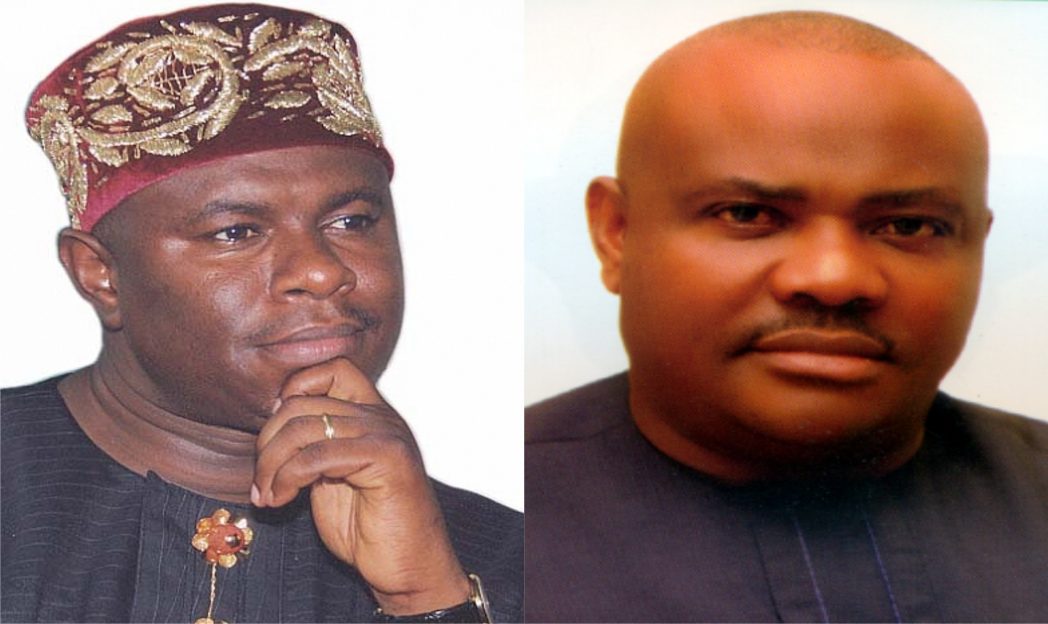
Dakuku Peterside, APC Guber Candidate and Nyesom Wike, PDP Guber Candidate




Justice Peter Lifu of the Federal High Court in Abuja on Monday brushed aside the order of the Court of Appeal in Abuja which ordered him to stay proceedings in a suit that sought deregistration of the African Democratic Party (ADC), Accord Party and three others.
The Court of Appeal in a unanimous decision of a panel of three Justices had on May 22, 2026 directed the Federal High Court Judge not to proceed with the suit until an appeal pending before them and filed by Accord Party is resolved.
In a Certified True Copy Enrol Order of the Superior Court, Justices Mohammed Danjuma, Adebukola Banjoko and Oyejoju Oyewumi asked the lower Court Judge to stay proceedings until all issues on the appeal filed by the Accord Party were resolved
Governor Ademola Adeleke of Osun State had, through the Accord Party, applied to justice Lifu to join him as a defendant in the deregistration legal battle instituted by a group of former legislators.
The contention of the Osun State governor was that he had a stake in the Accord Party, being the platform he was seeking re-election in the August 15 gubernatorial poll in the state.
In his ruling, Justice Lifu on April 27 ruled against the Osun State governor, rejecting his request to be joined in the suit to defend his own position and interest.
Not satisfied with the Federal High Court decision, the Osun State governor, through his lawyer, Musibau Adetunbi (SAN), moved to the Court of Appeal in Abuja where he challenged the Justice Lifu decision to refuse to allow him join the suit.
After listening to the argument canvassed, especially that he has interest to protect as Accord Party gubernatorial candidate for Osun State governorship election, the three Justices of the Court of Appeal, unanimously directed Justice Lifu to allow them look into the grievances of the governor.
In specific terms, the Court of Appeal Justices directed Justice Lifu not to proceed further with the matter and fixed October 27 to determine the interlocutory appeal of the appellant.
However, when the certified enroll order and notice of appeal were served on Justice Peter Lifu by Mr Adetunbi (SAN), the judge rejected it on the ground that it was a ploy to arrest his judgment in the matter.
Although the judge had adjourned his judgment delivery in the matter indefinitely, he finally made a dramatic turn around on Monday and proceeded to deliver the judgment that has now proscribed the five political parties.

Actor turned politician, Mr Kenneth Okonkwo, has rejected the choice of former Rivers State Governor, Mr Rotimi Amaechi, as the running mate to Alhaji Atiku Abubakar in the 2027 presidential election on the platform of the African Democratic Congress (ADC).
In a statement on Monday, Mallam Bolaji Abdulllahi, the National Publicity Secretary of the ADC, announced the party’s choice of Mr Amaechi.
However in a statement, Mr Okonkwo said that the choice of Mr Amaechi from the South South strengthens the continued marginalization of people from the South East.
According to the former spokesperson of the Labour Party, any arrangement that would not factor a person from the South East either as president or vice president in the party is anti-Igbo.
He contended that Chief Raph Nwosu, who founded the ADC in 2005 and willingly surrendered it’s leadership to Senator David Mark did not do so to entrench Igbo marginalization in the party.
The former actor said: “I heard from the social media that ADC has picked its vice presidential candidate from the South-South. If this is true, it is unfortunate, as this will continue the crude marginalisation of the South-East.
“This geo-political zone has neither produced a president or vice president since 1999. To deny the South-East the opportunity to produce the president or vice president in the ADC in 2027, will amount to perpetuating the marginalisation.
“The ADC was founded by Ralphs Nwosu from the South-East in 2005. He made the sacrifice to give up the party in 2025 for the coalition to usher in a better Nigeria. He couldn’t have made that sacrifice to marginalise his own people.
“I did not join the coalition to assist in marginalisation of my own people further. I am of the opinion that if we made a sacrifice to give up the national chairman and the president, it will amount to unpardonable injustice to deny us the vice president in 2027.
“I joined politics to fight for a better Nigeria where no region, geo-political zone, or person will be marginalised.
“The only favour I asked Atiku Abubakar, who openly declared that he is the pathway to the presidency of the South-East, is to show it by choosing someone from the South-East to be his vice.
“If it is confirmed that he has chosen a candidate from the South-South, I wish him well. I am not favourably disposed to campaigning for any presidential ticket that does not have a person of South-East origin as president or vice in 2027”

The National Chairman of the All Progressives Congress (APC), Professor Nentawe Yilwatda, on Monday said that the numerous projects being executed by President Bola Tinubu across the states in the southeast will give him upper hand over other presidential candidates during next year’s general elections.
Prof. Yilwatda stated this at the Abakaliki Township Stadium during a mega rally organized by the Ebonyi State government and Minister of Works, Senator David Umahi, during which President Tinubu and other APC candidates for the 2027 general elections were adopted.
According to the APC National Chairman, no President had done for the southeast region what President Tinubu has done for them and expressed the confidence that the president would not only win in Ebonyi State but in the entire South East.
Prof. Yilwatda also used the occasion to address growing insinuations in some quarters that Ebonyi State had been conceded to the Peoples Democratic Party (PDP) ahead of the 2027 general elections.
Dismissing the claim, Prof. Yilwatda said the state would not allow the PDP to win any position in the forthcoming general election.
“We will return President Bola Ahmed Tinubu and Francis Nwifuru as Governor of Ebonyi State in 2027.
“We want to return all APC senators, members of the House of Representatives and House of Assembly candidates in 2027.
“Nobody has conceded Ebonyi to the PDP. Therefore, there is no vacancy in Ebonyi State. Ebonyi PDP has no place, and there is no vacancy at all in the Government House come 2027,” the APC National Chairman declared.
He commended the people of the state for their support for President Tinubu and urged them to re-elect him in the next presidential election in appreciation of what he has done for the state and the entire South-East through infrastructural transformation and human capital development.
Governor Francis Nwifuru, who also spoke at the event, said the state had no other presidential candidate for the 2027 general elections apart from President Tinubu.
He declared that Ebonyi remained a stronghold of the APC and vowed that the party would deliver the President in the state.
Gov. Nwifuru said President Tinubu had shown exceptional commitment to the state and deserved total support for appointing Senator Umahi as Minister of Works, a role he said Senator Umahi had performed creditably.
“Ebonyi has no other presidential candidate apart from President Bola Ahmed Tinubu, and we will return him in the presidential election.
“We are standing here today to tell the whole world, especially those using the President’s name to orchestrate division and confusion in this great state, that we have only one party, and that is the APC.
“This statement became necessary because some people are going around claiming they have discussed with Mr President and that he has handed Ebonyi over to the PDP. They are also saying that Chief Nyesom Wike is their leader and that Wike said the President has given Ebonyi to him.
“Ebonyi is not for sale. We are restraining ourselves because the people are with us. Nobody should push us because we have what it takes to confront anyone trying to destabilise us.
“We want to tell Mr President that he has earned our votes. He gave us what we had never had in Eastern Nigeria — the office of the Minister of Works. And this Minister of Works is not sitting idle; he is working,” he stated.
Senator Umahi, in his remarks, said President Tinubu had done what no other President had done for Ebonyi State and the entire South-East by executing numerous projects across the state and the region.
“Ebonyi State is a one-party state under Governor Francis Ogbonna Nwifuru. We are not going to repeat the mistakes of the past.
“President Bola Ahmed Tinubu has done a lot, not just for Ebonyi State but for the entire South-East and other geopolitical zones,” he said.