
Nation
THE STATES

Bauchi
The Federal Government said it approved N100 million
in 2011 for the establishment of Entrepreneurship Centres in both federal and state universities in the country.
Prof. Suleiman Bogoro, the Executive Secretary, Tertiary Education Trust Fund (TETFUND), made this known on Wednesday in Bauchi, while declaring open a two-day workshop on “Entrepreneurship for lecturers in higher institutions in the North East Zone’’.
Bogoro, represented by a TETFUND coordinator, Murtala Mustapha said that the centre would produce the needed platform for lecturers, students and members of the public to articulate appropriate strategies for entrepreneurship skills for national development.
He said that TETFUND Board of Trustee, in line with the policy had approved a five-year vision from 2014 to 2019 to deepen its focus on economic content, quality and excellence.
Borno
The Independent Electoral Commission (INEC) said that
it planned to make provisions for Internally Displaced Persons (IDPs) to cast their votes in the 2015 general polls.
The Borno State Resident Electoral Commissioner, Prof. Tukur Sa’ad, said this during a visit to the Shehu of Borno, Alhaji Abubakar Ibn Garbai in Maiduguri.
Sa’ad, however, said that the commission was yet to work out modalities for the IDPs to vote.
He said that the INEC had slated Nov. 28 for the commencement of distribution of Permanent Voter Cards (PVCs) in Borno.
Sa’ad explained that the exercise would hold in 12 out of the 27 local government areas of the state due to the current security challenges.
“The issuance of PVCs to registered voters will take place in only 12 LGAs considered to be relatively safe in Borno.
“The exercise will last for six days,” he said.
FCT
The Minister of Women Affairs and Social Development,
Hajia Zainab Maina, has called on the leadership of political parties to create enabling environment to enhance engagement of women in politics.
Maina, who was represented by the Director of Women and Gender Affairs in the ministry, Mrs Iran Ajufo, made the call when she led women groups in a meeting with chairmen of political parties in Abuja recently.
Maina said that the ministry recognised the role of political parties in determining the political participation of Nigerian women in politics and decision making.
“The National Gender Policy, which has been passed by the Federal Executive Council, has established the benchmark of 35 per cent women representation in public office in Nigeria.
“Poor performance in the basic human development indices in Nigeria reflect the low level of women participation.
He said that in an effort to promote their participation in politics, many of the parties offered free nomination forms to women interested in contesting in the 2015 general elections.
Jigawa
The Government Secondary School in Aujara, Jigawa
State, emerged winner of the quiz competition organised by the Security and Exchange Commission (SEC) for six select secondary schools in the state.
Announcing the result in Dutse, the Head of the North-West zone of the commission, Malam Adamu Sambo, said GSS Aujara scored the highest points of 35.
Sambo said that Dutse Model International School got 32.5 points to place second, while Salem Group of Schools scored 30 points to clinch the third position.
He said that the competition was organised for secondary school students to enable them acquire knowledge on capital market.
“Capital market is an arm of the financial system that strengthens the economy, and no economy can develop globally without it,” he said.
Kogi
The Nigerian Press Council (NPC) has urged journalists
to always follow the ethics of their profession while carrying out their duties.
This is contained in a communiqué signed by the Acting Executive Secretary of the council, Mr Nnamdi Njemanze, at the end of a training workshop for journalists in Lokoja.
The communiqué urged journalists to exercise restraint in their choice of language in order not to overheat the polity and undermine efforts to achieve a peaceful electoral process.
It advised journalists to exercise professionalism in news gathering and not to compromise the tenets of truth, accuracy, balance, fairness and objectivity in their reportage.
Kwara
An Ilorin Magistrates’ Court has remanded Jimoh
Oniwuridi, 30, at the Federal Prison, Oke-kura, Ilorin, for defrauding a man under the pretext of helping him out of his childlessness.
The accused, who resides at Oniwuridi Compound, Pakata area, Ilorin, was arraigned on a charge of Advance Fee Fraud, Contrary to Section 3(1) of Advance Fee Fraud and Other Related Offences Act of the federation, 2004.
The prosecutor, Sgt. Zaccheus Folorunsho, told the court that on October 28 the accused went to the house of Tajudeen Onibon and convinced him that he could solve his wife’s barrenness.
Folorunsho said that the accused fraudulently collected an initial N200, 000 from the complainant and also collected N320, 000 for some sacrifice he claimed he would perform.
He said that investigation also revealed that the accused deceived the victim to dispose of his car at the sum of N140, 000 and his Jincheng motorcycle for N30, 000, and he collected all the money.
Lagos
A Federal High Court in Lagos has ordered that a 38-year-old scavenger, Ismail Ali, charged with drug trafficking be remanded at the Ikoyi Prisons, Lagos.
The accused, a resident of Abutu Alaba Rago in Ojo, Lagos, was arraigned by the National Drug Law Enforcement Agency (NDLEA).
He pleaded guilty to the one-count charge preferred against him.
The trial judge, Justice Rita Ofili-Ajumogobia, consequently ordered his remand at the Ikoyi Prisons and adjourned the case to December 4 for a review of the facts of the case and sentencing of the accused.
According to the charge, the accused is said to have committed the offence on June 3.
Ogun
The Road Safety Officers’ Wives Association of Nigeria
(ROSOWA), Ogun chapter, yesterday donated food items to accident victims at the Ogun State Hospital in Ijebu-Ode.
Our correspondent reports that the items include tins of milk, beverages, soap, toothpaste, toothbrushes, disinfectants and tissue-papers.
Mrs Adekunbi Adetunji, the leader of the delegation and wife of the Ogun sector commander of the Federal Road Safety Corps, said the gesture was to commemorate the UN World Day of Remembrance of Road Accident Victims.
According to her, it is also part of the association’s contribution towards alleviating the plight of the victims.
She urged the beneficiaries to use the items judiciously and join the campaign for the prevention of road accidents in the country.
Plateau
Auntie Mary Secondary School, Langtang, in Jos
emerged Plateau State champions in the ongoing Securities and Exchange Commission (SEC) national quiz competition, aimed at exposing students to the capital market.
Our correspondent reports that the school clinched 40 points from the seven-round quiz to beat its closest rival, St. Louis Secondary School, Jos, who garnered 35 points.
The duo had tied at 35 points at the end of the seven rounds and had to be separated by a fresh round of questions.
Newsmen reports that Nakam Secondary School, Panyam, came third with 25 points, while Pankshin and Barkin-Ladi Government Secondary Schools, with 17 and 10 points, clinched the fourth and fifth positions, respectively.
Government Model Secondary School, Doemark, however, came last with five points.
Yobe
The military, Police and State Security Services in Yobe
State have stressed the need to install Close Circuit Television (CCTV) cameras to monitor movements in schools.
Malam Wakil Kaku, the National Orientation Agency (NOA) state Director, disclosed this in an interview with newsmen in Damaturu.
“The military, Police and State Security Services authorities noted that all schools must be provided with wall fence and installation of close circuit Television (CCTV) cameras to monitor movements and objects in and around the schools.
“The security authorities also emphasised on the need to provide designated entry and exit points to check unauthorised movements around the schools,’’ he said.
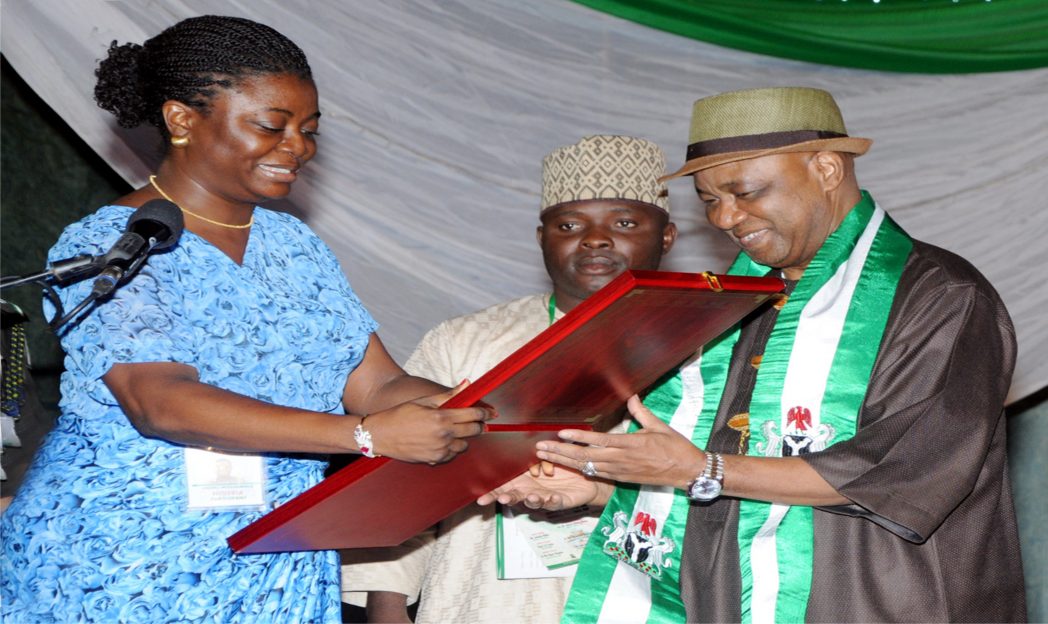
A Youth Leader, Mosunmola Umoru (left), presenting an award to Vice President Namadi Sambo, at the 2014 International Youth Day celebration in Abuja recently



Rivers State University and the Otonti Nduka Foundation for Values Education jointly hosted a two-day National Conference on 8 and 9 May 2026 to examine the state of values in Nigeria.
The two days conference held at Rivers State University convocation arena brought together academics, policymakers, legal experts and education leaders under the theme _“Trends and Challenges in Upholding Values in Nigeria.”_
The gathering focused on policy gaps, curriculum reform, and the role of ethics in public service and education.
The event opened on Friday with remarks from Vice Chancellor Prof. Chief Isaac Zeb-Obipi, who stressed the need to address declining moral and civic values across Nigeria’s education and public sectors. A book of abstracts for the plenary sessions was also presented to participants.
Key speakers included former Attorney General Chief Dr Kanu Agabi, SAN; NERDC Executive Secretary Prof. Shehu Salisu; Prof. Hauwa Imam, FNAE, of the University of Abuja; former Rivers SUBEB Chairman Ven Dr Fyneface Akah, ; former NIMASA DG Dr Hon. Dakuku Adol-Peterside; and RSU Director of ICT Prof. Sunny Orike.
Discussions centered on integrating values education into schools, tertiary institutions and public institutions, alongside the impact of technology on moral development among young Nigerians. Panel and plenary sessions produced practical recommendations for curriculum and policy reform.
On Saturday, the foundation marked its centenary with the unveiling of the book _Otonti Nduka in History_, launched by Chief Engr. Grant Offor, FNSE. The Nigerian Academy of Education held a ceremonial procession led by its President Prof. Olu Jegede and the Ikwerre Professors Forum.
In a communiqué, participants called for stronger collaboration between government, civil society and academia to mainstream values education nationwide. They recommended reviewing teacher training curricula and expanding digital platforms to promote ethical civic engagement, with the foundation pledging to share the outcomes with education authorities for implementation.
Dignitaries present included Ogbakor Ikwerre Worldwide as Chief Host, Prof. Emeritus Chief T. Uzodimma Nwala, the Ikenga 1 of Mbaise and first philosophy student of Prof. Otonti Nduka, alongside scholars and community leaders.
Amadi Akujobi

The Shell Nigeria Gas Limited, in partnership with the Manufacturers Association of Nigeria, has reaffirmed support for efforts to expand gas distribution infrastructure in Rivers State as part of initiatives aimed at improving access to affordable, cleaner and more reliable energy for industries across the South-South region.
The commitment was highlighted during the SNG–MAN Business Forum held in Port Harcourt, where stakeholders from the industrial and public sectors examined the role of natural gas in driving industrialisation, boosting local production and strengthening energy security.
Speaking at the forum on behalf of the Managing Director of Shell Nigeria Gas Limited, the company’s Head of Gas Distribution, Mr. Chukwuka Amos Ejesi, described natural gas as a critical component of Nigeria’s energy mix and a key driver of sustainable industrial growth.
According to him, Nigeria’s gas development agenda has reached a stage where policy direction must be matched with practical implementation capable of addressing the energy challenges confronting manufacturers.
He noted that pipeline gas offers industries a cleaner, more dependable and cost-effective energy alternative capable of supporting uninterrupted operations, reducing emissions and improving production efficiency.
“Gas is the backbone of manufacturing, and we are encouraged by the growing recognition among stakeholders of the need for cleaner and more reliable energy solutions,” he said.
Ejesi stressed the need for sustained collaboration among energy providers, government institutions and industrial stakeholders to maximise the country’s gas resources for economic development.
He added that improved gas infrastructure would strengthen manufacturing value chains, enhance productivity and promote more competitive industrial operations across Rivers State and the wider South-South region.
Participants at the forum also emphasised the importance of expanding energy infrastructure as a pathway to unlocking industrial capacity, reducing operating costs and promoting sustainable industrial development.
Representing Governor Siminalayi Fubara, the Director-General of the Rivers State Investment Promotion Agency, Dr. Chamberlain Peterside, reaffirmed the state government’s commitment to partnering with private sector investors to revitalise industrial activities in the state.
He identified key projects targeted under the initiative to include the revival of the Ahoada Industrial Park, the New Port City project and the proposed Bonny Industrial Park, all aimed at stimulating economic growth and expanding industrial opportunities along the Bonny corridor.
According to the governor, the long-term vision is to position Rivers State as a leading manufacturing hub in Southern Nigeria through strategic public-private partnerships.
Governor Fubara also commended Shell Nigeria Gas and MAN for sustaining engagements geared towards improving industrial energy access, noting that gas infrastructure development remains central to the state’s economic recovery plans.
He further observed that the gas sector presents enormous opportunities for economic growth, especially as global energy systems continue to shift towards cleaner energy sources.
The governor called on stakeholders to work collectively towards developing a practical and sustainable gas framework capable of supporting the state’s industrial and energy development objectives.
Chairman of MAN, Rivers and Bayelsa Branch, Elder Vincent Okuku, described gas as indispensable to industrial operations, noting that many manufacturers continue to struggle with the high cost of alternative energy sources.
Similarly, President of the Port Harcourt Chamber of Commerce, Industry, Mines and Agriculture, Dr. Chinyere Ngozi Nwoga, said the transition to natural gas had become increasingly necessary for businesses seeking stable and cost-efficient operations.
“Pipeline natural gas provides a more cost-effective and reliable source of energy for industries,” she stated.
Also speaking, former Chairman of MAN in Rivers and Bayelsa States, Mrs. Emilia Akpan, stressed the need to align energy infrastructure development with investment in human capacity.
She maintained that rebuilding the state’s economy would require not only reliable energy supply but also the development of technical skills needed to support long-term industrial growth.
By Kevin Nengia

The City Boy Movement in Etche Local Government Area of Rivers state has commended Senator Allwell Onyesoh on his victory in the APC primary election for Rivers East Senatorial District.
Chairman of the group in Etche, Dr. Fortune Uchenna Obi, spoke to journalists in Okehi Ward after participating in Monday’s direct primary. He described Onyesoh’s emergence as the party’s candidate for the 2027 senatorial election as a reflection of the people’s will.
Dr. Obi said the senator has performed well during his first term and deserves re-election. He also thanked FCT Minister Nyesom Wike, leader of the Renewed Hope Agenda and Rainbow Coalition in Rivers State, for supporting Onyesoh’s candidacy. According to him, Wike’s backing was instrumental to the senator’s nomination, clearance, and victory at the primary.
He further praised voters in Etche and across Rivers East for turning out in large numbers at ward centers and urged them to sustain the support to ensure Onyesoh’s success in the January 2027 general election.