
Nation
THE STATES

Adamawa
Former APC National Vice Chairman, North-East, Alh.
Umaru Duhu, has alleged that the impeachment plan against Adamawa State governor, Murtala Nyako by the state House of Assembly was instigated by the Presidency.
Duhu stated that the political squabble was as a result of the memo written by the governor to the Northern States Governors’ Forum (NSGF) and the international community wherein he expressed his concerns over the spate of insurgency in the country, especially in the North-East.
He counselled President Goodluck Jonathan to concentrate his attention on tackling the current security challenges in the country rather than sponsoring impeachment in the state. He equally described the Speaker of the state House of Assembly, Hon. Ahmadu Umaru Fintiri, as being over ambitious and selfish.
Duhu disclosed that efforts are being made by stakeholders in the state to broker the peace in the political logjam, adding that “the only problem we have in Adamawa State today is inflicted on us by the Presidency due to Nyako position on the insurgency in the country.
Ekiti
The Nigerian Medical Association (NMA), Ekiti State
chapter, has condemned Federal Government’s plan to appoint nurses and pharmacists as consultants and Chief Medical Directors of public health institutions in the country.
The NMA, at a press conference to kick start the nationwide strike also called for the scrap of Joint Health Sector Union, which represents the amalgamation of all sectors in the country.
The body said each professional affiliate body should be allowed to operate through their parent organizations.
Speaking through their state chairman, Dr Obitade Obimakinde, the NMA at a press conference in Ado Ekiti, argued that the new structure as being mooted by the federal government is capable of causing internal confusion in health institutions.
Obimakinde said pharmacists and nurses must be allowed to play supportive roles and take directives from doctors, rather than “eroding the well entrenched clinical structures in the hospitals”.
FCT
The Inspector-General of Police, Mr Mohammed Abubakar,
last Thursday said continuous acquisition of knowledge by officers and men of the force was required for effective policing.
Abubakar said at the inauguration of the Police Special Study Centre of the National Open University of Nigeria at the Dei Die Police barracks in the FCT, that with the establishment of the centre, personnel of the force aspiring to acquire higher qualification could do so without necessarily leaving their place of primary responsibility.
He said, “Policing requires acquisition of knowledge and with this special study centre, university education has been brought very close to us. Our journey to the land of knowledge has begun as higher qualification can be pursued and obtained without going far from our place of primary responsibility.”
Abubakar charged officers and men of the force to take advantage of the centre and acquire additional qualifications.
Kaduna
A first class traditional ruler in the Southern part of Kaduna
State last Thursday shunned protesting youths who staged a peaceful protest to his palace over the persistent killings and destructions in the area.
The youths, under the aegis of Concerned Southern Kaduna Youths (CSKY) had marched peacefully to the palace of the paramount ruler of Kagoro in Kaura Local Government of Kaduna State, Chief Ufuwai Bonet, to present a protest letter for onward delivery to other traditional rulers in the southern part of Kaduna State.
However, on arrival at the palace, the traditional ruler refused to grant them audience on the ground that the youths did not follow due process to see him.
Determined to present the letter, the youths vowed not to leave the palace until the chief gave them audience and decided to sit on the ground, singing gospel songs.
It was gathered that all efforts to convince the traditional ruler to grant audience to the youths was unsuccessful as he insisted that the group did not inform him that they were coming to see him.
Appeals by the protesting youths, including a former Kaduna State Attorney-General and Commissioner for Justice, Mr. Jonathan Kish Adamu, who is from the area could not make the chief to change his mind.
Kwara
Exactly two weeks after the death of Aare Musulumi of
Yoruba land, Abdul-Azeez Arisekola-Alao, one of his widows, Jelilat, died in an auto-crash at Eyenkorin, near Ilorin, Kwara State last Tuesday evening. She was aged 62.
The late Jelilat was the eldest wife of the late billionaire, who died in his London home on the day he was due back in Nigeria. Her late husband had died of a heart-related disease in his sleep in London after taking his breakfast and drugs.
She had two children for the Muslim leader, Abdullahi and Fatimah. She was buried at her residence in Apata area of Ibadan last Wednesday.
Family, friend’s children and neighbours mourned the late Jelilat Arisekola-Alao, describing her as a devout Muslim and a generous neighbour.
Ogun
The Committee for Defence of Human Rights in Ogun State
recently called on the operatives of Economic and Financial Crimes Commission and Independent Corrupt Practices and other Related Offences Commission to probe alleged diversion of fund allocated to some local governments in the state.
The state chairman of the CDHR in the state, Mr. Folarin Olayinka, stated this during a press conference held at NUJ Secretariat, Oke-Ilewo, Abeokuta.
The organisation also demanded a statement of appropriated Federal allocation, Internally Generated Revenue, statement of expenditure and a document of projects activities embarked upon by the local governments between July 2012 and April 2014.
Olayinka said the CDHR has written to some of the councils which include: Abeokuta South, Abeokuta North, Sagamu, Ifo, Ado-Odo-Ota, Ijebu-Ode and Odogbolu, to make available their accounts to them for scrutiny, exploring the Freedom of Information Act.
According to him, the petitioners had alleged that the projects many of them executed were not commensurate with allocation they received.
Ondo
As part of the ongoing revolution in the agriculture sector,
Ondo State Government will soon present a bill on Cocoa Revolution to the state House of Assembly.
The state Commissioner for Information, Kayode Akinmade, who disclosed this recently explained that the bill when passed into law would enable government to actualise its decision to make cocoa farmers to begin to reap the fruits of their labour.
He said government would not allow cocoa farmers in the state to be ripped off any longer, adding that “by the time the bill becomes law, the cocoa business would naturally receive a boost and the farmers would be encouraged to do more.”
Akinmade said the initiative of Governor Olusegun Mimiko to revamp cocoa production through the Cocoa Revolution Project was a good vision and another landmark in boosting the revenue of the state and declared that the project and all matters connected therewith would be encompassed in the bill for the sustainability of the project.
Oyo
The Oyo State Governor, Abiola Ajimobi, says the state
workers salary had grown from N2 billion to N4.6 billion in the last three years. The governor lamented that developmental projects in the state had suffered because the state’s share from federal allocation had not been enough to prosecute the projects in the state.
Ajimobi spoke at the 2014 Adegoke Adelabu Memorial Lecture in Ibadan, Oyo State, recently, where he condemned the type of politics witnessed today as compared to what obtained in the days of the late prominent Ibadan politician.
He said, “In the last three years, this administration has increased workers salary from a total of N2bn that we met to N4.6bn every month. We receive allocation from the Federal Government but if we have to do everything needed to be done in the state at a time, the money can never be enough because our people need lots of assistance from us.”
The governor added that Adedibu’s name would be immortalised by the state government with an edifice, promising the same in honour of the late Aare Musulumi of Yoruba land, AbdulAzeez Arisekola-Alao, who died on June 18.
Guest speaker at the forum, Prof. Isiaka Aransi, who delivered a lecture titled ‘Local Government and its Impact on the People’, called for the creation of more local government as the only solution to the social challenges in the country.
Plateau
The University of Jos said it would spend over N40 million
to establish three new faculties for the study of Veterinary Medicine, Agriculture and Engineering.
Vice Chancellor of the university, Prof. Hayward Babale Mafuyai, who spoke with newsmen recently, said plans have reached advanced stage to establish the new faculties and have them take off by October this year.
Mafuyai said the programmes would require a lot of financial and material support to meet the requirements of the National Universities Commission (NUC) and the various professional bodies in the country.
He said when fully established, the faculties would address the problem of numerous candidates seeking university education and appealed to federal and state governments as well as public-spirited individuals to provide the university with critical support materials for infrastructural development.
Taraba
Taraba State acting governor, Alhaji Garba Umar, has flagged
off the distribution of farm inputs to farmers in the state.
Speaking during the exercise, Umar said the procurement of free farm inputs for farmers was part of government’s efforts aimed at boosting production and guarantee food security in the state.
“This year’s rains have given the indication of a good wet season. We are very hopeful that the Almighty God and nature will bless us with the right amount of rain that will lead to bumper harvest. I therefore urge our hardworking and dedicated farmers to take advantage of this combination of factors created by the Almighty, nature and the government to step up production level this year”, he said.
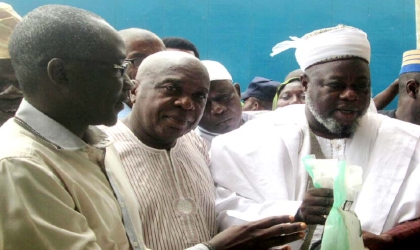
L-R: Ekiti State Deputy Governor-elect, Dr Olusola Eleka, Director-General, Ayo Fayose Campaign Organisation (AFCO), Chief Dipo Anisulowo and Ekiti State Chief Imam, Alhaji Jamiu Kewulere, during the presentation of bags of rice to Ekiti Muslim faithful for Ramadan at Ado-Ekiti Central Mosque, recently.



The University of Port Harcourt Women Association (UPWA) on Thursday staged a vibrant and memorable edition of its Annual Inter-House Sports Competition at the University of Port Harcourt Sports Village, drawing an impressive turnout of pupils, parents, staff and invited guests.
The event, organised by the UPWA International Group of Schools, brought together children from the pre-nursery, nursery and secondary sections in a colourful celebration of youth athleticism, discipline and teamwork. The arena came alive with cheers and excitement as pupils, clad in their various house colours, marched in a ceremonial parade before proceeding to compete in a wide range of track and field events, relays, novelty races and other team-based activities designed to promote physical fitness and healthy competition.
Declaring the competition open, the Vice-Chancellor of the University of Port Harcourt, Professor Owunari Georgewill, commended UPWA for sustaining a tradition that continues to nurture young talents beyond the classroom. He noted that sports remain a critical component of holistic education, helping to build resilience, confidence, leadership skills and social interaction among children.
In her remarks, the President of UPWA, Professor Udeme Georgewill, expressed appreciation to parents, teachers and members of the organising committee for their dedication and sacrifice in ensuring the success of the programme despite prevailing economic challenges. She described the event as a reflection of unity and collective effort within the school community.
“This is the first time White House is emerging overall winner, and that shows remarkable improvement and great sportsmanship,” she said. “We all had fun. It is not easy putting an event like this together considering the economic situation, but we are grateful to the parents for being part of this journey. The excitement everywhere is truly heartwarming.”
The competition featured spirited participation from the various houses, including Purple House, San Chicago Red House and White House, with pupils demonstrating strength, speed, coordination and teamwork. Parents and supporters filled the stands, cheering enthusiastically and adding colour to the spectacle, while teachers ensured orderliness and safety throughout the proceedings.
Professor Georgewill emphasized that the true essence of sports lies not merely in winning trophies but in participation and personal growth. “Sports is not just about winning. It is an avenue for growth, discipline and opportunity. The fact that a child is able to participate is already a win. Losing this year does not mean you cannot win next year. Keep trying,” she encouraged, urging pupils to see both victory and defeat as stepping stones to greater achievements.
She further observed that while there are many competing interests in the Nigerian sports sector, consistent grassroots investment remains essential for discovering and nurturing future champions.
The colourful ceremony culminated in medal presentations, trophy awards and group photographs, with UPWA executives, including Vice President I, Professor Adedamola Onyeaso, joining the participating teams to celebrate the day’s achievements.
The annual inter-house sports competition continues to stand as one of UPWA’s flagship events, reinforcing its commitment to balanced education, character formation and the promotion of healthy lifestyles among its pupils.
 Nigeria’s quest for national greatness may remain elusive if educational policies continue to suffer poor implementation, Prof Nathaniel Abraham has warned, declaring that education remains the strategic compass capable of steering the country toward sustainable growth and global competitiveness.
The respected scholar made this assertion while delivering the 206th Inaugural Lecture of the University of Port Harcourt at its Abuja Centre of Excellence. His lecture, titled, “The Rudderless Ship and Its Major Rescuer,” employed a striking maritime metaphor to illustrate the state of the nation’s educational system and, by extension, its development trajectory.
According to Prof. Abraham, the rudder, though a small and seemingly insignificant component located at the rear of a ship, determines the direction, stability, and safety of the entire vessel. Without it, even the most magnificent ship with powerful engines and sophisticated equipment will drift aimlessly and is at risk of wreckage. He likened this crucial component to educational policies in a nation’s governance structure, arguing that policies serve as the guiding mechanism that determines whether a country reaches its intended destination or wanders endlessly without direction.
In his analysis, he noted that Nigeria possesses abundant human and natural resources and is not! lacking in intellectual capacity or policy formulation. However, he emphasised that the country’s recurring challenge lies in weak implementation, inconsistency, and a culture of cutting corners.
He recalled that at independence in 1960, Nigeria stood shoulder to shoulder with several nations that are now classified among the world’s leading economies. The difference, he maintained, is not destiny or potential, but discipline and adherence to policy execution.
“What made them move forward was discipline and the will to implement policies the way they were designed. For as long as we trivialise our educational policies, we will continue to drift. But the moment we commit to proper implementation, Nigeria is destined for greatness,” he stated.
Prof. Abraham stressed that education remains the foundation upon which every other sector stands. He argued that a properly structured and effectively managed educational system produces competent manpower, ethical leadership, innovation, and national cohesion. Conversely, a poorly managed system weakens governance, slows economic growth, and undermines social stability.
Delving into higher education administration, the Professor identified funding as a critical coordinate of effective university management. Drawing from his scholarly publications in international journals, he explained that adequate and well-managed funding directly impacts teaching quality, research output, infrastructure development, staff motivation, and global competitiveness of universities.
He described the current funding situation in Nigerian universities as grossly inadequate, noting that without intentional and strategic financial investment, reforms may remain theoretical.
“Funding is very poor. If we address it deliberately and commit to doing it right, the transformation will be evident,” he affirmed.
Beyond funding, he called for collective responsibility in rebuilding the education sector, urging policymakers, administrators, lecturers, parents, and students to play active roles in restoring value and credibility to the system.
He emphasised that education should not be seen as the exclusive concern of those currently within school walls, but as a national asset that shapes future generations and determines the country’s long-term prosperity.
Respondents at the well-attended lecture described it as both diagnostic and prescriptive, noting that Prof. Abraham not only identified systemic weaknesses but also offered a roadmap for reform. Some participants expressed optimism that the insights presented could serve as a blueprint for policymakers if carefully studied and adopted.
The event drew members of the academia, deans, the clergy, stakeholders, and guests from various sectors who commended the inaugural lecturer for what many described as a courageous and timely intervention in the national conversation on education.
At the conclusion of the lecture, Prof. Abraham was flanked by deans and colleagues in recognition of his contribution to scholarship and public discourse.
The 206th Inaugural Lecture once again highlighted the role of the University of Port Harcourt as a centre for intellectual engagement and policy advocacy. More importantly, it amplified a central message: without a functional “rudder” in the form of faithfully implemented educational policies, Nigeria’s journey toward development may remain uncertain. But with discipline, adequate funding, and unwavering commitment to policy execution, the nation can chart a new course toward enduring greatness.

Former Students’ Union Government (SUG) leaders of the University of Port Harcourt, have organised a one-day symposium in honour of the institution’s outgoing Vice Chancellor, Prof Owunari Abraham Georgewill, as his tenure draws to a close.
The maiden symposium, with the theme, “Resolution: From Agitations to Negotiations,” was convened by five past presidents of the university’s SUG as a mark of appreciation for what they described as a student-friendly and peaceful administration under the 9th Vice Chancellor of the university.
The event, held recently at the University of Port Harcourt Centre of Excellence, Abuja Campus, attracted past and present student leaders, members of the academic community, and invited guests.
In his remarks, the current SUG President, Sen. Amaechi Walson Tonye, said the cordial relationship between the Vice Chancellor and the student body informed the decision to organise the symposium, noting that students were proud to associate with a Vice Chancellor who consistently listened to their concerns and prioritised dialogue in resolving issues.
He commended the past SUG leaders for taking the bold initiative to honour the Vice Chancellor, describing the gesture as a reflection of the mutual respect and understanding that characterised the administration.
Speaking in an interview, Prof. Georgewill expressed gratitude to God and the students for the recognition accorded him. He described the honour as deeply significant, recalling that from his first day in office, he pledged to work closely with students to foster peace and ensure uninterrupted academic activities.
According to him, the peaceful atmosphere enjoyed on campus over the past five years was a result of deliberate engagement and a shared commitment to negotiation rather than confrontation.
“For the five years of my administration, we did not experience student-related demonstrations, closure of the school, or management-student crises, which are common in many institutions.We are celebrating because we chose negotiation over agitation. That is the essence of today’s honour,” he said.
He urged Vice Chancellors and student union leaders across the country to prioritise dialogue in addressing grievances, stressing that negotiation remains the best pathway to stability and academic progress.
Prof. Georgewill added that he would like to be remembered for humble and humane leadership anchored on inclusiveness and constructive engagement. He attributed the stability and infrastructural development recorded during his tenure to the grace of God and the cooperation of stakeholders.
The symposium featured a keynote lecture delivered by Prof. Obari Gomba, presentation of awards to the Vice Chancellor and the Dean of Student Affairs, Prof. Wokoma Chima, as well as a drama performance and goodwill messages from former SUG presidents.
Among those who spoke were Comrade Ubabuike Gift; Comrade Dickson Senibo; Comrade Okpara Martins; and Comrade Harmony Lawrence, who initiated and coordinated the event alongside other past student leaders.
The event concluded with renewed calls for sustained collaboration between university management and students to preserve the culture of peace and dialogue at the institution.
-

 News3 days ago
Amend Constitution To Accommodate State Police, Tinubu Tells Senators
-

 Politics3 days ago
Senate Urges Tinubu To Sack CAC Boss
-

 News2 days ago
Disu Takes Over As New IGP …Declares Total War On Corruption, Impunity
-
Business3 days ago
President Tinubu Extends Raw Shea Nuts Export Ban To 2027
-
Business3 days ago
Crisis Response: EU-project Delivers New Vet. Clinic To Katsina Govt.
-
Business3 days ago
President Tinubu Approves Extension Ban On Raw Shea Nut Export
-
Sports3 days ago
NDG: Rivers Coach Appeal To NDDC In Talent Discovery
-
Rivers3 days ago
Etche Clan Urges Govt On Chieftaincy Recognition