
Nation
THE STATES

Borno
The Borno-based vigilance group, the Civilian JTF, has
called on the 7 Division, Nigerian Army, to relax the curfew in Maiduguri, to enable it contribute more in checkmating suspected terrorists.
The Legal Adviser to the group, Mr Jubrin Gunda, who made the call while addressing newsmen recently in Maiduguri said relaxing the curfew would enable members of his group to keep a 24-hour vigil on major roads leading into the city.
“We want to appeal to the 7 Division of the Nigerian Army and the state government to please review or lift the current 7 p.m. to 6 a.m. curfew in Maiduguri. We believe that the curfew has given individuals with bad intention easy access to the state capital as our members have been kept away,” Gunda said.
He said that the vigilance members would have done their bit to prevent the January 14 blast if they had been allowed to keep a vigil.
Ekiti
A sanitary officer in Ikole Local Government Area of
Ekiti State, Mr Michael Olagbaju, has warned inhabitants of the area to avoid drinking unwholesome water to avert water-borne diseases.
Olagbaju, who gave the warning last Thursday in an interview in Ikole advised the residents to ensure that they got water from good sources, stressing that water-borne diseases were often rampant during the dry season.
“Unwholesome sachet and bottled water should be rejected and people should check for NAFDAC number and origin of such bottled or sachet water before buying. Water from river, untreated wells and other doubtful sources should be boiled properly before drinking,” she said.
Olagbaju called for regular sanitary inspection in every part of the local government area to ensure healthy living among the residents and urged the people to provide health officers in their communities with information on any health challenges to enable them to take prompt action in addressing such challenges.
FCT
The Copyright Society of Nigeria (COSON) says the Na
tional Broadcasting Commission’s (NBC) decision affirming COSON’s legality to collect royalties on behalf of musical artists is a victory for stake holders in the industry.
Chairman of the Society, Chief Tony Okoroji, who made the declaration in a statement signed by COSON’s Senior Executive, Media, Miss Mayree Uket, last Thursday in Abuja, said that the declaration over the dispute in the broadcast industry was a boost to the industry.
Okoroji said respect for intellectual property rights would benefit the music, film or literary industries in the country and expressed optimism that the NBC’s decision would make the broadcasting stations become centres of profitable, marketable and exportable programming, instead of just being sellers of air time.
Gombe
No fewer than three villages will be relocated to protect
residents from environmental hazards, as a result of the expansion of the Ashaka Cement Company in Gombe State.
The company’s General Manager, Projects, Mr Tony Okpara, disclosed this in Ladde-Bage village of Funakaye Local Government Area of the state recently during the foundation-laying ceremony of some projects.
He named the three communities as Lariski, Darumpa and Malari, and said the company was preparing to spend N262 million on the relocation.
The General Manager said the amount would be spent on the construction of 55 houses, three blocks of classrooms, clinic, mosque and three boreholes for the affected communities.
Jigawa
No fewer than 11 persons have been killed by cholera
outbreak in Jigawa State, the Commissioner for Health, Dr Abubakar Tafida, has said.
In a statement signed by the Public Relations Officer in the state Ministry of Health, Malam Mati Ali, recently in Dutse, said that a total of 153 cholera cases were reported in the state from January 1 to date.
The statement said that the cholera cases were reported in Taura, Birnin Kudu, Garki, Ringim, Babura and Gwaram local government areas of the state, adding that the situation was currently under control.
Kaduna
Wife of the Vice President, Hajiya Amina Sambo, has
described Theatre and Performing Arts as tool for addressing socio-political and economic issues in the society.
Sambo made the remark recently at the inauguration of the Centre of Excellence on Development Communication at the Department of Theatre Arts, Ahmadu Bello University (ABU), Zaria.
The VP’s wife, who was represented by wife of Kaduna State Governor, Hajiya Fatima Yero, said the disciplines had pushed forward messages that promoted good relationships, peace, understanding and scholarship.
“Perhaps that explains why ABU through the department of theatre and performing arts has been engaging communities, especially women and children since its inception in 1975. This is evident in the impact the products of the institution are making in the country and beyond,” she said.
Kebbi
A Non-Government Origination, Youth Advancement
Organisation of Nigeria, says it has intensified its campaign on malaria prevention and diarrhoea management in rural areas of Kebbi.
The Project Director, Alhaji Haruna Alkassim, who made this known in an interview in Birnin Kebbi last Thursday, said that the campaign was being conducted in collaboration with the United States Agency for International Development (USAID).
He said that funding from USAID was utilised to promote child survival interventions, nutrition, breast-feeding, malaria and diarrhoea prevention, treatment and management.
Alkassim said that 150,263 people had been enlightened on the prevention of the diseases in 15 local government areas from January 2013 to date.
Lagos
The Attorney-General of Lagos State, Mr Ade Ipaye,
has stressed the need for a conducive working environment for judges, in order to enhance smooth dispensation of justice.
Ipaye spoke during a valedictory court session held at the Federal High Court, Lagos, in honour of retired Justice Marcellus Awokulehin, who bowed out last Thursday.
According to Ipaye, inadequate working tools and power failure are also now common place in the courts, adding that it constituted a major draw back to the productivity of judges.
“There are harsh working conditions for our judges in the courts and this is almost becoming a norm. Cases of congested courtrooms, inadequate working tools, power failure, are almost becoming normal, and this is very unacceptable”, he said.
Nasarawa
A youth advocate in Keffi, Nasarawa State, Mr Monday
Adamu, last Thursday called on the state government to initiate more youth programmes to reduce youths’ restiveness and other vices.
In an interview in Keffi, headquarters of Keffi Local Government Council, he warned that government should not concentrate on developing the towns, while the villages were suffering.
Another youth, Mr Bala Bernard, also urged the state government to delegate its officials to visit villages and communities to know the state of infrastructure.
He said that it was necessary for government to know the state of the facilities with a view to improving on them and ensure even development.
Ondo
The Ondo State Government last Thursday called on
contractors handling road projects in the state to ensure completion of the projects on schedule.
The state Commissioner for Works, Mr Gboye Adegbenro, who made the call in Akure when he spoke to the contractors and consultants handling the jobs said the state government was “in a hurry to deliver all the road projects to the benefit of the people of the state”.
“Our target now is to complete all ongoing roads projects in the three senatorial districts of the state this year. Some of the roads will be commissioned in this first quarter of the year,” he said.
Responding, the manager of CGC Nig. Ltd, Mr Li-Hung Guang, who spoke on behalf of the contractors, assured the commissioner that they would deliver on their jobs according to specifications.
Oyo
The Archbishop of Ibadan Catholic Diocese, Alaba Job,
is set to retire from service after 43 years. His successor, Archbishop Gabriel Abegunrin, would be installed on January 24.
The Chairman, Central Planning Committee for the installation of Abegunrin, Rev. Fr. Felix Ethapemi, disclosed this at a news conference held at St. Mary’s Cathedral, Oke-Padre, Ibadan, last Thursday.
He said that having attained the canonical retirement age of 75 years on October 29, 2013, Job had applied to Pope Francis 1 for retirement disclosing that the Pope, had approved his application and appointed Abegunrin to succeed him.
Ethapemi said that Abegunrin would retain his administrative duties as Bishop of Osogbo Diocese until a new bishop was appointed.
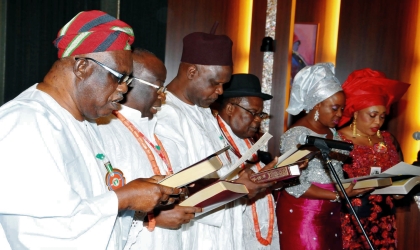
A cross section of members of the Federal Character Commission Board taking their oath of office during the inauguration of the board by President Goodluck Jonathan in Abuja, last Wednesday. Photo: NAN.



Rivers State University and the Otonti Nduka Foundation for Values Education jointly hosted a two-day National Conference on 8 and 9 May 2026 to examine the state of values in Nigeria.
The two days conference held at Rivers State University convocation arena brought together academics, policymakers, legal experts and education leaders under the theme _“Trends and Challenges in Upholding Values in Nigeria.”_
The gathering focused on policy gaps, curriculum reform, and the role of ethics in public service and education.
The event opened on Friday with remarks from Vice Chancellor Prof. Chief Isaac Zeb-Obipi, who stressed the need to address declining moral and civic values across Nigeria’s education and public sectors. A book of abstracts for the plenary sessions was also presented to participants.
Key speakers included former Attorney General Chief Dr Kanu Agabi, SAN; NERDC Executive Secretary Prof. Shehu Salisu; Prof. Hauwa Imam, FNAE, of the University of Abuja; former Rivers SUBEB Chairman Ven Dr Fyneface Akah, ; former NIMASA DG Dr Hon. Dakuku Adol-Peterside; and RSU Director of ICT Prof. Sunny Orike.
Discussions centered on integrating values education into schools, tertiary institutions and public institutions, alongside the impact of technology on moral development among young Nigerians. Panel and plenary sessions produced practical recommendations for curriculum and policy reform.
On Saturday, the foundation marked its centenary with the unveiling of the book _Otonti Nduka in History_, launched by Chief Engr. Grant Offor, FNSE. The Nigerian Academy of Education held a ceremonial procession led by its President Prof. Olu Jegede and the Ikwerre Professors Forum.
In a communiqué, participants called for stronger collaboration between government, civil society and academia to mainstream values education nationwide. They recommended reviewing teacher training curricula and expanding digital platforms to promote ethical civic engagement, with the foundation pledging to share the outcomes with education authorities for implementation.
Dignitaries present included Ogbakor Ikwerre Worldwide as Chief Host, Prof. Emeritus Chief T. Uzodimma Nwala, the Ikenga 1 of Mbaise and first philosophy student of Prof. Otonti Nduka, alongside scholars and community leaders.
Amadi Akujobi

The Shell Nigeria Gas Limited, in partnership with the Manufacturers Association of Nigeria, has reaffirmed support for efforts to expand gas distribution infrastructure in Rivers State as part of initiatives aimed at improving access to affordable, cleaner and more reliable energy for industries across the South-South region.
The commitment was highlighted during the SNG–MAN Business Forum held in Port Harcourt, where stakeholders from the industrial and public sectors examined the role of natural gas in driving industrialisation, boosting local production and strengthening energy security.
Speaking at the forum on behalf of the Managing Director of Shell Nigeria Gas Limited, the company’s Head of Gas Distribution, Mr. Chukwuka Amos Ejesi, described natural gas as a critical component of Nigeria’s energy mix and a key driver of sustainable industrial growth.
According to him, Nigeria’s gas development agenda has reached a stage where policy direction must be matched with practical implementation capable of addressing the energy challenges confronting manufacturers.
He noted that pipeline gas offers industries a cleaner, more dependable and cost-effective energy alternative capable of supporting uninterrupted operations, reducing emissions and improving production efficiency.
“Gas is the backbone of manufacturing, and we are encouraged by the growing recognition among stakeholders of the need for cleaner and more reliable energy solutions,” he said.
Ejesi stressed the need for sustained collaboration among energy providers, government institutions and industrial stakeholders to maximise the country’s gas resources for economic development.
He added that improved gas infrastructure would strengthen manufacturing value chains, enhance productivity and promote more competitive industrial operations across Rivers State and the wider South-South region.
Participants at the forum also emphasised the importance of expanding energy infrastructure as a pathway to unlocking industrial capacity, reducing operating costs and promoting sustainable industrial development.
Representing Governor Siminalayi Fubara, the Director-General of the Rivers State Investment Promotion Agency, Dr. Chamberlain Peterside, reaffirmed the state government’s commitment to partnering with private sector investors to revitalise industrial activities in the state.
He identified key projects targeted under the initiative to include the revival of the Ahoada Industrial Park, the New Port City project and the proposed Bonny Industrial Park, all aimed at stimulating economic growth and expanding industrial opportunities along the Bonny corridor.
According to the governor, the long-term vision is to position Rivers State as a leading manufacturing hub in Southern Nigeria through strategic public-private partnerships.
Governor Fubara also commended Shell Nigeria Gas and MAN for sustaining engagements geared towards improving industrial energy access, noting that gas infrastructure development remains central to the state’s economic recovery plans.
He further observed that the gas sector presents enormous opportunities for economic growth, especially as global energy systems continue to shift towards cleaner energy sources.
The governor called on stakeholders to work collectively towards developing a practical and sustainable gas framework capable of supporting the state’s industrial and energy development objectives.
Chairman of MAN, Rivers and Bayelsa Branch, Elder Vincent Okuku, described gas as indispensable to industrial operations, noting that many manufacturers continue to struggle with the high cost of alternative energy sources.
Similarly, President of the Port Harcourt Chamber of Commerce, Industry, Mines and Agriculture, Dr. Chinyere Ngozi Nwoga, said the transition to natural gas had become increasingly necessary for businesses seeking stable and cost-efficient operations.
“Pipeline natural gas provides a more cost-effective and reliable source of energy for industries,” she stated.
Also speaking, former Chairman of MAN in Rivers and Bayelsa States, Mrs. Emilia Akpan, stressed the need to align energy infrastructure development with investment in human capacity.
She maintained that rebuilding the state’s economy would require not only reliable energy supply but also the development of technical skills needed to support long-term industrial growth.
By Kevin Nengia

The City Boy Movement in Etche Local Government Area of Rivers state has commended Senator Allwell Onyesoh on his victory in the APC primary election for Rivers East Senatorial District.
Chairman of the group in Etche, Dr. Fortune Uchenna Obi, spoke to journalists in Okehi Ward after participating in Monday’s direct primary. He described Onyesoh’s emergence as the party’s candidate for the 2027 senatorial election as a reflection of the people’s will.
Dr. Obi said the senator has performed well during his first term and deserves re-election. He also thanked FCT Minister Nyesom Wike, leader of the Renewed Hope Agenda and Rainbow Coalition in Rivers State, for supporting Onyesoh’s candidacy. According to him, Wike’s backing was instrumental to the senator’s nomination, clearance, and victory at the primary.
He further praised voters in Etche and across Rivers East for turning out in large numbers at ward centers and urged them to sustain the support to ensure Onyesoh’s success in the January 2027 general election.
-

 Editorial2 days ago
Enough Of Xenophobic Attacks On Nigerians
-

 Nation2 days ago
RSU, Otonti Nduka Foundation Holds Centenary Conference, Unveil Book on Values in Nigeria
-

 Oil & Energy2 days ago
Rivers PETROAN Elects 12-Member Executive
-

 Sports2 days ago
Oparaodu Urges Rivers United To Win Katsina United
-
Politics2 days ago
APC Group Protests Ex–Presidential Aspirant’s Disqualification From Rivers Senatorial Race
-
Politics2 days ago
Reps Speaker Secures APC Return Ticket For Fifth Term
-

 Sports2 days ago
” Nigeria’s best domestic players are not in NPFL”
-
Politics2 days ago
Primaries: Diri Lauds APC’s Unity, Cohesion In Bayelsa