Business
Agriculture Remains Backbone Of Nigeria’s Economy – CBN
The Governor of Central Bank of Nigeria (CBN), Mr. Godwin Emefiele, says agriculture remains a strong pillar and saving grace for the Nigerian economy.
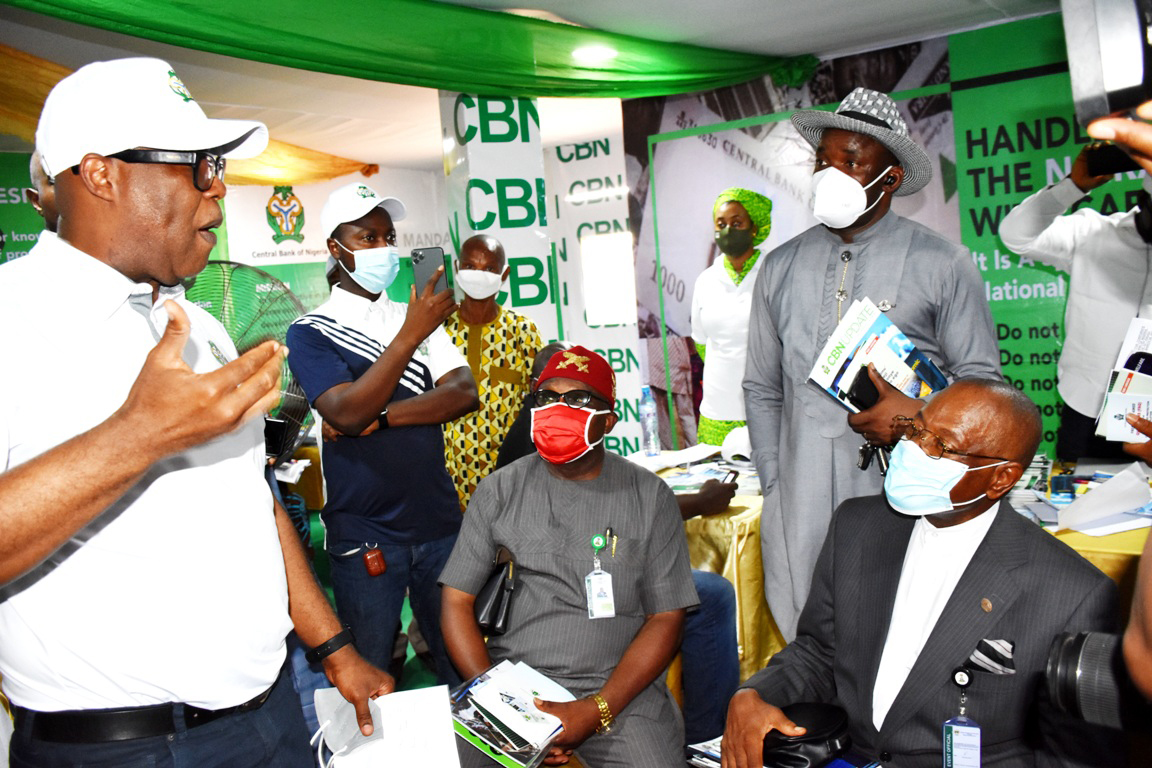
Emefiele said this recently while addressing journalists during an inspection tour of a palm plantation at Odighi Village in Ovia North East Local Government Area of Edo State.
The CBN Governor expressed satisfaction with the level of interest shown in agriculture and the tremendous impact the sector had had in the last six years.
He wondered how the country could have coped with the rising prices of food and commodity items across the world without the foresight to revamp agriculture.
Emefiele said the Central Bank had assumed a pivotal role in agriculture since 2015, when President Muhammadu Buhari directed that “we produce what we eat and eat what we produce”.
The apex bank had “come up with several initiatives aimed towards repositioning the sector with a view to creating employment opportunities as well as growing the Gross Domestic Product (GDP)”, he said.
Shortly after the assessment of farm, Emefiele attested to the giant strides already being recorded in the production of maize and cassava and expressed optimism that in the next 12 months, palm produce harvests would have commenced.
He acknowledged the significant role played by Edo State Government, under the leadership of Governor Godwin Obaseki, who, he said, had matched words with action by making sure that arable land was made available to those genuinely interested in agriculture.
He said the smallholder farmers could now cultivate and produce enough for their families and sell produce for loan repayment with ease.
Emefiele also commended the efforts of the promoting company, Agri-Allied Resources and Processing Limited and its parent company, Tolaram Limited, for heeding the clarion call by the CBN to source their critical raw materials locally.
He noted that the company had painstakingly embraced backward integration principle by acquiring farmland, measuring about 18,000 hectares, for the cultivation of oil palm, cassava, and maize, which are the critical raw materials used by the group.
Earlier, Managing Director of Agri-Allaied Resources, Mr. Madhukar Khetan, said the company had so far accessed a 10-year loan in the sum of N15 billion at single-digit interest rate with two-year moratorium, under the Commercial Agricultural Credit Scheme (CACS), for the project.
The farm currently has a workforce of about 1,000 .

Banking/ Finance
Ripple Survey Reveals Appetite for Digital Assets
Cornerstone of Financial Services
A survey of more than 1 000 global finance leaders undertaken by digital payment network Ripple shows that 72% of respondents believe they need to offer a digital asset solution to remain competitive.
According to Ripple, leaders from the banking, fintech, corporate and asset management sector have made it clear that the “digital asset revolution is happening now”.
“Digital assets are quickly becoming a cornerstone of financial services, underpinned by progressive regulation, growing interest from Tier-1 banks, a steady consumer shift from banks to fintech providers, and booming stablecoin adoption,” Ripple says.
The survey was conducted in early 2026 and the findings released in March.
Stablecoin Boon or Bane?
Ripple has experienced significant success in the stablecoin sector since launching its Ripple USD (RLUSD) stablecoin in 2024.
With a market cap of $1.56 billion, it is considered a major regulated player in the market.
No doubt the platform was pleased to learn through its own survey that financial leaders were most bullish about stablecoins.
Roughly three-quarters of respondents believed they could boost cash-flow efficiency and unlock trapped working capital.
Ripple noted that finance leaders were thinking about stablecoins as more than “just a new way to execute payments”; instead, they viewed them as effective tools for treasury management.
In March 2026, Ripple began testing a new trade finance model built around RLUSD in a bid to increase the speed of cross-border payments.
The pilot initiative, developed alongside supply chain finance company Unloq [https://unloq.com], is running on the XRP Ledger inside a testing framework developed by the Monetary Authority of Singapore.
The Asian city-state is one of the platform’s biggest growth markets.
The idea behind the project is to see whether stablecoin-based settlement can streamline trade finance, too often hampered by reliance on intermediaries and slow reconciliation.
The only potential drawback is that if the initiative takes off, the Ripple to USD price could be negatively affected.
Ripple has always championed its native XRP token as a bridge asset, the “middleman” in the process of a financial institution turning dollars in the US into pounds in the UK, for example.
Ripple converts dollars into XRP and then back into pounds.
If RLUSD can do exactly the same thing, questions will be asked about XRP’s relevance.
That is a bridge Ripple will have to cross if it gets to that point.
Tokenisation Partners
Another interesting finding from Ripple’s survey is that most banks and asset managers are seeking tokenisation partners to help execute their strategies.
Some 89% of respondents said digital asset storage and custody were top priority. “Token servicing/lifecycle management also ranks highly for banks at 82%, while asset managers place greater emphasis on primary distribution at 80%,” Ripple found.
The survey also revealed that just more than half of fintechs and financial institutions want an infrastructure provider that can offer a “one-stop-shop solution”. This rose to 71% among corporate financial leaders.
Ripple attributes this to institutions and firms wanting uncomplicated, cohesive systems.
Infrastructure Rules
In its final analysis, Ripple says companies across the board are looking for partners and solutions that are “secure, compliant, battle-tested and that enable growth and execution”.
“The message is clear: infrastructure decisions made today will shape competitive positioning tomorrow.”
No surprise that this is precisely where Ripple is placing much of its focus.