
Sports
Federer, Djokovic Pay Tribute To Retiring Briton

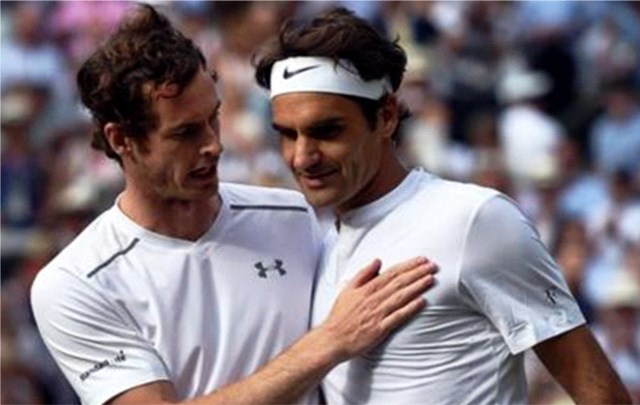
Swiss great Roger Federer hopes retiring Briton Andy Murray can finish his career “the way he wants” at Wimbledon later this year.
Meanwhile, world number one Novak Djokovic says he will carry “beautiful memories” from his time on and off court with the Scot.
Murray, 31, plans to retire after Wimbledon but admits the Australian Open could be his final tournament.
“The news has hit us top guys hard,” Federer, 37, said.
“I hope he can play a good Australian Open and he can keep playing beyond that.”
Although Federer is the defending champion at the Australian Open, and Djokovic goes into the tournament as the top seed, Murray’s impending retirement was – understandably – a prominent part of their first news conferences at Melbourne Park.
Murray has often been considered, alongside them and Rafael Nadal, as one of the ‘big four’ on the ATP Tour, even though he is well short of the Grand Slam victories recorded by his rivals.
Despite Federer turning 38 this year, and Nadal struggling with injury throughout his career, it is Murray who looks set to quit playing first after battling his hip injury for almost two years.
“I was disappointed and sad, a little bit shocked, to know now we’re going to lose him at some point,” said Federer, who has won an all-time record 20 Grand Slam singles titles.
“But we’re going to lose everybody at some point. It’s just now that it’s definite.”
In addition to his major titles, Murray also won two Olympic golds and 45 ATP tournaments, and led Britain to the 2015 Davis Cup.
“He won everything he wanted to win. Anybody would substitute their career with his,” added Federer.
“It’s a tough one, but on down the road he can look back on and be incredibly proud of everything he has achieved.”
Andy Murray was in tears as he spoke to journalists ahead of the Australian Open
Serbia’s Djokovic and Murray were born just a week apart in May 1987, meaning they grew up together on the junior circuit before moving on to the senior tour.
The pair have regularly battled for the biggest titles, with Murray beating Djokovic to claim his first Grand Slam at the 2012 US Open and then again to become the first British man to win Wimbledon in 77 years in 2013.
However, 14-time Slam champion Djokovic has triumphed in five other major finals, including four at Melbourne Park.
“I will carry beautiful memories from the court and off the court with him. We’ve played lots of epic matches,” said Djokovic, who starts against American qualifier Mitchell Krueger on Tuesday.
“To see him struggle so much and go through so much pain, it’s very sad and it hurts me as his long-time friend, colleague, rival.”
The pair played together in a practice match in Melbourne on Thursday, hours before Murray made his announcement the following morning, but Djokovic insisted he was not holding back against the Scot.
“It was very obvious for everyone, you didn’t need to be on court, to notice he’s struggling and not moving as well as he normally does,” he said.
Djokovic says he can relate “a little bit” to Murray’s predicament after having elbow surgery last year before recovering to win the Wimbledon and US Open titles.
“I think his injury of the hips is something certainly far worse than my injury, because it’s obviously something he’s been carrying for couple of years,” he said.
“He’s unable, even after surgery, to get back to the desired level.
“As an athlete, injury is probably the biggest obstacle and enemy that you can have.”



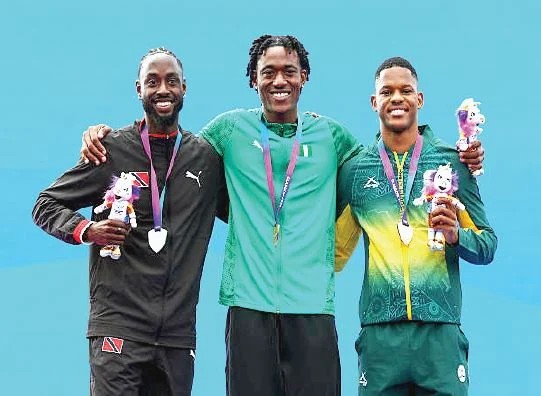
Team Nigeria finished sixth on the overall medals table at the Glasgow 2026 Commonwealth Games, falling short of the National Sports Commission’s ambitious target after ending the competition with 23 medals, comprising 10 gold, seven silver and six bronze
The tally represents a shortfall against the lofty expectations set before the Games.
Director General of the Commission, Bukola Olopade, had projected that Nigeria could surpass the 18-gold target set by the Elite Athletes Podium Finish initiative to win as many as 22 gold medals, citing structural reforms under NSC chairman Shehu Dikko and backing from President Bola Tinubu.
Nigeria’s confidence had been rooted in its performance at the 2022 Birmingham Games, where the country recorded its most successful outing with 35medals, comprising 12 gold, nine silver and 14 bronze, to finish seventh overall.
While the final gold count of 10 fell well short of the 22 projected and even the eighteen baseline target, and the overall medal haul of 23 was down on the 35 won in Birmingham, Team Nigeria’s campaign in Glasgow nonetheless produced several standout moments across a broader spread of disciplines than in previous editions, with medals arriving from athletics, judo, weightlifting, para athletics, para powerlifting and swimming.
Samuel Ogazi delivered Nigeria’s first-ever Commonwealth Games gold in the men’s 400m, powering to victory in 44.25 seconds, while Ezekiel Nathaniel added another gold in the men’s 400m hurdles in 48.47 seconds. Chukwuebuka Enekwechi became the first Nigerian to win the men’s shot put title at the Games with a throw of 21.07m, and further medals came from Ella Onojuvwevwo, who claimed bronze in the women’s 400m to end a wait dating back to 1994, Ruth Usoro, who won silver in the long jump, Udodi Onwuzurike, who took silver in the men’s 200m, and Kayinsola Ajayi, whose bronze in the men’s 100m ended a twenty-year wait for Nigeria in the event. The men’s 4x100m relay team and the mixed 4x400m relay quartet both closed out the athletics programme with bronze medals, while the women’s 4x100m team finished sixth.
Beyond the track, Enku Ekuta ended a 24-year wait for a Nigerian judo medal at the Commonwealth Games with bronze in the women’s -63kg category, a result hailed as one of the most symbolic achievements of the campaign given the sport’s long struggle to convert domestic talent into podium finishes.
The Commission had sought to keep morale high throughout the Games with an enhanced welfare package.
NSC chairman Shehu Dikko had announced an upward review of bonuses partway through the competition, raising the reward for gold medallists to 10,000 dollars, comprising 5,000 dollars in instant cash and 5,000 dollars paid directly into their accounts, up from an initial structure of 8,000 dollars. Silver medallists received 5,000 dollars, made up of 2,000 dollars in instant cash and 3,000 dollars paid into their accounts, while bronze medallists received 3,000 dollars, comprising 1,000 dollars in instant cash and 2,000 dollars paid into their accounts.
Coaches whose athletes won gold were also entitled to a 5,000-dollar incentive, on top of daily allowances of 200 dollars for athletes and 250 dollars for coaches.
Despite the increased incentives and the individual milestones recorded across several disciplines, Team Nigeria’s sixth-place finish and gold medal count leave the Commission short of the record-breaking outing it had targeted before the Games, setting up questions for officials over preparation and investment as the country looks ahead to future global multi-sport events.
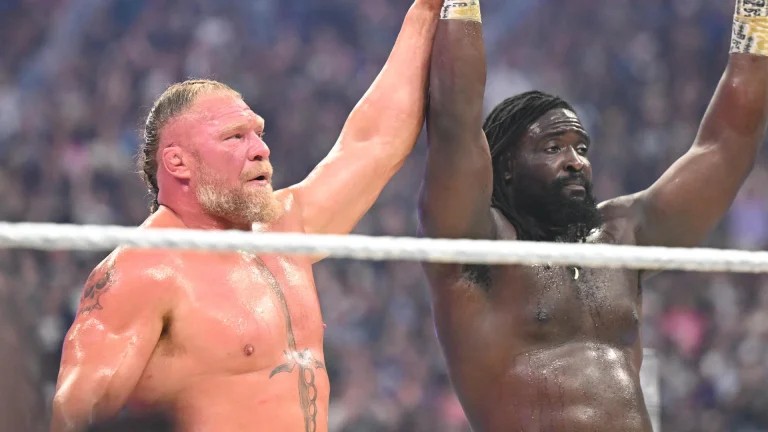
Nigerian professional wrestler, Oba Femi, defeated former UFC and WWE champion, Brock Lesnar, in a brutal Hell in a Cell match at WWE SummerSlam on Saturday night, earning one of the biggest victories of his career.
The contest, held at US Bank Stadium in Minneapolis, Minnesota, saw the Lagos-born wrestler overcome Lesnar in his first-ever Hell in a Cell appearance.
Femi took the fight to Lesnar from the opening bell, surviving multiple German suplexes, a Tombstone onto exposed wooden boards beneath the ring and several attacks with steel steps before countering with two chokeslams.
The match reached its climax after Lesnar attempted to use a steel chair, but Femi knocked it from his grip with a stiff right hand before delivering his signature Fall From Grace to secure the victory.
Following the bout, Lesnar embraced Femi, took a microphone and publicly endorsed the Nigerian star.
Declaring himself the past and Femi the future of WWE, Lesnar praised his opponent in front of the SummerSlam crowd.
Reacting to the moment, Femi admitted he did not expect the show of respect from his longtime rival.
“The hug and public endorsement was definitely a shock, and I didn’t see that coming.
“I know that deep down, Brock has always respected me, and he knows that deep down, I respect him as well,” Femi said.
The victory continues an impressive breakthrough year for the Nigerian wrestler, who defeated Lesnar at WrestleMania 42 in April before winning the 2026 King of the Ring tournament in June.
Their SummerSlam clash was the culmination of a months-long rivalry that saw Lesnar return from an apparent retirement to attack Femi before defeating him in a rematch at Clash in Italy.
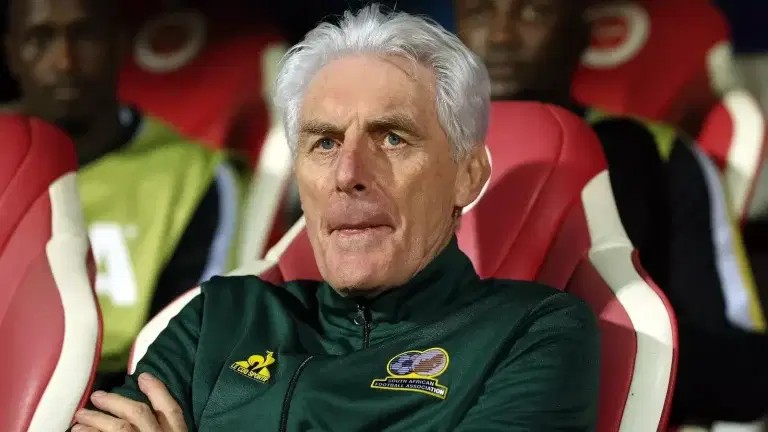
South Africa national team head coach Hugo Broos has left his position after five years in charge, with South African Football Association (SAFA) president Danny Jordaan confirming the Belgian’s departure at the weekend.
Broos’ contract officially expired last Friday, bringing an end to his tenure, which began in May 2021 after Bafana Bafana failed to qualify for the Africa Cup of Nations.
The 74-year-old coach leaves behind a period that included several notable achievements for South Africa.
Under Broos, Bafana Bafana finished third at the 2023 AFCON, which was eventually staged in early 2024 in Ivory Coast after being postponed.
He also guided the team to the knockout stage of the 2026 FIFA World Cup in the United States, Mexico and Canada, marking South Africa’s first appearance beyond the group stage at the tournament.
The qualification itself ended a 24-year wait for Bafana Bafana, who had last featured at the World Cup in 2010 as hosts. Their 2026 appearance was their first since that tournament.
Broos had previously indicated that his departure from the national team was settled.
Speaking to the media after the World Cup, Broos said his decision to leave the Bafana Bafana job was irreversible, citing his desire to spend more time with his family. However, he also
expressed a willingness to take up another position within SAFA.
His comments sparked uncertainty, with SAFA initially releasing a statement denying that Broos had already stepped down.
Further speculation followed when reports emerged that the coach had been offered a one-year contract extension. SAFA subsequently issued another statement insisting that no extension had been finalised.
-
 News5 days ago
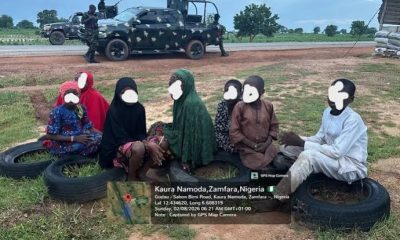
Soldier, Police Officer Killed As Army Rescues Nine Abductees In Zamfara
-
 News5 days ago
Fubara Reaffirms Commitment To Creating Conducive Environment For Business Growth …Commissions Paint Manufacturing Plant
-
 Sports5 days ago
Fifa Scraps Controversial World Cup in Plan
-

 Business5 days ago
FG Grants Customs Duty, VAT Exemptions On Imported Electric, Gas Vehicles
-
 News5 days ago
PH NBA Election: Committee Uncovers Over 500 Padded Names On Voters’ Register
-
 Business5 days ago
Vet Doctors Vow Support To Check Rabies Spread In Rivers
-
Sports5 days ago
INEC Seeks Media Partnership, Declares Readiness For Osun Guber Poll
-
 Business5 days ago
Jonathan Applauds NCDMB, China’s Model for Shaping Nigeria’s Local Content Policy