
Featured
Wike Presents N510bn 2018 Budget To Assembly …As 2017 Budget Records 74% Performance

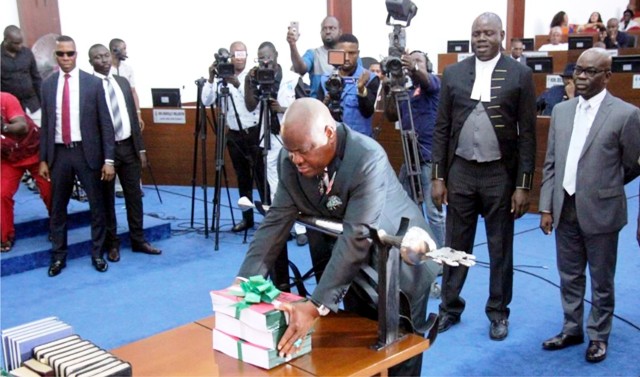
The Rivers State Governor, Chief Nyesom Wike has presented the 2018 Appropriation Bill of N510billion to the Rivers State House of Assembly for consideration and subsequent approval.
Christened the “Budget of Consolidation, Advancement and Empowerment”, Wike said the budget will consolidate and advance the state’s investments in infrastructure, education, healthcare, and security, as well as in growing the economy to create jobs and empower the people.
Presenting the budget proposal to the House, yesterday, the governor said the proposed 2018 Rivers State Budget has N379, 997, 687, 404.00 as capital expenditure, while N132 billion will be used for recurrent expenditure.
He said: “This gives a capital to recurrent expenditure ratio of 75 to 25 per cent respectively. The substantial increase in capital over recurrent expenditure, once again, underscores our commitment to direct substantial resources to the critical growth sectors of our economy.”
Wike said the 2018 budget will be funded from the Federation Accounts Allocation Committee (FAAC) N40billion; 13 per cent oil minerals fund of N120billion; Value Added Tax inflow of N6billion; Internally Generated Revenue of N132billion; reimbursements amounting to N70billion; Domestic/International Credits of N70billion; and Capital receipts N20billion.
The governor stated that a total portfolio of N90billion and N35billion have been allocated to the Ministry of Works and the Special Projects Bureau, respectively, to fund the delivery of capital projects in the 2018 budget.
He said that the administration was committed to the completion of key projects in different parts of the state.
The projects include: Dualisation of Saapkenwa–Bori road; Dualisation of Slaughter–Trans Amadi–Garrison road; Dualisation of Elelenwo–Akpajo road; Dualisation of Oil Mill–Woji–Elelenwo–Akpajo road; Dualisation of Prof Tam David-West (Obiri Ikwerre–Airport) road; the Andoni–Opobo section of the Unity road.
Others include internal road networks in Abonnema in Akuku-Toru Local Government Area; Amadi-Ama in Port Harcourt Local Government Area; Okochiri in Okrika Local Government Area; Elele and Isiokpo in Ikwerre Local Government Area; among others.
Other key projects also earmarked for delivery in 2018 include Bonny–Bille Waterside Jetty; Mile One Market, Phase 2; reclamation works in Abalama in Asari-Toru Local Government Area; Ogu town in Ogu/Bolo Local Government Area; Bakana in Degema Local Government Area; and Ogbunabali in Port Harcourt Local Government Area.
The rest include constituency projects such as Real Madrid Football Academy; luxury living quarters for judicial officers from the state, among other projects; and the cinema and restaurant project in the Port Harcourt Pleasure Park.
The governor added: “We shall also start some new projects, including the Women Development Centre, the new world-class international conference centre, and roads.”
On education, Wike said: “We are devoting N50billion to fund the education sector for the 2018 fiscal year. This sum is N20billion more than that of 2017.
“In addition, we have proposed a capital grant of N500million to each of our tertiary institutions to bolster infrastructural development and improve quality.
“Apart from proposing the sum of N2billion for the provision of scholarships for critical areas of the state’s manpower needs, we have also proposed to set aside another N2billion to partner, encourage and support the development of private universities and improve access to tertiary education for Rivers indigenes in the state,” the governor added.
Wike stated that his administration was “Providing the sum of N30billion in 2018 to enhance all aspects of the healthcare delivery system in the state, including the provision of health infrastructure for health institutions, recruitment and training of medical doctors and other healthcare personnel, refurbishing and equipping our primary healthcare centres, providing vaccines for routine immunization against child-killer diseases, as well as in carrying out education and sensitization programmes on reproductive, maternal, neonatal and child healthcare”.
On security, Wike said that the state government will continue to invest heavily in the security of lives and property through the funding of security agencies and provision of logistics for them to effectively secure the state.
He said: “We have also approved the establishment of the Rivers State Neighbourhood Safety Corps (RSNSC) to further enhance the security in the state. When fully established and operational, the corps will have the responsibility to collaborate with the security agencies to combat crime and cultism in our communities and neighbourhoods.
“The State Executive Council has already approved the bill to give effect to this initiative, which we shall soon transmit for the consideration of the House of Assembly and passing into law. The N22billion we have proposed in the 2018 budget for security operations will also take care of the setting-up and operationalisation of this agency,” Wike added.
In order to tackle high level of youth unemployment and poverty, the governor said that empowerment has been prioritised in 2018.
Wike proposed N6billion for employment generation, N7billion for women development and N2 billion to support youth development.
He added that the state government will inject N1billion into the state’s Microfinance Agency (RIMA) to provide loans and support the development of small-scale enterprises in the state.
The governor said that sports development will be funded by the state government in 2018, noting that the Real Madrid Football Academy will come on stream.
He said: “We will also continue to fund the state’s football teams and support them to win laurels at national and continental levels for the state. For these and other activities for a comprehensive development of sports in the state, we propose to spend N2.5billion for fiscal year 2018.”
The governor said that investments in the administration of justice and the justice sector will be sustained.
He said that N4.350billion has been allocated to the law and justice sector.
The state chief executive said the administration decided to renew and strengthen her partnership with the church of God in the state by proposing to establish a Trust Fund for the church to administer to its needs.
“The sum of N1billion has been proposed under this budget for this purpose,” he noted.
Wike said that in the past two and a half years, the administration has demonstrated that it is committed to solving the problems it inherited and advance the overall wellbeing of the people.
He said: “For us, our state deserves meaningful development and we must, as a government, continue to do our best to deliver to our people. That is why we are offering a realistic budget for 2018, which takes a balanced and pragmatic approach towards solving the developmental challenges of our state and take it to the next level of transformation.”
It would be recalled that the Rivers State Governor, Chief Nyesom Wike proposed a Budget of N470billion for 2017.
The 2017 budget recorded about 74 per cent performance, which was a significant improvement over that of 2016.
In his remarks, the Speaker of the House of Assembly, Ikunyi-Owaji Ibani assured the people of Rivers State that the state Assembly will continue to support the Executive to deliver the development of the state.
Ibani said an analysis of the 2018 Budget shows that the Rivers State governor will consolidate on development in different sectors of the state’s economy.
He said that the state House of Assembly will treat the budget expeditiously, but stated that due process will be followed.
According to the speaker, “Only a pathological fault finder will not see the good works of the Rivers State governor. The governor has performed creditably well”.

Featured
JUNE 12: Democracy Remains Nigeria’s Strongest Path To Unity, Progress, Says Fubara ….Extols Abiola, Wife


Governor of Rivers State, Sir Siminalayi Fubara, has reaffirmed that democracy remains the most effective system of government for Nigeria, given the country’s rich diversity of ethnic, religious, and cultural identities.
In a goodwill message to Nigerians on the occasion of the 2026 Democracy Day celebration, Governor Fubara said June 12 represents far more than a historic date; as it embodies the enduring struggle, sacrifice, and collective aspiration of Nigerians for freedom, justice, and representative governance.
The Governor extended warm felicitations to Nigerians at home and in the Diaspora, paying tribute to the heroes and heroines of the democratic struggle, particularly Chief MKO Abiola, his wife, Kudirat Abiola, and countless others whose courage and sacrifices helped secure the democratic freedoms Nigerians enjoy today.
According to him, “June 12 is a reminder of the price paid for the democracy we enjoy today. The sacrifices made by Chief MKO Abiola, Kudirat Abiola, and many other patriots who laid the foundation for the democratic journey we continue to enjoy today. Their commitment to the principle that power must ultimately reside with the people remains a source of inspiration for every generation of Nigerians.”
Governor Fubara noted that thirty-three years after the historic June 12, 1993 election, Nigeria’s democratic experiment has continued to evolve despite challenges and setbacks.
“Our democratic journey has not been without difficulties, but the resilience of our institutions and the determination of our people have kept the nation moving forward. The ability to express differing opinions, engage in constructive debate, and peacefully choose leaders through the ballot remains one of the greatest achievements of our nation,” he said.
Governor Fubara stressed that democracy provides the best framework for managing Nigeria’s diversity and transforming it into a source of national strength.
“Nigeria’s diversity should never be seen as a weakness. Properly harnessed, it is our greatest asset. Democracy offers us the opportunity to build consensus, promote inclusion, strengthen national unity, and create the conditions for sustainable development and shared prosperity,” he said.
Governor Fubara commended President Bola Ahmed Tinubu, for his commitment to the Renewed Hope Agenda and ongoing efforts aimed at economic revitalization, strengthening security, and deepening democratic institutions across the country.
He reiterated the readiness of Rivers State to continue partnering with the Federal Government in advancing policies and programmes that improve the lives of citizens through infrastructure development, job creation, enhanced security, quality education, healthcare delivery, and good governance.
The Governor further called on Nigerians, regardless of political affiliation, ethnic background, or religious belief, to use the occasion of Democracy Day to renew their commitment to the Nigerian project and the ideals that underpin democratic governance.
“Democracy must not be viewed merely as a periodic electoral exercise. It must be reflected in our daily commitment to accountability, transparency, tolerance, justice, respect for the rule of law, and responsible leadership. As citizens and leaders, we all share a collective responsibility to strengthen our democracy and build a nation that future generations will be proud to inherit,” he said.
Governor Fubara expressed optimism about Nigeria’s future, urging citizens to remain united, hopeful, and committed to the values of peace, dialogue, and national development.
“Together, we can build a stronger, more inclusive, and more prosperous Nigeria where every citizen has the opportunity to thrive and contribute meaningfully to national progress,” he said.

Governor of Rivers State, Sir Siminalayi Fubara, has reaffirmed the unwavering commitment of his administration to peace, unity, security, and inclusive development as Rivers State marked its 59th anniversary, last Wednesday.
In a goodwill message issued on Wednesday to commemorate the anniversary, Governor Fubara stated that despite the challenges faced over the years, the people of Rivers State have continued to demonstrate resilience, strength, and an enduring spirit of unity that has sustained the state since its creation.
The Governor noted that the strong bond of brotherhood among the various ethnic nationalities of the state, including the Ijaw, Ikwerre, Ogoni, Etche, Ekpeye, Andoni, Kalabari, and others, remains one of Rivers State’s greatest strengths and a critical foundation for peace, stability, and progress.
He further observed that Rivers State has remained a major driver of Nigeria’s economy for decades, not only because of its abundant oil and gas resources, but also because of the exceptional contributions of its people across diverse sectors including academia, jurisprudence, business, entertainment, public service, and sports.
Governor Fubara assured the people that his administration will continue to prioritize policies and programmes that promote peace, protect lives and property, and expand development across all parts of the state. He emphasized that governance must be people centered and impactful, with equal attention given to every Local Government Area of the state.
The Governor also paid tribute to the elders and founding leaders of the state for preserving the spirit of unity and coexistence over the years, while urging the youths to remain hopeful, responsible, and actively committed to building a greater Rivers State through innovation, hard work, and patriotism.
He equally acknowledged the invaluable role of women in strengthening families, communities, and society, describing them as indispensable partners in the continued growth and stability of the state.
Governor Fubara called on all Rivers people to use the occasion of the anniversary as a moment of reflection and renewed commitment to peaceful coexistence, mutual respect, dialogue, and collective progress, stressing that the unity and future of Rivers State must always rise above personal interests and political differences.
Rivers State was created on May 27, 1967, by General Yakubu Gowon.

-

 Niger Delta2 days ago
Warri Airport Manager Disputes Air Peace Bird Strike Claim
-

 News2 days ago
Nigeria Won’t Surrender Any Territory To Criminals -Tinubu
-

 News2 days ago
FG Begins Trial Of Over 600 Terrorism Suspects
-

 Rivers2 days ago
79th IAUE Inaugural Lecture: Prof Anero Advoctes Tuition-Free Education For Children
-

 Politics2 days ago
Parties’ Deregistration: How Justice Lifu Overruled Appeal Court Justices
-

 Politics2 days ago
ADC: Okonkwo Rejects Amaechi As Presidential Running Mate, Withdraws Support
-

 News2 days ago
Rivers Judges Commence Annual Vacation, July 20
-

 Politics2 days ago
2027: Tinubu’s Projects Give APC Edge In South East – Yilwatda