
Featured
Judges’ Raid, DSS, Amaechi …What To Do, If I Were Buhari

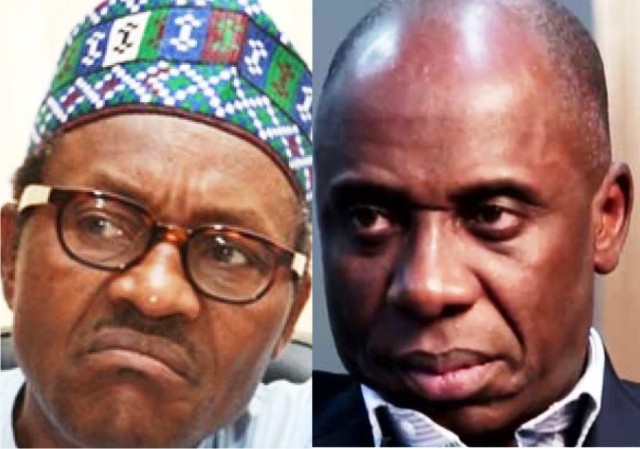
One of the pillars on which the Buhari Presidency rests is the War Against Corruption, a subject which many Nigerians believe was well-thought out. Their position is strengthened by the high credentials and pedigree of the driver of the crusade.
President Muhammadu Buhari, before the 2015 general elections, was acclaimed as a simple, modest and disciplined leader, not given to the known habits of ostentatious living, corruption and abuse of office. It was indeed these qualities that made his averment to fight corruption believable.
It was also on the crest of those values that Muhammadu Buhari became President. He matched public expectations with his public declaration of assets with as little as N3 million cash in earnings, a few cows and a plot of land in Port Harcourt, which location he was yet to be told.
That meant one of few things. That it was a mere promise by the then Governor of Rivers State, Chibuike Rotimi Amaechi. That Buhari, at the time of declaring his assets, did not have valid documents, including C of O, to lay claim to such asset. Or that it was a post-declaration, pending when he would get such land.
Whatever interpretations Nigerians may draw from that land claim, it showed transparency on the part of the President, even if, were such a gift given to former President Goodluck Jonathan by say, the Kaduna State Government, it would be revoked. That is a talk for another day.
But truth is, Buhari carries with him the reputation of one capable of fighting corruption of any kind to its logical conclusion. A key hindrance, however, might well be the measure of goodwill he enjoyed, by way of campaign and election sponsorship by defecting Peoples Democratic Party (PDP) governors, alleged to have diverted huge funds belonging to their states into his Presidential Project.
How would Buhari fight persons who contributed to his campaign project, since it was clear that he did not have the required resources to finance his presidential project? Or is it that such funds diversion did not rise to the level of corruption since they were channeled to a ‘noble cause’, the cause of helping to elect a pious man?
But by far the major criticism of the war against corruption, even among foreign commentators is that it is selective. That it targets mainly opposition politicians whose actions threatened his electoral fortunes, in the three instances, he took shots at the presidency
This is why many believe that the recent raid and subsequent arrest of judges by men of the Directorate of State Services, DSS, in a Gestapo style sting operation, followed same selective pattern. Most Nigerians agree that there is corruption in the Judiciary but believe that no judge, friendly to the ruling All Progressives Congress (APC- led) Federal Government would have suffered such embarrassment in the hands of the executive arm.
That is why it did not come as a surprise to many when two of the affected judges cried out that they were being hounded for not doing the bidding of agents of the government concerning election cases involving the ruling APC.
Last Friday, many Nigerian national daily newspapers were awash with damning headlines on the cries of one of the judges, a second within days.
The Punch of Friday October 21, 2016 has as its banner lead headline: ‘Another Judge Says Amaechi Asked Him To Influence Judgments’.
The Guardian led with, ‘Another Judge Blames Chibuike For Arrest By DSS’, while, The Sun screamed, ‘Amaechi Offered Me Bribe To Sack Fayose; – Allegation Mere Fiction, Says Transport Minister.
Even the pro – APC Nation Newspaper had the headline, Judge: Amaechi Asked Me to Help Nullify Fayose’s Election; – Justice Ngwuta’s Allegatioin Is Fiction – Minister.
The publications stemmed from a petition by one of the affected judicial officers, a Justice of the Supreme Court, Justice Nwali Sylvester Ngwuta to the Chief Justice of Nigeria (CJN), Justice Mahmud Mohammed, and the National Judicial Council (NJC).
Dated October 18, 2016, the petition chronicled events that led to the raid of his home and eventual arrest. In brief, Justice Ngwuta alleged that he was a victim of executive attack for refusing to compromise his ‘sacred oath’ to uphold truth and justice.
Justice Ngwuta pointedly accused former Rivers State Governor and Transportation Minister, Chibuike Rotimi Amaechi and his Science and Technology counterpart, Dr Ogbonnaya Onu of asking him to help influence the Supreme Court’s decision in some election cases.
According to the Justice, his ordeal was connected to his refusal to accede to the requests made by the minister.
Justice Ngwuta’s letter which came 48 hours after that by Justice John Okoro, who was also arrested by the DSS operatives, had accused Amaechi of asking him (Okoro) to influence the apex court’s decision on poll judgments in Rivers, Akwa Ibom and Abia States.
Following in Justice Okoro’s footsteps, Ngwuta in his petition to the National Judicial Council (NJC), traced his ordeal to between 2013 and 2014, when, he alleged that Amaechi approached him at a function at the International Conference Centre (ICC), Abuja, to help set aside judgment on Ekiti State Governor, Ayo Fayose’s election in order to make way for Fayose’s predecessor, and now Minister of Solid Minerals, Kayode Fayemi.
His words: “My present plight started sometime between 2013 and 2014. I represented the then CJN in an event organised at the International Conference Centre (ICC), Abuja.
‘Honourable Rotimi Amaechi came in late and sat next to me at the high table. He introduced himself to me and we exchanged contacts. A few weeks later, Fayose’s case was determined in the Court of Appeal.
‘Amaechi called me by 6.45 am and said he had come to see me, but was told I had left for the office, when he said he could return in the evening. I demanded to know what he wanted, but he would not tell me.
‘He didn’t come that evening, but came the following morning when I was already prepared to go to work.
‘He begged me to ensure Fayose’s election was set aside and another election ordered for his friend Fayemi, to contest. I told him I would not help him and that even if I was on the panel, I would have only my one vote.
‘After the Rivers Governorship election was determined by the Court of Appeal, he called to tell me his ‘ears were full’ and he would like to tell me what he heard. I told him I was out of Abuja at the time. On my return, he came in the evening and even before he sat down, he barked, ‘you have seen Wike’.
After the Supreme Court affirmed the election of Nyesom Wike, Amaechi also called him on phone and said ‘Oga is not happy’.
Transportation Minister Amaechi denied these allegations, describing them as fiction and part of a larger plan to pull him down at all cost.
Pulling someone innocent down is a grave moral, even criminal offence that should not be swept under the carpet, just as the allegations raised by Justices Okoro and Ngwuta.
To inject the needed credibility into the anti-corruption campaign, if I were Buhari, I would instruct that the claims of the Judges and Amaechi be spot-checked.
For instance, which event did both Amaechi and Ngwuta attend and when? That is very easy to find out. Next, after ascertaining that day, were there telephone calls? Affected communication service providers can easily ascertain and even produce transcripts. Did Amaechi and the Judge meet again in the Judge’s home after decision on the Rivers’ governorship elections? That too can be verified.
If I were Buhari, to prove that I am high above such vendetta as alleged by the Judges, I would institute a probe or a judicial inquest with a view to ascertaining truth of the matter.
My Agony is that there are earlier allegations, even valid judicial reports, yet to be attended to and so there may not be any urgency on the current one. Case closed.
Soye Wilson Jamabo

Featured
JUNE 12: Democracy Remains Nigeria’s Strongest Path To Unity, Progress, Says Fubara ….Extols Abiola, Wife


Governor of Rivers State, Sir Siminalayi Fubara, has reaffirmed that democracy remains the most effective system of government for Nigeria, given the country’s rich diversity of ethnic, religious, and cultural identities.
In a goodwill message to Nigerians on the occasion of the 2026 Democracy Day celebration, Governor Fubara said June 12 represents far more than a historic date; as it embodies the enduring struggle, sacrifice, and collective aspiration of Nigerians for freedom, justice, and representative governance.
The Governor extended warm felicitations to Nigerians at home and in the Diaspora, paying tribute to the heroes and heroines of the democratic struggle, particularly Chief MKO Abiola, his wife, Kudirat Abiola, and countless others whose courage and sacrifices helped secure the democratic freedoms Nigerians enjoy today.
According to him, “June 12 is a reminder of the price paid for the democracy we enjoy today. The sacrifices made by Chief MKO Abiola, Kudirat Abiola, and many other patriots who laid the foundation for the democratic journey we continue to enjoy today. Their commitment to the principle that power must ultimately reside with the people remains a source of inspiration for every generation of Nigerians.”
Governor Fubara noted that thirty-three years after the historic June 12, 1993 election, Nigeria’s democratic experiment has continued to evolve despite challenges and setbacks.
“Our democratic journey has not been without difficulties, but the resilience of our institutions and the determination of our people have kept the nation moving forward. The ability to express differing opinions, engage in constructive debate, and peacefully choose leaders through the ballot remains one of the greatest achievements of our nation,” he said.
Governor Fubara stressed that democracy provides the best framework for managing Nigeria’s diversity and transforming it into a source of national strength.
“Nigeria’s diversity should never be seen as a weakness. Properly harnessed, it is our greatest asset. Democracy offers us the opportunity to build consensus, promote inclusion, strengthen national unity, and create the conditions for sustainable development and shared prosperity,” he said.
Governor Fubara commended President Bola Ahmed Tinubu, for his commitment to the Renewed Hope Agenda and ongoing efforts aimed at economic revitalization, strengthening security, and deepening democratic institutions across the country.
He reiterated the readiness of Rivers State to continue partnering with the Federal Government in advancing policies and programmes that improve the lives of citizens through infrastructure development, job creation, enhanced security, quality education, healthcare delivery, and good governance.
The Governor further called on Nigerians, regardless of political affiliation, ethnic background, or religious belief, to use the occasion of Democracy Day to renew their commitment to the Nigerian project and the ideals that underpin democratic governance.
“Democracy must not be viewed merely as a periodic electoral exercise. It must be reflected in our daily commitment to accountability, transparency, tolerance, justice, respect for the rule of law, and responsible leadership. As citizens and leaders, we all share a collective responsibility to strengthen our democracy and build a nation that future generations will be proud to inherit,” he said.
Governor Fubara expressed optimism about Nigeria’s future, urging citizens to remain united, hopeful, and committed to the values of peace, dialogue, and national development.
“Together, we can build a stronger, more inclusive, and more prosperous Nigeria where every citizen has the opportunity to thrive and contribute meaningfully to national progress,” he said.

Governor of Rivers State, Sir Siminalayi Fubara, has reaffirmed the unwavering commitment of his administration to peace, unity, security, and inclusive development as Rivers State marked its 59th anniversary, last Wednesday.
In a goodwill message issued on Wednesday to commemorate the anniversary, Governor Fubara stated that despite the challenges faced over the years, the people of Rivers State have continued to demonstrate resilience, strength, and an enduring spirit of unity that has sustained the state since its creation.
The Governor noted that the strong bond of brotherhood among the various ethnic nationalities of the state, including the Ijaw, Ikwerre, Ogoni, Etche, Ekpeye, Andoni, Kalabari, and others, remains one of Rivers State’s greatest strengths and a critical foundation for peace, stability, and progress.
He further observed that Rivers State has remained a major driver of Nigeria’s economy for decades, not only because of its abundant oil and gas resources, but also because of the exceptional contributions of its people across diverse sectors including academia, jurisprudence, business, entertainment, public service, and sports.
Governor Fubara assured the people that his administration will continue to prioritize policies and programmes that promote peace, protect lives and property, and expand development across all parts of the state. He emphasized that governance must be people centered and impactful, with equal attention given to every Local Government Area of the state.
The Governor also paid tribute to the elders and founding leaders of the state for preserving the spirit of unity and coexistence over the years, while urging the youths to remain hopeful, responsible, and actively committed to building a greater Rivers State through innovation, hard work, and patriotism.
He equally acknowledged the invaluable role of women in strengthening families, communities, and society, describing them as indispensable partners in the continued growth and stability of the state.
Governor Fubara called on all Rivers people to use the occasion of the anniversary as a moment of reflection and renewed commitment to peaceful coexistence, mutual respect, dialogue, and collective progress, stressing that the unity and future of Rivers State must always rise above personal interests and political differences.
Rivers State was created on May 27, 1967, by General Yakubu Gowon.

-
Nation4 days ago
Asarama Kingdom Condemns Gruesome Murder of A Commercial Vehicle Driver
-
Rivers4 days ago
Monarch Raises Alarm Over Defamatory Politics … Urges For Unity In Ogoni
-
News4 days ago
Nigeria, Ethiopia Seal Agreement To Transfer 100 Nigerian Prisoners
-
News4 days ago
Nigeria No Longer Safe For Drug Cartels – Marwa
-
News4 days ago
Xenophobia: 268 Nigerian Returnees Arrive In Lagos From S’Africa
-

 News4 days ago
FG Declares Today Public Holiday To Mark Democracy Day
-
Women4 days ago
Nigerian Women And Dividends Of Democracy
-
Business4 days ago
FG Approves $1 Bn AFCFTA Credit Facility For Nigerian Exporters