
Oil & Energy
FG Commences Longest Gas Pipeline Project This Year

In order to ensure
steady supply of gas to meet fast growing market demand for gas, the federal government says it would commence the longest pipeline project in the country which would run from Calabar, through Ajaokuta to Kano.
The Minister of Petroleum Resources, Mrs Diezani Alison-Madueke said this while delivering her paper titled, ‘Encouraging Investment in Gas Production, Supply and Consumption”, at a conference organised by the Senate Committee on Gas Resources in Abuja, recently.
According to the minister, the longest gas pipeline project would be a Public Private Partnership scheme and would commence by the end of this year.
The minister who was represented at the conference by the Group Managing Director of Nigerian National Petroleum Corporation (NNPC), Engr Andrew Yakubu, explained that at present, the federal government was constructing the strategic East-West pipeline while the Lagos end segment of the Escravos to Lagos Pipeline System (ELPS) is nearing completion.
She said that almost 500km of new gas pipelines have been completed and commissioned including the doubling of the capacity of the EPLS between Escravos and Oben and the extension from Oben to Geregu and River Imo to Alaoji, respectively.
The minister explained that by the end of 2018 the backbone pipeline infrastructure for gas would have been delivered thereby concluding an initial phase of over 2500km of gas pipeline infrastructures development.
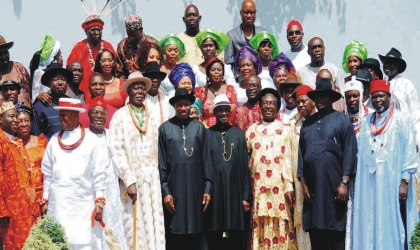
President Goodluck Jonathan, Vice President Namadi Sambo and members of Oil and Gas producing communities in Nigeria, after a meeting at the Presidential Villa in Abuja recently. Photo: NAN

Oil & Energy
NCDMB Unveils $100m Equity Investment Scheme, Says Nigerian Content Hits 61% In 2025 ………As Board Plans Technology Challenge, Research and Development Fair In 2026


In the bid to revitalise the gas industry and stabilise power generation, President Bola Ahmed Tinubu has authorised the settlement of N185 billion in long-standing debts owed to natural gas producers.
The payment, to be executed through a royalty-offset arrangement, is expected to restore confidence among domestic and international gas suppliers who have long expressed concern about persistent indebtedness in the sector.
According to him, settling the debts is crucial to rebuilding trust between the government and gas producers, many of whom have withheld or slowed new investments due to uncertainty over payments.
Ekpo explained that improved financial stability would help revive upstream activity by accelerating exploration and production, ultimately boosting Nigeria’s gas output adding that Increased gas supply would also boost power generation and ease the long-standing electricity shortages that continue to hinder businesses across the country.
The minister noted that these gains were expected to stimulate broader economic growth, as reliable energy underpins industrialisation, job creation and competitiveness.
In his intervention, Coordinating Director of the Decade of Gas Secretariat, Ed Ubong, said the approved plan to clear gas-to-power debts sends a powerful signal of commitment from the President to address structural weaknesses across the value chain.
“This decision underlines the federal government’s determination to clear legacy liabilities and give gas producers the confidence that supplies to power generation will be honoured. It could unlock stalled projects, revive investor interest and rebuild momentum behind Nigeria’s transition to a gas-driven economy,” Ubong said.


