
News
‘Court Can’t Sack Defecting Govs’

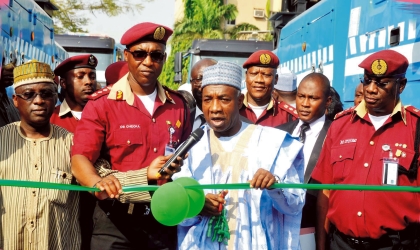
L-R: Unit Manager, Ministry of Works, Mr Mohammed Isa, frsc Corps Marshal, Mr Osita Chidoka, representative of the Minister of Works, Mr Abubakar Mohammed, and the Deputy Corps Marshal, Mr Boboye Oyeyemi, at the handover of heavy duty trucks and patrol vehicles by the Minister of Works to frsc, in Abuja, recently. Photo: NAN
The suit by the ruling Peoples Democratic Party (PDP) asking a Federal High Court in Abuja to sack the G5 Governors for defecting to the All Progressives Congress (APC) has been dismissed as an exercise in futility.
“The suit is laughable and betrays the ignorance of the PDP leadership about the laws of the land. It is also a further demonstration of the impunity associated with PDP in its disdain for democracy and due process,”
Erstwhile National Publicity Secretary of New PDP, Chief Eze Chukwuemeka Eze, stated this in a statement issued in Abuja.
Eze quoted relevant sections of the 1999 Nigerian Constitution to prove that the seats of the affected governors, namely, Alhaji Murtala Nyako (Adamawa), Rotimi Amaechi (Rivers), Alhaji Magatakarda Wamakko (Sokoto), Alhaji Rabiu Kwankwaso (Kano) and Alhaji Abdulfatai Ahmed (Kwara), are safe.
His words: “For the education of the confused PDP leadership and its legal team, there is no danger of any of our Governors losing their seats as made clear by sections 68(1)(g) and 109(1)(g) of the 1999 Constitution of the Federal Republic of Nigeria (as amended) in relation to the status of members of a legislative house (state and national) who defect from the political parties from which they were elected to join another political party.
“The wordings of the aforesaid sections are in agreement with those of sections 64(1)(g) of the 1979 Constitution of the Federal Republic of Nigeria given judicial interpretation by the Supreme Court in the case of FEDECO Vs Goni (1983) FNR 203. This case was argued by the best legal minds of that era (Chief FRA Williams SAN and GOK Ajayi SAN). The court held that such a member keeps his seat if his defection is as a result of a division or split in his party.
“G5 Governors must be commended and congratulated for standing against the draconian and undemocratic acts of PDP and should go about their normal business as both PDP and its sponsors lack the power to sack any of them. This as well covers all members of the National Assembly who desire to join the Aso Rock-bound train (APC) come 2015,” he said.
Eze said it was not debatable that PDP is crisis-ridden, thus guaranteeing that none of its members who defects can be punished as a result. He quoted and attached a recent letter by the Independent National Electoral Commission (INEC) voiding the suspension of Prince Olagunsoye Oyinlola, Alhaji Abubakar Baraje and Dr. Sam Sam Jaja as proof that PDP is in crisis.
The letter signed by INEC’s Secretary, Mrs. Augusta Ogakwu, was dated November 25, with reference number INEC /EPM/PDP/02/024/Vol.T/161 and titled: ‘Re: Suspension of Alhaji Abubakar Baraje, Dr. Sam Sam Jaja, Prince Olagunsoye Oyinlola and Ambassador Ibrahim Karaure from the PDP”. The letter, addressed to the National Chairman of the PDP, Alhaji Bamanga Tukur, reads: “This is to acknowledge the receipt of your letter dated November 12, 2013 informing the commission on the suspension of four members of your party.
“The commission notes that some of the individuals so suspended held positions covered by the provisions of section 85(1) of the Electoral Act 2010 (as amended) and that no notice of the meeting which approved their suspension was provided to the commission. “Accordingly, the records of the commission does not reflect the process and composition of the meeting that approved the suspension of the individuals, as such, the commission cannot establish an informed position on the matter “Please accept the commission’s highest regard and consideration.”
Eze supported INEC’s position by quoting Section 85 (1) of the Electoral Act 2010 (as amended), which states thus: “Every registered political party shall give the commission at least 21 days notice of any convention, congress, conference or meeting convened for the purpose of electing members of its executive committees, other governing bodies or nominating candidates for any of the elective offices specified under this Act.”
The former New PDP Spokesman accused PDP of mischief for instigating the Houses of Assembly in the affected states to start impeachment proceedings against the defected Governors as being witnessed in Rivers State, where six rebel legislators are desperately trying to impeach Governor Chibuike Rotimi Amaechi. He warned PDP to desist from any further act of destabilisation capable of plunging the country into chaos and truncating the country’s hard-won democracy.
In conclusion, Chief Eze asked how come that PDP received Chief TA Orji of Abia State and Chief Ikedi Ohakim former Governor of Imo State that defected from PPA and Alh. Isa Yuguda of Bauchi State who defected from ANPP and joined PDP without declaring their seats vacant. Now that PDP is at the receiving end of the same medicine they administered on others and they are window shopping for ways to have their cakes after devouring them. What a pity as about seven more PDP Governors will be joining APC by the first quarter of 2014 at that time they will be preparing on how to bury PDP formally by 2015.



Nigeria’s crude oil production has surged to an 11-month high in May, 2026, with the country exceeding its Organisation of the Petroleum Exporting Countries (OPEC) production quota.
The average crude oil production recorded during the month of May represents 102 per cent of Nigeria’s 1.5mbpd of production quota allocated by the OPEC.
The production report released by the Nigerian Upstream Petroleum Regulatory Commission (NUPRC), yesterday, disclosed that Nigeria’s oil production averages 1,530,354 barrels of crude oil and 170,446 barrels of condensates per day (bpd).
According to the report, this brings the total combined production to 1, 700, 800 barrels per day and consolidating Nigeria’s position as Africa’s largest oil producer.
The report said the production performance during the review period remained robust, with combined crude oil and condensate output ranging between a low of 1.51 million bpd and a peak of 1.86 million bpd.
It said the May 2026 production figures represented the highest recorded by Nigeria since July 2025, when output surged to 1,712,282.
“In strict crude oil terms (excluding condensates), the 1.53 million barrels recorded in May 2026 represents the highest Nigeria has witnessed since January 2025 when crude oil production hit 1.538mbpd.
“The latest crude oil production statistics thus represents a 15-month high on a month on month basis, production rose by 2.77 per cent in May 2026 as against 1.48mbpd in April,” it said.
The report said the broader production trend over the last five months had also remained positive.
It said combined crude oil and condensate output increased from 1.48 million bpd in February to 1.54 million bpd in March, 1.66 million bpd in April, and then 1.7 million bpd in May, underscoring sustained growth in Nigeria’s hydrocarbon production levels.
According to the report, among production streams, Bonny Terminal led the pack with a total blend of 293,870 bpd, closely followed by Forcados Terminal at 289,900 bpd, Qua Iboe ranked third with 173,360 bpd, while Escravos Oil Terminal contributed 135,470 bpd.
It said the Odudu (Amenam Blend) completed the top five production streams, accounting for 63,250 bpd during the month under review.
The NUPRC attributes the rise in production to a sustained positive momentum as operations remained stable throughout the reporting period with no significant pipeline or facility outages recorded.
Additionally, all previously scheduled turnaround maintenance activities had been successfully completed, contributing to improved operational reliability and production efficiency.
The House of Representatives, yesterday passed a landmark constitutional amendment bill to establish state police nationwide, marking a significant milestone in Nigeria’s decades-long debate over decentralising policing and strengthening internal security.
The bill, titled “A Bill for an Act to Alter the Constitution of the Federal Republic of Nigeria, 1999 to Provide for the Establishment of State Police and for Related Matters (Sixth Alteration) Bill, 2026,” was approved during consideration at the Committee of the Whole, presided over by Speaker of the House, Rt. Hon. Tajudeen Abbas.
Voting commenced after the Deputy Speaker and Chairman of the House Committee on Constitution Review, Hon. Benjamin Kalu, presented the report on the proposal and canvassed support from lawmakers, stressing the need for a more decentralised policing framework to effectively address the country’s growing security challenges.
The exercise was conducted manually, with members raising their hands to indicate their positions. At the end of the voting, 289 lawmakers voted in support of the bill, one member abstained, while none voted against it, reflecting overwhelming bipartisan backing for the far-reaching reform.
The proposed amendment seeks to fundamentally restructure Nigeria’s policing architecture by creating both Federal and State Police formations.
One of the bill’s key provisions amends Section 214 of the 1999 Constitution to formally establish the Federal Police and the State Police. Under the proposal, the National Assembly would be empowered to prescribe the structure, organisation, administration and powers of the Federal Police, while also providing the legal framework and minimum standards for the establishment and operation of state police services.
The bill stipulates that no state police formation shall commence operations unless it is established by a law enacted by the relevant State House of Assembly and certified as complying with national minimum standards prescribed by an Act of the National Assembly.
It further provides that until a state police force becomes operational, the Federal Police shall continue to exercise policing powers and responsibilities within such states.
In a bid to preserve the autonomy of state police formations and prevent undue federal interference, the bill limits federal intervention in states’ internal security affairs. Under the proposal, the Federal Police may intervene only where there is a complete breakdown of law and order, upon the request of a governor or where a state police force becomes unable to function due to administrative, financial or other operational challenges.
The amendment also proposes significant changes to the police’s appointment and command structure.
Under the amended Section 215 of the Constitution, the Inspector-General of Police would be appointed by the President on the advice of the Nigeria Police Council from among serving members of the Federal Police, subject to confirmation by the National Assembly.
Similarly, a State Commissioner of Police would be appointed by a governor on the advice of the Nigeria Police Council from among serving officers of the State Police, subject to confirmation by the respective State House of Assembly.
The bill empowers governors to issue lawful directives to State Commissioners of Police on matters relating to public safety and the maintenance of law and order. However, where a commissioner considers such directives unlawful or inconsistent with accepted policing standards, the matter may be referred to the Nigeria Police Council, whose decision shall be final.
The proposal also amends Section 84 of the Constitution by replacing references to the “National Police Council and the Federal Police Service Commission” with the “Nigeria Police Council and the Police Service Commission.”
The passage of the bill by the House represents one of the most far-reaching security reforms contemplated since the return to democratic rule in 1999 and is expected to rekindle nationwide debate on issues relating to funding, accountability, operational control and safeguards against abuse.
With the House’s approval, the constitutional amendment bill will now proceed to the Senate for concurrence. Thereafter, it must secure the endorsement of at least two-thirds of the State Houses of Assembly and receive presidential assent before becoming part of the Constitution of the Federal Republic of Nigeria.
If eventually enacted, the legislation would usher in a new era of multi-layered policing in Nigeria and could redefine the country’s approach to tackling banditry, terrorism, kidnapping and other forms of violent crimes through a more localised security architecture.

The Federal Government has declared today, public holiday to commemorate Nigeria’s 27 years of unbroken democratic rule.
This is contained in a statement in Abuja, by the Permanent Secretary, Ministry of Interior, Magdalene Ajani.
Ajani said that the Minister of Interior, Dr Olubunmi Tunji-Ojo, made the declaration on behalf of the federal government.
Tunji-Ojo reaffirmed the federal government’s commitment to the preservation of democratic ideals, rule of law, transparency, accountability and inclusive governance.
He assured that the ministry in collaboration with relevant security agencies woulsd continue to take appropriate measures in maintaining and strengthening Nigeria’s internal security.
The minister noted that a secured and stable environment was essential to democracy and national development.
He urged Nigerians to see the holiday as an opportunity for civic reflection.
“As we mark this historic day, every Nigerian is encouraged to remain law-abiding, uphold the institutions that sustain our democracy, and remember that the strength of any democracy lies ultimately in the character of its citizens,” he said.
He also said that June 12 every year remained a significant day in Nigeria’s history in honour of the courage, resilience and sacrifices of Nigerians whose efforts made democratic governance possible.
“Their legacies continue to inform the values and responsibilities of the Nigerian state,”Tunji-Ojo added.
-
Nation4 days ago
Asarama Kingdom Condemns Gruesome Murder of A Commercial Vehicle Driver
-
Rivers4 days ago
Monarch Raises Alarm Over Defamatory Politics … Urges For Unity In Ogoni
-
News4 days ago
Nigeria, Ethiopia Seal Agreement To Transfer 100 Nigerian Prisoners
-
News4 days ago
Nigeria No Longer Safe For Drug Cartels – Marwa
-
News4 days ago
Xenophobia: 268 Nigerian Returnees Arrive In Lagos From S’Africa
-

 News4 days ago
FG Declares Today Public Holiday To Mark Democracy Day
-
Women4 days ago
Nigerian Women And Dividends Of Democracy
-
Business4 days ago
FG Approves $1 Bn AFCFTA Credit Facility For Nigerian Exporters