
Featured
Obaseki Gets Certificate Of Return …Extends Olive Branch To Oshiomhole, Ize-Iyamu, APC

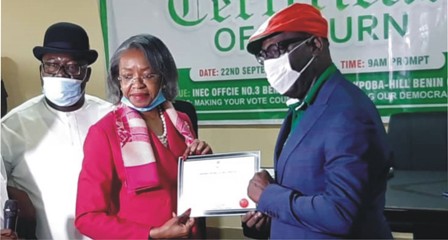
The Edo State Governor, Mr. Godwin Obaseki, yesterday, received his Certificate of Return, just as he called on former National Chairman of the All Progressives Congress (APC), Comrade Adams Oshiomhole, the gubernatorial candidate of the APC, Pastor Osagie Ize-Iyamu and other members of the APC to join hands with his administration, in developing the state.
Receiving the document as governor-elect in the September 19 governorship election at the headquarters of the Independent National Electoral Commission (INEC) in Benin City, Obaseki commended President Muhammadu Buhari for ensuring that the Edo State governorship election was free, fair and credible.
He added that the President had the option to ensure the APC candidate won the governorship election in the state, but decided to do the right thing and allowed the votes of the people to count.
“I thanked President Muhammadu Buhari for the part he played in ensuring a free, fair and credible election. He will be remembered as the father of democracy in Nigeria. He had a choice to ensure his party was declared winner but insisted that the right thing be done,” he said.
He urged members of the opposition party, the APC, to join hands with his administration to move Edo State forward, adding, “I use this opportunity to reach out to our brothers on the other side of the divide as we are one family in the pursuit to provide public good for our citizens.
“The election shows that they trust us more now to provide leadership. It doesn’t mean the opposition parties don’t have a role to play.
“I use this opportunity to extend the hands of fellowship to my brother, Pastor Osagie Ize-Iyamu and his other colleagues in the APC as well as other parties to join hands with us to move Edo forward.
“I call on Adams Oshiomhole that the fight is over and he should come and join in building the house which he was part of, in laying the foundation. We have no malice but only disagree on the approach in moving Edo forward.”
The governor commended the leadership of INEC for their unbiased role in the election and the commission’s national chairman’s ability to withstand pressure as an umpire, adding, “I want to thank the INEC Chairman, Prof. Mahmood Yakubu, for his intellect in introducing technology to provide transparency in the process.
“He should be hailed by all as INEC was able to view results as the counting of votes was ongoing in units across the state. This has introduced another ornament of transparency in the way we do election in Nigeria”.
Obaseki praised the leadership of the Peoples Democratic Party (PDP) for its tenacity and doggedness in ensuring the party got victory.
“Technology is the way to go, if we must have free, fair and credible elections in the future. Edo people spoke and their voices were heard because INEC did its best, did its job and decided to remain impartial in the whole process of the election.
“I also thank the Benin Monarch, Omo N’ Oba N’ Edo Uku Akpolokpolo, Ewuare II, for his fatherly role in ensuring that the election was peaceful. I thank Edo people and clergymen for their prayers and support towards ensuring a successful election.
“I thank God for helping Edo State conduct an election which many predicted would be bloody and characterised by violence, but God stepped in and made it peaceful,” he added.
“The INEC National Commissioner in charge of Edo, Bayelsa and Rivers states, Mrs. May Agbamuche-Mbu, said the presentation of Certificate of Return was in fulfilment of the statutory obligation of the commission as required by the electoral law.
“This occasion is made possible because of the successful conduct of the governorship election on Saturday. I must thank all stakeholders and the good and peace-loving people of Edo State for your contribution and commitment to credible and safe conclusion of the election process in Edo State.
“INEC has played its humble part and we always maintain that a successfully conducted election is a collective effort as this election has proven to be.”
The Resident Electoral Commissioner in Edo State, Alalibo Johnson, expressed appreciation to the security agencies for their collaboration which led to the huge success of the poll.
He said “Section 76 of the Electoral Act 2010 as amended has mandated the commission to issue Certificate of Return within seven days to the candidate who wins the election. This event is another fulfillment of the law.”






Featured
JUNE 12: Democracy Remains Nigeria’s Strongest Path To Unity, Progress, Says Fubara ….Extols Abiola, Wife


Governor of Rivers State, Sir Siminalayi Fubara, has reaffirmed that democracy remains the most effective system of government for Nigeria, given the country’s rich diversity of ethnic, religious, and cultural identities.
In a goodwill message to Nigerians on the occasion of the 2026 Democracy Day celebration, Governor Fubara said June 12 represents far more than a historic date; as it embodies the enduring struggle, sacrifice, and collective aspiration of Nigerians for freedom, justice, and representative governance.
The Governor extended warm felicitations to Nigerians at home and in the Diaspora, paying tribute to the heroes and heroines of the democratic struggle, particularly Chief MKO Abiola, his wife, Kudirat Abiola, and countless others whose courage and sacrifices helped secure the democratic freedoms Nigerians enjoy today.
According to him, “June 12 is a reminder of the price paid for the democracy we enjoy today. The sacrifices made by Chief MKO Abiola, Kudirat Abiola, and many other patriots who laid the foundation for the democratic journey we continue to enjoy today. Their commitment to the principle that power must ultimately reside with the people remains a source of inspiration for every generation of Nigerians.”
Governor Fubara noted that thirty-three years after the historic June 12, 1993 election, Nigeria’s democratic experiment has continued to evolve despite challenges and setbacks.
“Our democratic journey has not been without difficulties, but the resilience of our institutions and the determination of our people have kept the nation moving forward. The ability to express differing opinions, engage in constructive debate, and peacefully choose leaders through the ballot remains one of the greatest achievements of our nation,” he said.
Governor Fubara stressed that democracy provides the best framework for managing Nigeria’s diversity and transforming it into a source of national strength.
“Nigeria’s diversity should never be seen as a weakness. Properly harnessed, it is our greatest asset. Democracy offers us the opportunity to build consensus, promote inclusion, strengthen national unity, and create the conditions for sustainable development and shared prosperity,” he said.
Governor Fubara commended President Bola Ahmed Tinubu, for his commitment to the Renewed Hope Agenda and ongoing efforts aimed at economic revitalization, strengthening security, and deepening democratic institutions across the country.
He reiterated the readiness of Rivers State to continue partnering with the Federal Government in advancing policies and programmes that improve the lives of citizens through infrastructure development, job creation, enhanced security, quality education, healthcare delivery, and good governance.
The Governor further called on Nigerians, regardless of political affiliation, ethnic background, or religious belief, to use the occasion of Democracy Day to renew their commitment to the Nigerian project and the ideals that underpin democratic governance.
“Democracy must not be viewed merely as a periodic electoral exercise. It must be reflected in our daily commitment to accountability, transparency, tolerance, justice, respect for the rule of law, and responsible leadership. As citizens and leaders, we all share a collective responsibility to strengthen our democracy and build a nation that future generations will be proud to inherit,” he said.
Governor Fubara expressed optimism about Nigeria’s future, urging citizens to remain united, hopeful, and committed to the values of peace, dialogue, and national development.
“Together, we can build a stronger, more inclusive, and more prosperous Nigeria where every citizen has the opportunity to thrive and contribute meaningfully to national progress,” he said.

Governor of Rivers State, Sir Siminalayi Fubara, has reaffirmed the unwavering commitment of his administration to peace, unity, security, and inclusive development as Rivers State marked its 59th anniversary, last Wednesday.
In a goodwill message issued on Wednesday to commemorate the anniversary, Governor Fubara stated that despite the challenges faced over the years, the people of Rivers State have continued to demonstrate resilience, strength, and an enduring spirit of unity that has sustained the state since its creation.
The Governor noted that the strong bond of brotherhood among the various ethnic nationalities of the state, including the Ijaw, Ikwerre, Ogoni, Etche, Ekpeye, Andoni, Kalabari, and others, remains one of Rivers State’s greatest strengths and a critical foundation for peace, stability, and progress.
He further observed that Rivers State has remained a major driver of Nigeria’s economy for decades, not only because of its abundant oil and gas resources, but also because of the exceptional contributions of its people across diverse sectors including academia, jurisprudence, business, entertainment, public service, and sports.
Governor Fubara assured the people that his administration will continue to prioritize policies and programmes that promote peace, protect lives and property, and expand development across all parts of the state. He emphasized that governance must be people centered and impactful, with equal attention given to every Local Government Area of the state.
The Governor also paid tribute to the elders and founding leaders of the state for preserving the spirit of unity and coexistence over the years, while urging the youths to remain hopeful, responsible, and actively committed to building a greater Rivers State through innovation, hard work, and patriotism.
He equally acknowledged the invaluable role of women in strengthening families, communities, and society, describing them as indispensable partners in the continued growth and stability of the state.
Governor Fubara called on all Rivers people to use the occasion of the anniversary as a moment of reflection and renewed commitment to peaceful coexistence, mutual respect, dialogue, and collective progress, stressing that the unity and future of Rivers State must always rise above personal interests and political differences.
Rivers State was created on May 27, 1967, by General Yakubu Gowon.

-
Politics5 days ago
I DIDN’T PROMISE YOU TICKETS, AKPABIO TELLS APC SENATORS WHO FAILED PRIMARIES
-
Nation23 hours ago
Asarama Kingdom Condemns Gruesome Murder of A Commercial Vehicle Driver
-

 Rivers5 days ago
Police arrest 3 suspects over killing of driver in Rivers
-
Rivers23 hours ago
Monarch Raises Alarm Over Defamatory Politics … Urges For Unity In Ogoni
-

 News5 days ago
FUBARA ASSURES NUT OF SECURITY OF SCHOOLS IN RIVERS
-

 News5 days ago
NDLEA Arrests Four Notorious Female Drug Dealers In Four States
-
News22 hours ago
Nigeria, Ethiopia Seal Agreement To Transfer 100 Nigerian Prisoners
-
News22 hours ago
Nigeria No Longer Safe For Drug Cartels – Marwa