Connect with us

Business

Rivers Traders Lament Hike In Prices Of Food Stuffs

Published

on

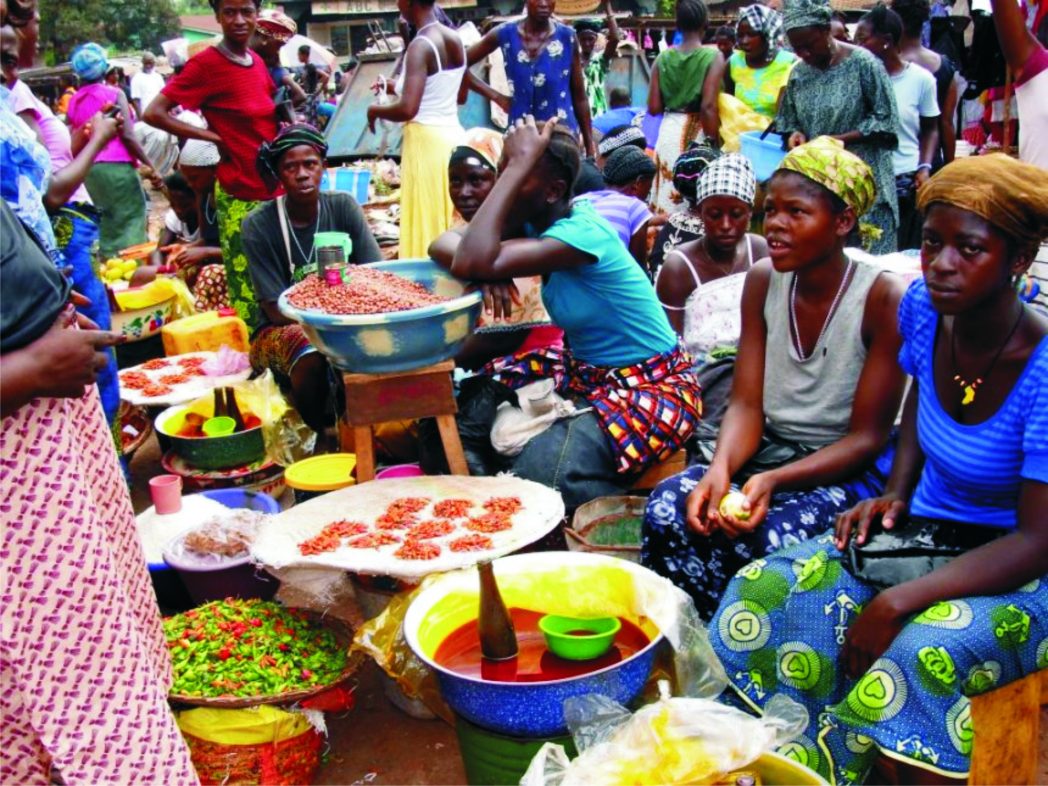
Some traders at the popular Rumuomasi market in Port Harcourt, Rivers, yesterday decried hike in prices of foodstuff, attributing it to the outbreak of COVID-19 in the country.
Some of the traders who spoke with newsmen during a market survey in Port Harcourt said that the rate of increase in prices of food items may soon kick them out of business and bring more hunger in the country.
Mrs Edna Offong, one of the traders who sells bags of rice in the market said that the rate of increase in the price of rice is alarming.
Offong stated that the price of rice had gone up twice in the market before the outbreak of the pandemic.
“The rate of increase in the prices of food is alarming, and I am afraid I don’t know how we are going to survive in this business.
“The price of 50kg bag of foreign rice which we sold at N26,000 before COVID-19, is now N39,000 while a bag of 50kg local rice that we were selling at N17,000 is now N29,000,” she said.
Similarly, Mrs Faith Emezie, another trader who sells bags of beans, said that prices of food stuff in the market are outrageous.
Emezie lamented that the increase in prices has made her to lose her business capital and slowed down patronage from her customers.
“I am just here because I don’t want to sit at home and see my children cry from hunger, I have lost my capital.
“This is because when I finished selling and I went back to market to restock, the price has increased more than the money I brought. I ended up buying small quantity of beans which I struggled hard to resell due to the increase in price.
“Remember that children have been out of school since the outbreak of COVID-19 pandemic, eating more than when they were going to school.
“This also contributes to the loss in my capital because I feed them from my sales, and I am sure other families are experiencing the same thing as well.
“Honestly, I am pleading with our government to control prices of goods in the markets, so that people will not be selling anyhow they like, not minding if it is suitable or not for buyers and sellers,” she pleaded.
Miss Marian Felix, another trader, who sells condiments attributed the high cost of spaghetti and macaroni pasta, tomato paste, and edible oil in the market to the shutdown by companies during the pandemic.
Felix said that a packet of pasta sold at N200 now sells for N250, while a sachet of tomato paste sold at N50 is currently sold for N120.
She said 4 litres of vegetable oil sold at N3,500 is now N5,000 and 4 litres of red oil sold at N1,500 now sells for N2,500.
“I pray that God Almighty will help our country to come out of this trying times for us to continue to live better as we have been living before the pandemic,” Felix said.


Continue Reading

Business

NSC Sensitises Cross-Border Traders, Business Community Use Of Border Information Centre

Published

on

The Nigerian Shippers’ Council (NSC), in collaboration with the Economic Community of West African States (ECOWAS) Commission, Deutsche Gesellschaft für Internationale Zusammenarbeit (GIZ), Nigeria Customs Service (NCS) on Wednesday carried out a sensitization exercise for traders and farmers around the Seme border axis on the need to make use of its Border Information Centre (BIC) located at the border.
The BIC according to the agency was established in 2014 to encourage cross border trade. It is to solve challenges faced by traders at the borders who are not aware of what is required of them in getting goods across the border.
Speaking at the event theme: “Trade Now: Empowering Cross-Border Traders through the Trade Information Desk (TID),” the Executive Secretary of NSC, Dr. Akutah Pius expressed satisfaction at the recent surge in the use of the BIC
“We are encouraging you all to start using the BIC, we are happy that the use of the facility has increased” he said
Akutah thanked the GIZ and ECOWAS Commission for their strategic roles in organising the event, even as he also appreciated their efforts at the Seme Border to simplify cross-border business.
Earlier, the Director of Consumer Affairs Department of the ShippersCouncil, Mrs. Ify Okolue, said the mandate of the Council goes beyond seaport, and covers the border posts.
She noted that the BIC initiative aligns with the Council’s mandate as Port Economic Regulator and complements other interventions, including Inland Dry Ports, Vehicle Transit Areas, and dispute resolution platforms.
According to her, the Council’s Border Information Centre (BIC) at Seme Border provides traders with accurate information on tariffs, documentation, standards, and dispute resolution, reducing delays and trade costs.
Noting that BICs are already operational at Seme-Krake, Jibia-Maradi, Illela-Birnin Koni, and Mfum-Nkot borders, she observed that Idiroko BIC will become operational before the end of the second quarter of 2026.
She urged traders, especially women and youth, to utilise the centres to enhance transparency, compliance, and regional trade efficiency.
“The BIC serves as a structured platform for transparency, guidance, and dispute resolution. It provides traders with accurate information on tariffs, documentation requirements, import and export procedures, standards, sanitary and phytosanitary measures, and other regulatory obligations. By reducing information gaps, the Centre directly addresses one of the key barriers to trade formalisation and competitiveness” she said
Meanwhile, the Director of Trade, ECOWAS Commission, Mr. Kolawole Sofola, stressed the need for regular sensitisation and awareness campaigns on the best approaches, documentation and dispute resolution at the Seme Border area.
Sofola, who was represented by Sarah Okporufe, also observed that the role of e-Commerce, gender-inclusive trade and sustainable practices should be prioritised in the sensitisation campaigns.
The ECOWAS team observed that a lot of traders at the Seme border corridor aren’t exploring the ECOWAS Trade Liberalization Scheme (ETLS) to enjoy the export or import of goods that are devoid of Customs tariffs, especially goods that originate from the subregion.
“Another right that traders have is that as soon as they have a valid passport, they can move to any ECOWAS country to reside or transact businesses.
 There is a process to have a biometric ECOWAS identity card that we expect will be adopted by Nigeria to allow traders and residents enjoy better access for businesses and other purposes,” the ECOWAS Commission representative said.
Speaking on behalf of the Comptroller-General of Nigeria Customs Service (NCS), Dr. Bashir Adewale Adeniyi, the Customs Area Controller, Seme Border Command, Comptroller Wale Adenuga, assured a maximum of 40 hours for the processing of legitimate imports and exports via the Seme Border.
According to him, farmers are particularly given consideration because of their perishable items.
While observing that trade facilitation is the core philosophy of the NCS under Adeniyi’s leadership, Comptroller Adenuga pledged the NCS’s continuous support at the Seme Border towards facilitating legitimate trade.
He encouraged traders to visit Seme Customs and the BICs to seek information about their trade in order to be informed about the requisite documentation, duties and goods that are prohibited.
“At Seme Customs, we will give you adequate information and adequate support.
By: Nkpemenyie mcdominic, Lagos
Continue Reading

Business

PENGASSAN Rejects Presidential EO On Oil, Gas Revenue Remittance  … Seeks PIA Review 

Published

on

The Natural Gas Senior Staff Association of Nigeria (PENGASSAN) Festus Osifo, has faulted the public explanation surrounding the Federal Government’s recent oil revenue Executive Order(EO).
President of the association, Festus Osifo, argued that claims about a 30 per cent deduction from petroleum sharing contract revenue are misleading.
Recall that President Bola Ahmed Tinubu, last Wednesday, February 18, signed the executive order directing that royalty oil, tax oil, profit oil, profit gas, and other revenues due to the Federation under production sharing, profit sharing, and risk service contracts be paid directly into the Federation Account.
The order also scrapped the 30 per cent Frontier Exploration Fund under the PIA and stopped the 30 per cent management fee on profit oil and profit gas retained by the Nigerian National Petroleum Company Limited.
In his reaction, Osifo, while addressing journalists, in Lagos, Thursday, said the figure being referenced does not represent gross revenue accruing to the Nigerian National Petroleum Company Limited.
He explained that revenues from production sharing contracts are subject to several deductions before arriving at what is classified as profit oil or profit gas.
Osifo also urged President Bola Tinubu to withdraw his recently signed Presidential Executive Order to Safeguard Federation Oil and Gas Revenues and Provide Regulatory Clarity, 2026.
He warned that the directive undermines the Petroleum Industry Act and could create uncertainty in the oil and gas industry, insisting that any amendment to the existing legal framework must pass through the National Assembly.
Osifo argued that an executive order cannot override a law enacted by the National Assembly, describing the move as setting a troubling precedent.
“Yes, that is what should be done from the beginning. You can review the laws of a land. There is no law that is perfect,” he said.
He added that the President should constitute a team to review the PIA, identify its strengths and weaknesses, and forward proposed amendments to lawmakers.
“When you get revenue from PSC, you have to make some deductibles. You deduct royalties. You deduct tax. You also deduct the cost of cost recovery. Once you have done that, you will now have what we call profit oil or profit gas. Then that is where you now deduct the 30 per cent,” he stated..
According to him, when the deductions are properly accounted for, the 30 per cent being referenced translates to about two per cent of total revenue from the production sharing contracts.
“In effect, that deduction is about two per cent of the revenue of the PLCs,” he added, maintaining that the explanation presented in the public domain did not accurately reflect the structure of the deductions.
Osifo warned that removing the affected portion of the revenue could have operational implications for NNPC Ltd, noting that the funds are used to meet salary obligations and other internal expenses.
“That two per cent is what NNPC uses to pay salaries and meet some of its obligations.The one you are also removing from the midstream and downstream, it is part of what they use in meeting their internal obligations. So as you are removing this, how are they going to pay salaries?” he queried.
Beyond the immediate impact on the company’s workforce, he cautioned that regulatory uncertainty could affect investor confidence in the sector.
“If the international community and investors lose confidence in Nigeria, it has a way of affecting investment. That should be the direction. You don’t put a cow before the horse,” he added.
According to him, stakeholders, including labour unions and industry operators, should be given the opportunity to make inputs at the National Assembly as part of the amendment process saying “That is how laws are refined,”
Continue Reading

Business

Nigeria’s ETF correction deepens as STANBICETF30, VETGRIF30 see 50% decline in a week

Published

on

Nigeria directs all oil, gas revenues to federation account in sweeping reform
Nigerian President Bola Tinubu has signed an order directing that all oil and gas revenues owed to the government be paid directly into the federation account, in sweeping reforms aimed at boosting public finances, the presidency said on Wednesday.
Under the law, the Nigerian National Petroleum Corporation keeps 30% of oil and gas profits for frontier exploration in inland basins. The presidency said those funds will now be paid into the federation account and appropriated by the government.
The Reuters Power Up newsletter provides everything you need to know about the global energy industry. Sign up here.
NNPC also retains 30% of oil and gas sales as operational costs and receives 30% of proceeds from Production Sharing Contracts. Under the new directive, all revenues under these arrangements will flow directly to the federation account, while the company will instead receive appropriated management fees.
Royalty payments, petroleum profit taxes and other statutory revenues previously collected and retained by the Nigerian Upstream Petroleum Regulatory Commission (NUPRC) will also be paid directly into the Federation Account. The Nigerian Midstream and Downstream Petroleum Regulatory Authority (NMDPRA) will likewise remit its revenues in full, with its cost of collection to be funded through appropriation.
Tinubu’s office said deductions enabled by the law had sharply reduced net oil inflows and contributed to fiscal strain across federal, state and local governments. The president also ordered a review of the law and established an implementation committee to enforce the changes.
Continue Reading

Trending