
Opinion
Between Expectation And Effective Governance

In the political domain, there are promises made during electioneering campaigns by politicians with baleful eyes on elective offices.
However, promises sometimes are always palatable, to the ear but when they get to the tongue they turn sour and bitter. In fact, it is like displaying a white sepulcher, while the content of the promise is not real.
For instance, Amah community in Ogba/Egbema/Ndoni Local Government Area (ONELGA) has gotten a glimpse of political promises from political office holders for decades without fulfillment. The only intervention came from the multi-purpose oil company, TotalFinaElf operating within the axis of the community that has brought about some amenities, whereas there are representatives of the people at various level of governance such as local government chairmen and commissioners for Niger Delta Development Commission (NDDC) respectively.
In the light of this, it is hopeful that the newly elected chairman for Ogba/Egbema/Ndoni Local Government Area, Hon. Raymond Wokocha, sworn-in to office at Government House by the Executive Governor of Rivers State, Rt. Hon. Chibuike Rotimi Amaechi on Tuesday, 6th April, 2010 AD, would change the ugly political nomenclature in ONELGA and put smiles on the people’s faces.
In his post swearing-in speech, Hon. Raymond Wokocha promises to create a make good platform for positive governance in ONELGA. Be that as it may, it is better said than done, because an adage says that “it is one thing to publicised about the killing of an elephant, however, it is another ball game to make visible that elephant for the people to ascertain.”
According to the council boss in a publication on page 14 of one of the local tabloid of April 12-18, 2010, he assured the people of the area that “he would make sure they reaped the dividends of democracy by completing the on-going projects and initiating new ones such as pipe borne water, health centres, and markets, among others.”
However, what attracts one’s interest is that the 21st century ONELGA boss hails from Ward 7-Igburu axis of the LGA. Of course, this is the second opportunity Igburu is playing host to the entire ONELGA from such a rare leadership position. Philosophically, it has been asserted that opportunity come but once. Now that an Igburu son has come to the apex of ONELGA administration once again, it behooves one to vehemently solicit that the incumbent council chairman should exercise all effort within his authority to transform the ugly episode and conditions in some quarters of the local government that lays the golden eggs.
A lot of things are eluding the people, particularly the Igburu constituency, in terms of social and infrastructural amenities such as road network, power supply by restructuring and maintenance of Community Development Committees (CDCs), provision of portable drinking water, health and educational facilities, chieftaincy and traditional stool tussle among the ethnic nationalities with particular reference to Ogba ethnic nationality et’cetera. In a global perspective, there are notable umbrella coordinating the interest of the ethnic groups and the umbrella group articulate the political needs of various forum. For example, the Ogbakor Ikwerre, the Ijaw National Congress, the Arewa Consultative Forum from the northern region, etc. It is pertinent that for decades, ONELGA has been without a formidable and united front but only in fragments that does not create room for coherence and mutual understanding, hence the developmental setbacks in ONELGA generally, despite her contributions for the sustenance of the economy.
For instance, indigenes of ONELGA suffer untold hardship and pay high fare from Port Harcourt municipality enroute ONELGA environs on transportation. In other words, the ONELGA Express Transport Services introduced during the Local Government administration of Chief Ibe-Eresia Eke, but moribund, should be resuscitated to enhance transportation in the area. Additionally, the financial allocation to the council by the Rivers State Government including the oil derivation fund for oil producing communities, should be judiciously utilised for meaningful and feasible developmental projects.
Ominyanwa resides in Port Harcourt.
Goddy Ominyanwa




Quote “Professor Kamene Okonjo
Some women leave behind more t
Yet, to remember Professor Kam
Professor Okonjo was the belov
one of the most dramatic chapt
On December 14, 2012, the then
She leaves behind children, gr
Professor Kamene Okonjo deserv
By: Sylvia ThankGod-Amadi

Quote: An African who invokes
This is the concluding part
… Given the fact that I was
At the end of the visit by the
Back to my apartment, at abo
Under normal circumstances, yo
That all she asks is that Chie
For some reason that I do not
I believe that everyone in hu
Our ancestors have not gone fa
By: Jason Osai
The Federal Government’s approval of a N70,000 monthly transport intervention for public service workers for six months, beginning in November 2026, offers hope to employees struggling with the rising cost of living. The agreement with the Nigeria Labour Congress (NLC), reached at a conciliation meeting in Abuja on October 27, is intended to cushion transport costs and ease pressure on workers’ incomes. But for public servants in Rivers State, it raises a familiar question: will the State Government key into the intervention and ensure that its workers benefit? The agreement provides for N70,000 monthly across all levels, for six months. The Federal Government also approved peculiar allowance arrears effective from May 1, 2026, to be paid in three equal instalments beginning in November.
The parties agreed to reconvene after one month to assess implementation. Ultimately, the value of these resolutions will be measured not by announcements but by whether eligible workers receive the money. Transport costs consume a substantial share of many civil servants’ earnings before they can meet household needs. Support for commuting is therefore not a luxury or political favour; it is temporary assistance to help workers remain at their jobs without sinking further into hardship. For lower-paid employees, transport costs can turn modest salaries into a daily exercise in difficult choices and sacrifice.
The agreement also urges State and Local Governments to participate and unions to press for implementation. The federal agreement does not automatically guarantee that every State and Local Government employee will receive the support. State authorities must clarify how it will apply to their workforce, make the necessary arrangements and publish a payment timetable. Rivers State must approach the arrangement with urgency and transparency. The Government should State whether it will implement the intervention and when payments will begin. Any administrative or financial question should be addressed promptly with organised labour, not allowed to become excuses for delay.
The concern is sharpened by the earlier N35,000 monthly wage award introduced by the Federal Government in 2023 after petrol subsidy removal. It was intended as temporary relief pending a new national minimum wage. While several States negotiated and paid wage awards or related sums, implementation nationwide was uneven. Reports in 2024 indicated that many States had failed to pay the federal award, while others provided different amounts. In Rivers, labour and media reports raised concerns about implementation of the N35,000 award for State workers, amid separate announcements and arrangements concerning Local Government employees.
The wage award was meant to ease the immediate effects of subsidy removal, yet workers faced uncertainty over whether the promised relief would reach them. In February 2024, the Rivers State Government announced approval of the N35,000 award for local government workers, but subsequent reports showed that implementation across worker categories remained a concern. The lesson is clear: approval and implementation are not the same. A declaration at a meeting offers little comfort to a worker whose account does not reflect the promised payment. For workers who travel to their offices daily, the implications of delayed support are significant. Transportation expenses compete with food, rent, school fees, healthcare and other essential household needs.
As fares rise, employees may be forced to reduce spending on necessities or borrow to sustain their families. A timely transport intervention would therefore provide practical relief and demonstrate that government understands the economic pressures confronting its workforce. Its temporary nature makes prompt implementation even more important. It is fair to acknowledge that this transport intervention is a new agreement and that its administrative details may require clarification. Rivers State should not be condemned in advance for a failure that has not occurred. Nevertheless, the earlier experience gives workers legitimate grounds to seek assurances before the November commencement date. The State should avoid allowing uncertainty to persist until workers begin asking why the promised assistance has not arrived.
The NLC and unions in Rivers State should engage the State Government immediately and seek a written commitment, an implementation plan and a process for reporting missed payments. If clarification from the Federal Government is needed, the State should seek it without abandoning the goal of providing relief. Labour leaders must also keep members informed about progress and insist that any agreed arrangements are applied fairly and transparently. The Rivers State Government should treat this intervention as an opportunity to rebuild confidence. Timely support would show that workers’ welfare is more than a talking point and that the State recognises the economic realities confronting its employees.
Silence, delay or selective implementation, by contrast, would revive frustration over earlier relief measures and weaken trust between government and labour. Every month lost to administrative delay leaves workers facing the same transport burden without the intended assistance. The State should consult labour, publish arrangements and pay eligible workers on time. Rivers workers should not have to wonder whether federal relief will reach them. The Federal Government has announced the support; now the State must make its position clear. We hope the N70,000 monthly transport intervention will not follow the troubling path of the earlier wage award. Rivers State should learn from that experience and ensure that this time, relief is not merely promised but delivered.
Sylvia ThankGod-Amadi
-
Rivers2 days ago
Don Seeks Repositioning Of Tech Education For Dev
-

 Education2 days ago
PAMO MEDICAL UNIVERSITY -Nullifies Arrest warrant on VC
-
Niger Delta2 days ago
PANDEF Seeks 50% Oil Derivation Allocation Increase
-

 Education2 days ago
IAUE MOVES TO END GHOST WORKERS SYNDROME AS 400 NEW NON-TEACHING STAFF UNDERGO MANDATORY ETHICS TRAINING
-

 News2 days ago
Fresh Ebola Scare As NCDC Records Two Cases
-
News2 days ago
Customs Partners EFCC, NDLEA, Others To Tackle Money Laundering, Terrorism Financing
-
 Politics2 days ago
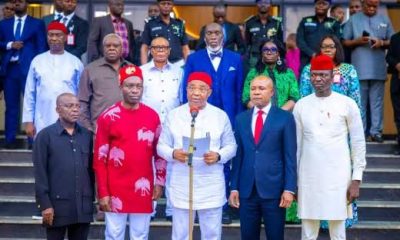
2027: South-East Govs Insist On Tinubu’s Re-election
-

 Politics2 days ago
2027: RIVERS GUBER CANDIDATES SIGN CHARTER TO PRIORITIZE CITIZENS’ DEMANDS