
News
Terrorism: SERAP Carpets FG Over Threat To Sanction BBC, Daily Trust

Socio-Economic Rights and Accountability Project (SERAP has urged President Muhammadu Buhari to urgently instruct the Minister of Information and Culture, Lai Mohammed, to withdraw the threat to sanction the British Broadcasting Corporation (BBC) and Daily Trust over their documentaries on terrorism in the country.
Mohammed had last Thursday stated that the Federal Government would sanction the BBC and Trust TV for airing documentaries that allegedly “glorify”, “promote”, and “fuel” terrorism and banditry in Nigeria.
In a letter dated July 30, 2022, and signed by SERAP Deputy Director, Kolawole Oluwadare, the organisation said, “The media has the duty to impart information and ideas on issues of public importance. If carried out, the threat to sanction the BBC and Daily Trust would inhibit the media from reporting on issues of public interest”.
According to SERAP, “Media houses and journalists ought to be given the room to determine how best to present information of public interest, especially information about the growing violence and killings across the country”.
The organisation said, “Rather than punishing the media for promoting access to diverse opinions and information on issues of public importance, your government should focus on delivering your promises to ensure the security of Nigerians”.
The organisation also said, “Carrying out the threat to sanction the BBC and Daily Trust would lessen the flow of diverse viewpoints and information to the public.
The letter read in part, “We would be grateful if the requested action is taken within 48 hours of the receipt and/or publication of this letter. If we have not heard from you by then, SERAP shall take all appropriate legal actions in the public interest.
“A free, uncensored, and unhindered press or other media is essential in any society to ensure freedom of opinion and expression and the enjoyment of other rights. It constitutes one of the cornerstones of a democratic society.
“Sanctioning the BBC and Daily Trust would be entirely inconsistent and incompatible with Nigeria’s obligations under article 9 of the African Charter on Human and Peoples’ Rights and article 19 of the International Covenant on Civil and Political Rights.
“The threat, if carried out, would impermissibly restrict the constitutional and international rights to freedom of expression, access to information, and victims’ right to justice and effective remedies that are central to public debate and accountability in a democratic society.
“Access to information is essential for the enjoyment of other human rights and freedoms and constitutes a fundamental pillar for building a democratic society and strengthening democracy.
“Allowing the media to freely carry out their duties is essential to building secure society and leaving no one behind. Conversely, imposing impermissible restrictions on media houses, journalists and other Nigerians undermines the security that builds a healthy and vibrant society.
“The grounds for sanctioning the BBC and Daily Trust as stated by Mr Mohammed fail to meet the requirements of legality, necessity, and proportionality.
“The requirement of necessity also implies an assessment of the proportionality of the grounds, with the aim of ensuring that the excuse of ‘glorifying, promoting, and fuelling terrorism and banditry’ are not used as a pretext to unduly intrude upon the rights to freedom of expression and access to information.
“Any interference with the constitutional and legal duties of the BBC and Daily Trust would not be justified in the context of the right to information.
“The Federal Government has not shown that the documentaries by the media houses would impose a specific risk of harm to a legitimate State interest that outweighs the public’s interest in the information provided by the documentaries.
“The documentaries by the BBC and Daily Trust pose no risk to any definite interest in national security or public order.
“It is inconsistent and compatible with the Nigerian Constitution 1999 [as amended] to invoke the grounds of ‘glorifying, promoting, and fuelling terrorism and banditry’ as justifications for suppressing freedom of expression or withholding from the public information of legitimate public interest that does not harm national security.
“It is contrary to both the Nigerian Constitution and international standards to threaten or punish journalists and media houses such as the BBC and Daily Trust for disseminating such information.
“The vague and overbroad definitions of ‘glorifying’, ‘promoting’, and ‘fuelling’ raise concerns that the threat by the Federal Government if carried out would unduly interfere with the rights to access to information, and disproportionate to any purported legitimate governmental aim. Ill-defined and/or overly broad grounds are open to arbitrary application and abuse.
“The broad definitions of what may constitute ‘glorifying’, ‘promoting’, and ‘fuelling’ also heighten concerns of overreach, confer far-reaching discretion on the government, and suggest that the grounds cited by the Federal Government are more intrusive than necessary.
“These words do not indicate precisely what kind of individual conduct would fall within their ambit.
“The use of these words by the Federal Government, given their opaque and ambiguous meaning, leaves open the possibility for application beyond unequivocal incitement to hatred, hostility, or violence. Such words may function to interpret legitimate reporting by media houses, journalists, and other Nigerians as unlawful.
“The grounds cited by the Federal Government for sanctioning the BBC and Daily Trust also fail to establish a direct and immediate connection between the reporting by the media houses and any risks to national security and peace.
“The threat if carried out would also create an environment that unduly deters and penalizes media houses and journalists, and the reporting of government wrongdoing more generally.
“The cumulative effect of any attempt to sanction the BBC and Daily Trust would be the gagging of the media from reporting on cases of violence and killings by terrorists and kidnappers, the reporting and information that is clearly in the public interest.
“SERAP recalls that in your 2022 new year message, you raised concerns about persistent insecurity in certain parts of the country and promised to remain resolute in giving utmost attention to the problem.
“While your government has the obligation to maintain national security, this obligation is not set apart from the obligation to protect and ensure human rights. National security is a necessary and integral part of the right to security guaranteed to each person individually”.



President Bola Tinubu has charged the newly decorated acting Inspector-General of Police, Tunji Disu, to make the Nigeria Police Force better than he met it, as the country grapples with banditry, terrorism, and other criminal activities.
The President, who personally decorated Disu with his new rank at the State House, Abuja, said the appointment comes at “a defining moment for our nation’s security,” expressing confidence in the new police chief’s ability to restore public confidence in the Force.
“The commitment that I expect from you is for you to make it better than you met it. And I’m sure you can do it. Nigeria is challenged right now with banditry, terrorism and all sorts of criminal activities,” Tinubu stated during the decoration ceremony on Wednesday.
The President, who drew on his personal knowledge of Disu from his tenure as Lagos State Governor, said he believes in the dedication the new IGP exhibited while serving in Lagos.
“I know your record. I believe in the dedication that you’ve exhibited while you were in Lagos and I was the Governor of Lagos State.
“Now you assume this responsibility at a defining moment for our nation’s security,” the President said.
Tinubu outlined specific expectations for the new police chief, emphasising discipline, professionalism, and inter-agency collaboration.
“I expect you to strengthen the discipline, enhance inter-agency collaboration, and restore public confidence in the Nigeria Police.
“Lead firmly but fairly, demand professionalism at every level and ensure that safety of lives and property remains your highest priority,” he charged.
Acknowledging the magnitude of the task ahead, the President assured Disu of his full support.
“It is a daunting challenge. I know you can do it.
“You have my full support as you advance the security pillars of the Renewed Hope agenda.
“You are a straightforward individual, committed and respected. You have sufficient discipline,” Tinubu stated.
The President urged the new IGP to draw from the experience of his predecessor, Kayode Egbetokun, who attended the ceremony.
“You can draw from the experience of Kayode Egbetokun who had been there before you.
“You have been part of the thinking, and you’ve been part of the innovation.
“The challenge as you hold the baton of this leadership is the belief that you will excel and Nigeria will prevail,” he said.
Tge President expressed gratitude to the former IGP, Kayode Egbetokun for his service while linking his legacy to the success of his successor.
“To the outgoing Inspector-General of Police, I extend the gratitude of the entire country.
“Nigeria, we are a grateful nation to you for your dedication in service, expression of good leadership attributes within the Force.
“You have served with commitment and distinction, and Nigeria appreciates your contribution to maintaining law and order in our country,” the President said.
He added, “What you should look back and remember is this: you have not succeeded without a good successor.
“Therefore, the success of Tunji Disu as IGP, when confirmed, is part of your responsibility and the joy you should look forward to.”
Tinubu noted that Disu’s previous role as Principal Staff Officer to Egbetokun positioned him well for the new assignment.
“Having been part of your Principal Staff Officer, I have no doubt he understands the ins and outs of the operation.
“He will only improvise. He’s an operational person from what I know,” the President stated.
The decoration ceremony, which took place at 4:00 pm at the President’s office, had in attendance Chief of Staff to the President Femi Gbajabiamila, and other senior government officials.
President Tinubu personally pinned the new insignia on Disu’s uniform, marking the formal transfer of leadership of Africa’s largest police force.
In his response, Disu pledged to justify the confidence reposed in him, vowing to end impunity and enforce zero tolerance to corruption within the Force.
“The President mentioning a lot of activities about me, mentioning areas I’ve worked, mentioning successes I’ve recorded as a policeman, brought emotion to me, almost brought me to tears,” Disu told State House correspondents.
He added, “I will let them know that the era of impunity is over. I will ensure that I train them and encourage them to follow human rights. I will ensure that they know that I will try to follow a regime of zero tolerance to corruption.”
The new police chief emphasised that Nigerian citizens are the ultimate bosses of the police.
“One of the first lectures I’m going to have with my men, I’m going to talk to them, let them know that the citizen, the citizen of the country, are the boss. No police anywhere in the world can succeed without the cooperation of members of the public,” Disu stated.
Egbetokun, in his remarks, expressed confidence in his successor’s ability to surpass his achievements.
“I invested in likely successors in the Nigerian Police Force, and I’m happy that one of those that I’ve invested in has been found most suitable for the job. I have so much confidence that he would surpass what I have done,” Egbetokun stated.
The decoration came barely 24 hours after Egbetokun submitted his resignation letter on Tuesday, citing family issues that require his undivided attention.
The new Police Chief later proceeded to the Police Headquarters to assume duty following his decoration by President Tinubu earlier in the day.
He took his first salute as Inspector-General from members of the Quarter Guard and other officers at the Force Headquarters after returning from the Presidential Villa at about 4:15 p.m. He thereafter proceeded to the official handover ceremony with Egbetokun.
Disu outlined three priorities for his tenure: professionalism and modernisation; accountability and integrity; and community partnership.
However, multiple Presidency sources told our correspondent that Egbetokun was asked to step down during a meeting with the President on Monday evening at the Presidential Villa.
Disu’s appointment came just 48 days before his scheduled retirement on April 13, 2026, when he would have reached the mandatory retirement age of 60 years.
However, under the amended Police Act, which allows Inspectors-General of Police to serve a four-year tenure regardless of age, Disu may remain in office until 2030.
According to the Special Adviser to the President on Information and Strategy, Bayo Onanuga, President Tinubu will convene a meeting of the Nigeria Police Council shortly to formally consider Disu’s appointment as substantive Inspector-General of Police, after which his name will be transmitted to the Senate for confirmation.
Born on April 13, 1966, on Lagos Island, Lagos State, Disu joined the Nigeria Police Force on May 18, 1992, and has served for over three decades across multiple operational and leadership roles.
He rose to national prominence as Commander of the Rapid Response Squad in Lagos State, where he served for six years. Under his leadership, the unit won the Best Anti-Crime Squad award in West Africa in 2016.
On August 2, 2021, he was appointed to head the Intelligence Response Team, replacing the suspended Abba Kyari.
Before his elevation to IGP, Disu was Assistant Inspector-General of Police in charge of the Force Criminal Investigation Department Annex, Alagbon, Lagos. He was also a Commissioner of Police in Rivers State and the Federal Capital Territory, Abuja.

President Bola Tinubu has appealed to the leadership of the 10th Senate to amend the constitution to provide a legal framework for the establishment of State Police to tackle insecurity nationwide.
President Tinubu made the appeal during an interfaith breakfast with senators at the Presidential Villa in Abuja, yesterday.
The president said that the creation of State Police has become urgent to address Nigeria’s evolving security challenges, strengthen grassroots policing, and enhance states’ capacity to respond swiftly to threats within their jurisdictions.
He noted that a decentralised policing structure would complement existing federal security architecture and promote intelligence-led, community-focused law enforcement.
“We are facing terrorism, banditry, and insurgency. But we will never fail to make a right response to this cause. What I will ask for tonight is for you (Senators) to start thinking how best to amend the constitution to incorporate the State Police for us to secure our country, take over our forests from marauders, and free our children from fear,” he said.
The president commended the cordial relationship between the Executive and the Senate, saying that unity is needed to defeat terrorism and banditry in the country.
“It is a good thing that we are working in harmony, we are looking forward to a country that evolves, a country that takes care of its citizens and protects all.
Tinubu thanked the Senate for its unflinching support towards achieving various economic reforms of his administration, especially the fuel subsidy removal and tax reform policy.
“I have a lot of credit for bold reforms. Without your collaboration and inspiration, those reforms would not be possible. We are reformists together. What we gave up and what we stopped is monumental corruption in the subsidy system. We don’t want to participate in monumental corruption and arbitrage foreign exchange.
You don’t have to chase me for dollars; you could see what Nigeria is today. You should be proud, and I am glad you are. What we are enjoying is a stable economy, and prosperity is beckoning us. We need to work hard, and this attendance means a lot to me,” the president said.
President of the Senate, Godswill Akpabio, commended the president for hosting the leadership of the Senate to the Interfaith breaking of fast.
He commended President Tinubu for providing the visionary leadership the nation needs at this critical time, stating that the administration’s bold reforms have now brought more revenue to governors at the sub-national level for the development of critical infrastructure.
The Senate President prayed for the administration, and for the nation’s peace and prosperity.
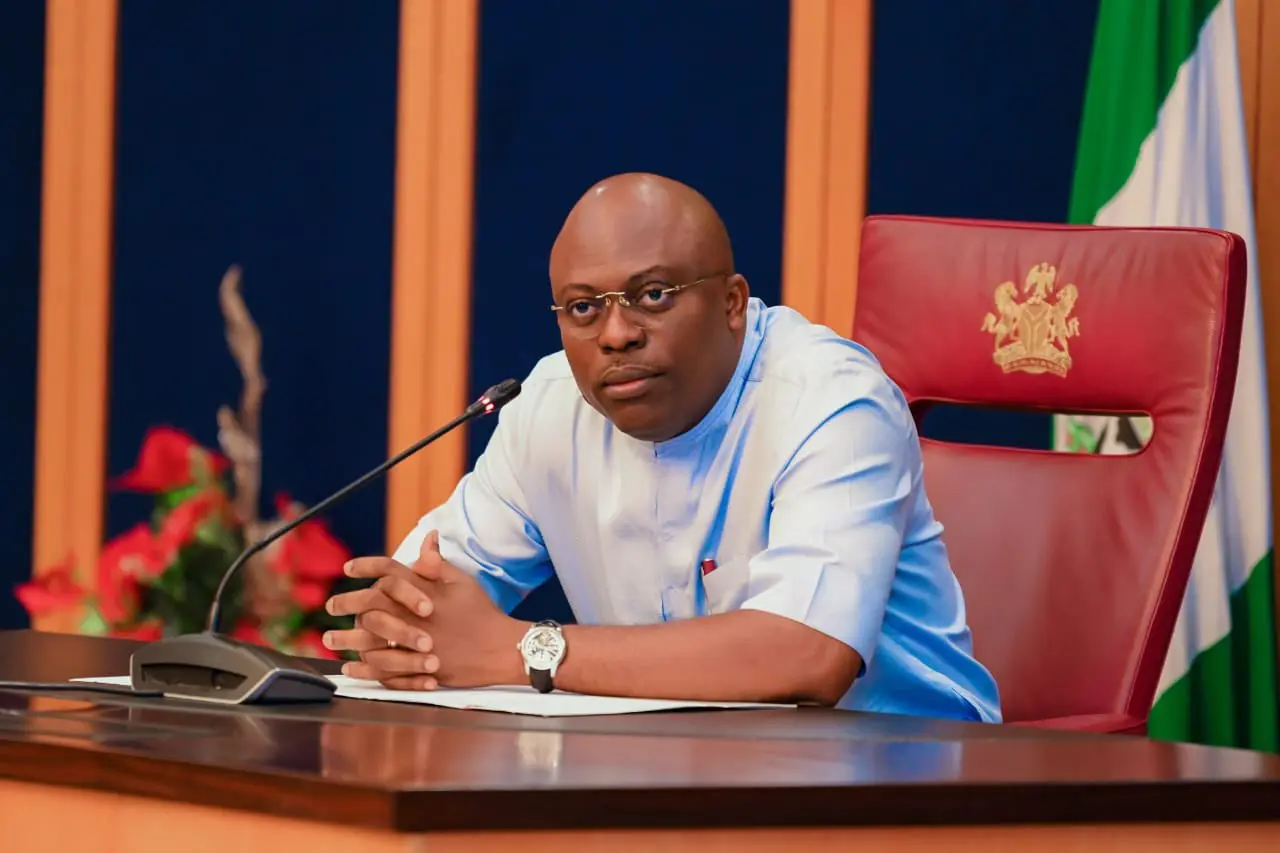
Rivers State Governor, Sir Siminalayi Fubara, has declared that his administration has made significant strides in the health sector in the past two and a half years.
Fubara, who stated this on Tuesday at the Government House, Port Harcourt, listed some of his notable achievements to include the revamping of health facilities, the establishment of the health insurance scheme and the employment of over 2,000 health workers to boost the manpower and efficiency of the sector.
The governor further disclosed that the administration has revived and expanded several abandoned health facilities, including the Zonal Hospitals in Bori, Omoku, Ahoada, and Degema.
He explained that the Ahoada Zonal Hospital is a 105-bed secondary facility that has capacity to cater for the health needs of the people in its catchment area.
In addition to the Zonal Hospitals, Fubara stated that his administration has also paid very close attention to the Primary Healthcare Centres across the state to ensure that citizens of Rivers State, especially those in the rural areas, have easy access to healthcare within their communities.
According to him, the administration approved the remodeling of 153 primary healthcare centers across the State to ensure their functionality.
“As an administration, we are very passionate about the health of every citizen and resident of Rivers State. When we realised that many people have been under stress as a result of economic hardship, we decided to introduce mental health services at the primary healthcare level. We are not just catering for those down with the common diseases such as malaria fever, we want to ensure that our people get the right attention to their mental health at the right time.
“At the tertiary level, we have also revamped the Intensive Care Unit of the Rivers State University Teaching Hospital and provided it with modern equipment, including monitors, ventilators, and scanners. Most of these innovations are massive and unprecedented,” he said.
On staff welfare, Fubara also disclosed that he approved the promotions for over 400 staff of the Rivers State University Teaching Hospital and recruited an additional 500 staff.
In the same vein, the governor said the number of scholarships for indigenes of Rivers State studying at the PAMO University of Medical Sciences has been increased from one hundred 100 to 150 under his watch.
-
Nation5 days ago
Nigeria Risks Drifting Without Strong Education Policies-Don
-

 Education4 days ago
Elga boss tasks law students on academics strides
-
 News1 day ago
Amend Constitution To Accommodate State Police, Tinubu Tells Senators
-
 Politics1 day ago
Senate Urges Tinubu To Sack CAC Boss
-
Business1 day ago
President Tinubu Extends Raw Shea Nuts Export Ban To 2027
-

 News1 day ago
Disu Takes Over As New IGP …Declares Total War On Corruption, Impunity
-
Business1 day ago
Crisis Response: EU-project Delivers New Vet. Clinic To Katsina Govt.
-

 Business1 day ago
PENGASSAN Rejects Presidential EO On Oil, Gas Revenue Remittance … Seeks PIA Review