
Featured
Judges’ Raid, DSS, Amaechi …What To Do, If I Were Buhari

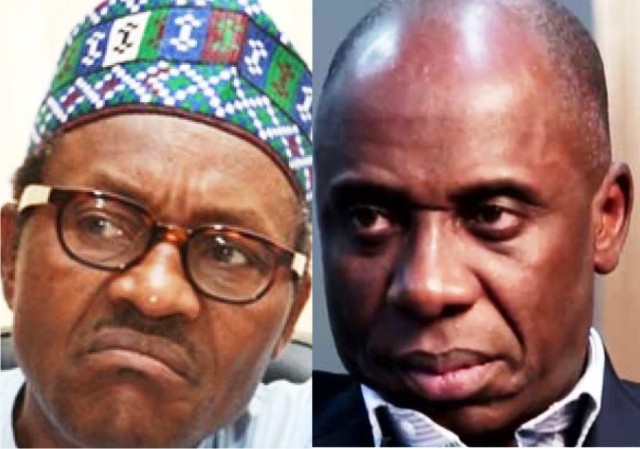
One of the pillars on which the Buhari Presidency rests is the War Against Corruption, a subject which many Nigerians believe was well-thought out. Their position is strengthened by the high credentials and pedigree of the driver of the crusade.
President Muhammadu Buhari, before the 2015 general elections, was acclaimed as a simple, modest and disciplined leader, not given to the known habits of ostentatious living, corruption and abuse of office. It was indeed these qualities that made his averment to fight corruption believable.
It was also on the crest of those values that Muhammadu Buhari became President. He matched public expectations with his public declaration of assets with as little as N3 million cash in earnings, a few cows and a plot of land in Port Harcourt, which location he was yet to be told.
That meant one of few things. That it was a mere promise by the then Governor of Rivers State, Chibuike Rotimi Amaechi. That Buhari, at the time of declaring his assets, did not have valid documents, including C of O, to lay claim to such asset. Or that it was a post-declaration, pending when he would get such land.
Whatever interpretations Nigerians may draw from that land claim, it showed transparency on the part of the President, even if, were such a gift given to former President Goodluck Jonathan by say, the Kaduna State Government, it would be revoked. That is a talk for another day.
But truth is, Buhari carries with him the reputation of one capable of fighting corruption of any kind to its logical conclusion. A key hindrance, however, might well be the measure of goodwill he enjoyed, by way of campaign and election sponsorship by defecting Peoples Democratic Party (PDP) governors, alleged to have diverted huge funds belonging to their states into his Presidential Project.
How would Buhari fight persons who contributed to his campaign project, since it was clear that he did not have the required resources to finance his presidential project? Or is it that such funds diversion did not rise to the level of corruption since they were channeled to a ‘noble cause’, the cause of helping to elect a pious man?
But by far the major criticism of the war against corruption, even among foreign commentators is that it is selective. That it targets mainly opposition politicians whose actions threatened his electoral fortunes, in the three instances, he took shots at the presidency
This is why many believe that the recent raid and subsequent arrest of judges by men of the Directorate of State Services, DSS, in a Gestapo style sting operation, followed same selective pattern. Most Nigerians agree that there is corruption in the Judiciary but believe that no judge, friendly to the ruling All Progressives Congress (APC- led) Federal Government would have suffered such embarrassment in the hands of the executive arm.
That is why it did not come as a surprise to many when two of the affected judges cried out that they were being hounded for not doing the bidding of agents of the government concerning election cases involving the ruling APC.
Last Friday, many Nigerian national daily newspapers were awash with damning headlines on the cries of one of the judges, a second within days.
The Punch of Friday October 21, 2016 has as its banner lead headline: ‘Another Judge Says Amaechi Asked Him To Influence Judgments’.
The Guardian led with, ‘Another Judge Blames Chibuike For Arrest By DSS’, while, The Sun screamed, ‘Amaechi Offered Me Bribe To Sack Fayose; – Allegation Mere Fiction, Says Transport Minister.
Even the pro – APC Nation Newspaper had the headline, Judge: Amaechi Asked Me to Help Nullify Fayose’s Election; – Justice Ngwuta’s Allegatioin Is Fiction – Minister.
The publications stemmed from a petition by one of the affected judicial officers, a Justice of the Supreme Court, Justice Nwali Sylvester Ngwuta to the Chief Justice of Nigeria (CJN), Justice Mahmud Mohammed, and the National Judicial Council (NJC).
Dated October 18, 2016, the petition chronicled events that led to the raid of his home and eventual arrest. In brief, Justice Ngwuta alleged that he was a victim of executive attack for refusing to compromise his ‘sacred oath’ to uphold truth and justice.
Justice Ngwuta pointedly accused former Rivers State Governor and Transportation Minister, Chibuike Rotimi Amaechi and his Science and Technology counterpart, Dr Ogbonnaya Onu of asking him to help influence the Supreme Court’s decision in some election cases.
According to the Justice, his ordeal was connected to his refusal to accede to the requests made by the minister.
Justice Ngwuta’s letter which came 48 hours after that by Justice John Okoro, who was also arrested by the DSS operatives, had accused Amaechi of asking him (Okoro) to influence the apex court’s decision on poll judgments in Rivers, Akwa Ibom and Abia States.
Following in Justice Okoro’s footsteps, Ngwuta in his petition to the National Judicial Council (NJC), traced his ordeal to between 2013 and 2014, when, he alleged that Amaechi approached him at a function at the International Conference Centre (ICC), Abuja, to help set aside judgment on Ekiti State Governor, Ayo Fayose’s election in order to make way for Fayose’s predecessor, and now Minister of Solid Minerals, Kayode Fayemi.
His words: “My present plight started sometime between 2013 and 2014. I represented the then CJN in an event organised at the International Conference Centre (ICC), Abuja.
‘Honourable Rotimi Amaechi came in late and sat next to me at the high table. He introduced himself to me and we exchanged contacts. A few weeks later, Fayose’s case was determined in the Court of Appeal.
‘Amaechi called me by 6.45 am and said he had come to see me, but was told I had left for the office, when he said he could return in the evening. I demanded to know what he wanted, but he would not tell me.
‘He didn’t come that evening, but came the following morning when I was already prepared to go to work.
‘He begged me to ensure Fayose’s election was set aside and another election ordered for his friend Fayemi, to contest. I told him I would not help him and that even if I was on the panel, I would have only my one vote.
‘After the Rivers Governorship election was determined by the Court of Appeal, he called to tell me his ‘ears were full’ and he would like to tell me what he heard. I told him I was out of Abuja at the time. On my return, he came in the evening and even before he sat down, he barked, ‘you have seen Wike’.
After the Supreme Court affirmed the election of Nyesom Wike, Amaechi also called him on phone and said ‘Oga is not happy’.
Transportation Minister Amaechi denied these allegations, describing them as fiction and part of a larger plan to pull him down at all cost.
Pulling someone innocent down is a grave moral, even criminal offence that should not be swept under the carpet, just as the allegations raised by Justices Okoro and Ngwuta.
To inject the needed credibility into the anti-corruption campaign, if I were Buhari, I would instruct that the claims of the Judges and Amaechi be spot-checked.
For instance, which event did both Amaechi and Ngwuta attend and when? That is very easy to find out. Next, after ascertaining that day, were there telephone calls? Affected communication service providers can easily ascertain and even produce transcripts. Did Amaechi and the Judge meet again in the Judge’s home after decision on the Rivers’ governorship elections? That too can be verified.
If I were Buhari, to prove that I am high above such vendetta as alleged by the Judges, I would institute a probe or a judicial inquest with a view to ascertaining truth of the matter.
My Agony is that there are earlier allegations, even valid judicial reports, yet to be attended to and so there may not be any urgency on the current one. Case closed.
Soye Wilson Jamabo



Rivers State Governor, Sir Siminalayi Fubara, has charged the newly appointed Secretary to the State Government (SSG) and Chief of Staff (CoS) to carry out their duties with discipline, loyalty and a firm commitment to the success of the administration and the wellbeing of the people of Rivers State.
The governor warned that any involvement in unauthorised nocturnal meetings or any conduct capable of embarrassing the government will attract immediate dismissal.
Fubara gave the warning yesterday shortly after the newly appointed Secretary to the State Government (SSG), Dr Dagogo S.A. Wokoma and the new Chief of Staff (CoS), Barrister Sunny Ewule, were sworn in at the Executive Council Chambers of Government House, Port Harcourt.
As part of the ceremony, the Chief Registrar of the State High Court, David Ihua-Maduenyi administered the Oath of Allegiance and Oath of Office on the duo before the governor gave his charge.
Addressing the appointees, Fubara reminded them that their elevation to the new positions was a call to service and not a platform for political grandstanding or the pursuit of personal ambition.
He stressed that their foremost responsibility should be to themselves and to the people of Rivers State, stressing that their conduct must always reflect integrity, restraint and dedication to public good.
Speaking directly to Dr. Wokoma, whom he described as an accomplished academic and mathematician, the governor expressed confidence in his intellectual depth and capacity to deliver on the new assignment.
The office of the Secretary to the State Government, Fubara stressed, demands thoroughness, discipline and a deep sense of responsibility. He charged the SSG to represent the State with honour at all times.
“Your duty includes representing the state government. You need to represent us in a way and manner that will bring honour to us.
“What is important to this administration is to see that the good works that we started and the ones that we met, are concluded in a way that will bring progress and development to our dear state,” he stated.
Turning to the new Chief of Staff, the governor explained that he is expected to ensure smooth administrative coordination, managing official engagements effectively and safeguarding the image of the Government House.
He underscored the sensitive and personal nature of the role and emphasised that the position operates strictly under the authority of the governor.
Fubara stressed that the role does not permit independent political engagements or private strategy meetings without his knowledge and consent.
“Let me sound it here very clearly. Your duty is to make sure that you handle the administrative duties and image making roles perfectly well, liaising with whoever is coming for any official assignment here.
“If you involve yourself in nocturnal meetings and all those things, I will sack you. I’m very serious. What is important to me today is peace, progress and prosperity of this state. I’m not going to compromise anything for it,” he said.
The governor cautioned that involvement of the new appointees in any action capable of bringing the government or his office to disrepute would attract appropriate sanctions.
While congratulating the new appointees, Fubara expressed optimism that they would justify the confidence reposed in them.
He called on all public officials to work together in unity, observing that collective success is stronger and more enduring than individual achievement.
The governor who also addressed the Permanent Secretaries present at the ceremony, directed those of them who have reached retirement age to start preparing their handover notes without delay.
The notice, he said, was not intended to scare anybody but to prepare their minds towards the inevitability of exiting the service one day and to pave way for an orderly transition.
He warned against any attempt to engage in financial misconduct or last-minute irregularities, stressing that he was closely monitoring the system to ensure strict enforcement of accountability rules.

Rivers State Governor, Sir Siminialayi Fubara, has dissolved the State Executive Council.
The governor announced the cabinet dissolution yesterday in a statement titled ‘Government Special Announcement’, signed by his new Chief Press Secretary, Onwuka Nzeshi.
Governor Fubara directed all Commissioners and Special Advisers to hand over to the Permanent Secretaries or the most Senior officers in their Ministries with immediate effect.
He thanked the outgoing members of the State Executive Council for their service and wished them the best in their future endeavours.
The three-paragraph special announcement read, “His Excellency, Sir Siminalayi Fubara, GSSRS, Governor of Rivers State, has dissolved the State Executive Council.
“His Excellency, the Governor, has therefore directed all Commissioners and Special Advisers to hand over to the Permanent Secretaries or the most Senior officers in their Ministries with immediate effect.
“His Excellency further expresses his deepest appreciation to the outgoing members of the Executive Council wishing them the best in their future endeavours.”
The Independent National Electoral Commission (INEC) yesterday told the National Assembly that it requires N873.78bn to conduct the 2027 general elections, even as it seeks N171bn to fund its operations in the 2026 fiscal year.
INEC Chairman, Prof Joash Amupitan, made the disclosure while presenting the commission’s 2026 budget proposal and the projected cost for the 2027 general elections before the National Assembly Joint Committee on Electoral Matters in Abuja.
According to Amupitan, the N873.78bn election budget covers the full conduct of national polls in 2027.
An additional N171bn is needed to support INEC’s routine activities in 2026, including bye-elections and off-season elections, the commission stated.
The INEC boss said the proposed election budget does not include a fresh request from the National Youth Service Corps seeking increased allowances for corps members engaged as ad-hoc staff during elections.
He explained that, although the details of specific line items were not exhaustively presented, the almost N1tn election budget is structured across five major components.
“N379.75bn is for operational costs, N92.32bn for administrative costs, N209.21bn for technological costs, N154.91bn for election capital costs and N42.61bn for miscellaneous expenses,” Amupitan said.
The INEC chief noted that the budget was prepared “in line with Section 3(3) of the Electoral Act 2022, which mandates the Commission to prepare its election budget at least one year before the general election.”
On the 2026 fiscal year, Amupitan disclosed that the Ministry of Finance provided an envelope of N140bn, stressing, however, that “INEC is proposing a total expenditure of N171bn.”
The breakdown includes N109bn for personnel costs, N18.7bn for overheads, N42.63bn for election-related activities and N1.4bn for capital expenditure.
He argued that the envelope budgeting system is not suitable for the Commission’s operations, noting that INEC’s activities often require urgent and flexible funding.
Amupitan also identified the lack of a dedicated communications network as a major operational challenge, adding that if the commission develops its own network infrastructure, Nigerians would be in a better position to hold it accountable for any technical glitches.
Speaking at the session, Senator Adams Oshiomhole (APC, Edo North) said external agencies should not dictate the budgeting framework for INEC, given the unique and sensitive nature of its mandate.
He advocated that the envelope budgeting model should be set aside.
He urged the National Assembly to work with INEC’s financial proposal to avoid future instances of possible underfunding.
In the same vein, a member of the House of Representatives from Edo State, Billy Osawaru, called for INEC’s budget to be placed on first-line charge as provided in the Constitution, with funds released in full and on time to enable the Commission to plan early enough for the 2027 general election.
The Joint Committee approved a motion recommending the one-time release of the Commission’s annual budget.
The committee also said it would consider the NYSC’s request for about N32bn to increase allowances for corps members to N125,000 each when engaged for election duties.
The Chairman of the Senate Committee on INEC, Senator Simon Along, assured that the National Assembly would work closely with the Commission to ensure it receives the necessary support for the successful conduct of the 2027 general elections.
Similarly, the Chairman of the House Committee on Electoral Matters, Bayo Balogun, also pledged legislative support, warning INEC to be careful about promises it might be unable to keep.
He recalled that during the 2023 general election, INEC made strong assurances about uploading results to the INEC Result Viewing portal, creating the impression that results could be monitored in real time.
“iREV was not even in the Electoral Act; it was only in INEC regulations. So, be careful how you make promises,” Balogun warned.
The N873.78bn proposed by INEC for next year’s general election is a significant increase from the N313.4bn released to the Commission by the Federal Government for the conduct of the 2023 general election.
-
Politics2 days ago
2027: NIGERIANS FAULT INEC ON DIGITAL MEMBERSHIP REGISTER DIRECTIVE
-

 Environment2 days ago
LAWMA Director Says Sweeping Reforms Have Improved Waste Collection
-
Politics2 days ago
LP Crisis: Ex-NWC Member Dumps Dumps Abure Faction
-

 Politics2 days ago
Umahi Dismisses Allegations On Social Media, Insists On Projects Delivery
-

 Sports2 days ago
Abia Not Sure To Secure continental Ticket
-
Sports2 days ago
La Liga: Yamal Records First Career Hat-trick
-

 Transport2 days ago
FAAN Announces Pick-Up Points for Go-Cashless Cards
-
Politics2 days ago
IT’S A LIE, G-5 GOVS DIDN’T WIN ELECTION FOR TINUBU – SOWUNMI