
Nation
THE STATES

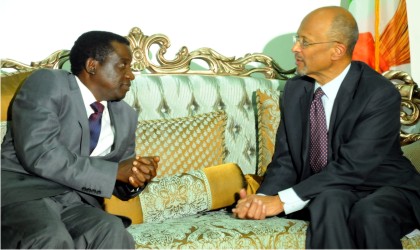
Governor Simon Lalong of Plateau State (left), with the Senior Adviser, Centre for Humanitarian Dialogue, Mr David Lambo, during a visit to the Governor in Jos on Thursday
Bauchi
A chieftain of the Peoples Democratic Party (PDP), Alhaji
Shehu Gabam, said President Muhammadu Buhari, has good intentions for the country and urged the opposition to support him.
Gabam, Chief of staff to former Governor Isa Yuguda of Bauchi State, made the call in Tilde-Fulani, Toro Local Government Area, in an interview with newsmen.
According to him, President Buhari has a good intention for the country and there is no need for the opposition to start bombarding him.
“Well, I believe the president should be allowed to determine his own pace of speed and also determine his own cruising level,” he added.
Benue
The Benue State House of Assembly says it is prepared to
assist the Government to tackle the spate of assassinations in the State.
The Speaker of the House, Mr Terkimbi Ikyange, made the remark during Valedictory Session in honour of former legislator, Mr Atoza Hindan, in Makurdi.
Hindan, who was murdered in his home in Katsina-Ala Local Government Area of the state, was a two-time member of the assembly between 1979 and 1983.
The speaker rued the death which he said had depleted the ranks of senior colleagues and hampered growth and development of the legislature.
Kaduna
The Kaduna State Government says it has appointed the
Emir of Birnin Gwari, Alhaji Zubairu Jibril, as the 2015 Amirul-Hajj for the state.
In a statement by the media aide to Governor Nasiru El-Rufa’I, Mr Samuel Aruwan, in Kaduna, it explained that government’s decision to stop sponsoring people for pilgrimages has saved the state more than N221.8 million.
The statement, however, said the government would send 116 officials and guides that would ensure smooth Hajj operations for the 5,682 pilgrims from the state.
“The government will discharge its obligation to the pilgrims and send a delegation of guides, preachers, medical personnel, media professionals and pilgrim officers,” it added.
Kano
The Kano State Government says it approved N15 million
for the establishment of an eight-kilometre shelter belt for preserving the forest reserves in Danbatta and Bichi Local Government Areas.
The state Commissioner for Information, Alhaji Muhammad Garba, who disclosed this while briefing newsmen on the outcome of the State Executive Council meeting, said the shelter belt would check desertification in desert-prone areas in the state.
The council, he said, also approved N35 million for the transformation of the Audu Bako Secretariat Complex into a green area.
The council, he added, also approved N2.2 billion for the execution of the 2015 constituency projects across the 44 local government areas of the state.
Kogi
A member of House of Representatives representing
Kabba/Bunu/Ijumu Federal Constituency of Kogi, Rep. Tajudeen Yusuf, has promised to give top priority to education of his people.
Yusuf, who made gave the promise in an interview with newsmen in Lokoja, said that there was no better time than now.
He noted that his back-to-school summer studies was a way of contributing to the lives and educational development of children in his constituency.
According to him, education plays a very vital role in the development and growth of the society, and advised that children should be given the attentions they deserved to enable them get better education.
Nasarawa
The Nasarawa State Governor, Tanko Al-Makura has said
that all projects initiated by his administration were meant to enhance the productive capacity of the people.
Al-Makura stated this during an inspection tour of Mararaba Orange Market Bridge being constructed by the government in Karu Local Government.
He gave the contractors handling the bridge one month to complete the project to boost the socio-economic development of the area.
“I want to re-state my commitment to the development of this state; to fight poverty, unemployment and to boost the standard of living of the people,” he added.
Lagos
The Head of Chancery, Indian High Commission in Lagos,
Mr Vyas Choudhary has expressed satisfaction at the growing relationship between Nigeria and his country.
Choudhary, who spoke with newsmen at a ceremony to mark India’s 69th Independence Day at the country’s High Commission in Lagos, revealed his government’s plan to increase bilateral relations with Nigeria in the years ahead.
He said that his government “strongly sees Nigeria as an important ally in Africa”, and would continue to sustain its areas of cooperation with Nigeria.
Choudhary said that the celebration in Lagos and Abuja was to strengthen India and Nigeria cultural relations.
Niger
A Magistrates’ Court in Minna has remanded three men,
Barde Usman, Abdullahi Isah and Samaila Umar in prison custody for alleged armed robbery.
The accused persons were arraigned on a two-count charge of criminal conspiracy and armed robbery, contrary to Sections 97 and 298 of the Penal Code.
The Police Prosecutor, Cpl. Jubilee Jac, told the court that a team of policemen on patrol along Bida road intercepted the accused persons robbing travellers on May 18.
When the charges were read to the accused persons, they pleaded not guilty, but the Presiding Judge, Magistrate Mariam King, said she could not take the plea of the accused as her court lacked jurisdiction to hear the matter.
Ogun
The Chairman of the Transition Committee of Ijebu-Ode
Local Government Area, Mr Adeshina Baruwa, has urged the Igbo community to support his administration’s resolve to deliver the dividends of democracy.
Baruwa made the call during a courtesy visit by the Eze Ndigbo of Ijebu-Ode, Chief Ezendo Onwanaka, and other Igbo leaders in Ijebu-Ode.
The chairman said the Igbo community must be alive to its responsibilities and continue to live in peace with the locals.
He said his administration would not condone poor sanitation and disregard for environmental laws, adding that the task to keep Ijebu-Ode clean was everyone’s responsibility.
Ondo
A former Chairman of Okitipupa Local Government Area
of Ondo State, Mr Femi Aju is dead. The deceased, aged 40, slumped and died before he was rushed to hospital.
The Chief Medical Director of Ondo State Specialist Hospital, Mr Olumide Akadiri, told newsmen that the deceased was brought-in dead and his remains deposited at the hospital’s mortuary.
Caretaker Chairman of Okitipupa Local Council, Chief Solomon Bitire, described Aju’s death as “shocking, sudden and unfortunate,’’ and added.
He said that the area had lost a vibrant and intelligent career officer and politician who had good intentions for the people.
Osun
Scores of senior lecturers and students of Obafemi Awolowo Univer
sity, Ile-Ife, Osun, have eulogised the late Ooni of Ife, Oba Okunade Sijuwade.
Some of them, who spoke with newsmen in the ancient town of Ile-Ife, described the late monarch as a an architect of peace, harmony and equality.
The Dean of Faculty of Arts, Prof. Femi Adewole, said the late monarch was an epitome of humility, man of valour, and a passionate custodian of Yoruba tradition.
He described him as an elephant whose might and influence went beyond the shores of Nigeria, and prayed to God to grant the immediate family of the Ooni the fortitude to bear the irreparable loss.
Plateau
The Director of Press and Public Affairs to Plateau State Governor,
Mr Emmanuel Nanle, has said that the governor has yet to award a contract for the renovation of Old Government House, Jos.
Nanle made the clarification in Jos following speculations that the governor had awarded a renovation contract of N2 billion for the complex to his brother.
The facility currently houses the Office of the Deputy Governor and General Administration Department.
Nanle told newsmen that although the structure needed renovation, no contract had been awarded but that an assessment of the facility was on.
Sokoto
The Acting Chairman of Sokoto State Zakkat and Endowment Com
mittee, Malam Lawal Maidoki, has said it returned over N1 million to the state government’s coffers.
Maidoki explained that the money was part of N45.8million released to the committee for the payment of allowances to physically-challenged persons across the state in June.
He urged the beneficiaries to utilise the allowances to improve their lives, so as not to defeat the objectives of the programme.
Yobe
The National Security Adviser (NSA), Maj.-Gen. Babagana Munguno
(rtd), has said security operatives fighting the Boko Haram would cultivate a new relationship with the civil populace to quickly end insurgency in the country.
Munguno, accompanied by the service chiefs, stated this in Damaturu when he paid a courtesy call on Governor Ibrahim Gaidam of Yobe State.
He said a strong military/civilian relationship based on trust and mutual respect would facilitate effective fight against insurgency.
The NSA said the visit was for the service chiefs to assess the situation on ground, discuss with political leaders and the people, so as to effectively restrategise and quickly end the Boko Haram menace.
Zamfara
The Zamfara State Ministry of Health says it is working with Non-
governmental Organisations to distribute 2.6 million Long Lasting Insecticide Nets (LLINs) across the 14 local government areas of the state.
The state’s Malaria Eradication Program Manager, Alhaji Hamisu Duran, said this during a one-day orientation workshop on “The role of the media towards ensuring a successful LLINs distribution Campaign,” held in Gusau.
Duran explained that the state government was also collaborating with Malaria Action Programmes for States (MAPS) and the Health Communication Capacity Collaborative Programme (HC3), in the distribution exercise.
Also speaking, the state MAPS’s Project Coordinator, Dr Kabiru Atta, commended the state government for creating an enabling environment for the MAPS to reduce malaria burden in the state.



As the world commemorates World Water Day, the Hydrocarbon Pollution Remediation Project (HYPREP) has reaffirmed its commitment to providing potable water across Ogoni communities, in line with the recommendations of the United Nations Environment Programme (UNEP) Report on the Ogoni Environment.
In a statement issued by its Project Coordinator, Nenibarini Zabbey, on March 22, 2026, HYPREP noted that this year’s theme, “Water and Gender,” alongside the campaign slogan, “Where Water Flows, Equity Grows,” underscores its resolve to extend potable water supply beyond oil-impacted communities to all Ogoni communities.
Zabbey emphasized that access to clean water is a fundamental human right, adding that HYPREP remains committed to ensuring inclusive and equitable water access across the region.
He disclosed that the agency has successfully provided potable water to over 43 communities in Ogoni, while ongoing Phase 3 water projects are expected to benefit an additional 17 communities. He also highlighted steady progress on windmill-powered water projects in less populated areas, particularly in Khana Local Government Area.
According to him, the K-Dere Water Project, which is over 99 percent complete, will be commissioned in the coming weeks, even as work continues on other water schemes across Ogoni.
Zabbey further noted that HYPREP’s interventions are aligned with the United Nations Sustainable Development Goal 6, which focuses on ensuring the availability and sustainable management of water and sanitation for all by 2030.
To ensure sustainability, he explained that the agency has adopted a joint management model involving host communities, the Rivers State Ministry of Water Resources and Rural Development, and the Rivers State Small Towns Water Supply and Sanitation Agency (RSSTOWA). He added that Water Consumers’ Associations have been established in communities such as Nchia and Eleme, alongside training programmes conducted in collaboration with non-governmental organisations.
The Project Coordinator stressed the importance of community ownership and protection of water facilities, echoing the call by the Minister of Environment, Balarabe Abbas Lawal, for residents to safeguard the infrastructure provided in their areas.
Zabbey expressed optimism that the ongoing efforts will significantly improve access to safe drinking water, reduce waterborne diseases, and enhance public health outcomes across Ogoni communities.
The Hydrocarbon Pollution Remediation Project (HYPREP) has announced that the mangrove wetlands in Ogoniland have been officially designated a Ramsar Site of International Importance by the Secretariat of the Ramsar Convention on Wetlands.
The designation, according to HYPREP, underscores the global ecological significance of Ogoniland’s mangrove wetlands and highlights ongoing restoration efforts aimed at addressing environmental degradation in the area.
In a press statement issued by the Project Coordinator of HYPREP, Prof Nenibarini Zabbey, the recognition was described as a major milestone for the agency, the people of Ogoni and other stakeholders working towards environmental restoration in the region.
Zabbey explained that the mangrove wetlands, which cover more than 31,700 hectares, consist of islands, tidal creeks, mudflats and mangrove forests that support a wide range of biodiversity. The ecosystem provides habitat for several species including fin fish, shellfish, crustaceans, crocodiles, turtles and the endangered grey parrot.
He noted that beyond biodiversity conservation, the wetland also provides essential ecosystem services such as fisheries production, flood control, water purification and carbon storage. According to him, the international recognition will further support local livelihoods, promote ecotourism and bring global attention to the region.
The HYPREP coordinator disclosed that the designation followed a meticulous process that began in 2024 when the project submitted a memorandum to the National Council on Environment seeking support for the recognition of the Ogoni wetlands as a Ramsar site.
Following the council’s review and approval, the Honourable Minister of Environment and Chairman of HYPREP’s Governing Council, Balarabe Abbas Lawal, formally wrote to the Ramsar Convention Secretariat requesting international recognition of the wetlands.
After a comprehensive ecological assessment, the Ramsar Secretariat granted the designation, officially recognising the Ogoniland wetlands as one of the world’s sites of international importance.
Zabbey said the recognition would strengthen ongoing environmental restoration efforts in the area and encourage stronger conservation measures and sustainable management of the wetlands for the benefit of present and future generations.
He added that the designation also fulfils a key recommendation of the United Nations Environment Programme (UNEP) Environmental Assessment Report on Ogoniland, marking another significant step in the implementation of the report’s recommendations.
The HYPREP project coordinator reaffirmed the agency’s commitment to restoring the Ogoni environment through the remediation of oil-polluted land, shorelines and mangrove ecosystems.
He also called for collective responsibility and stakeholder support to sustain the progress of the Ogoni cleanup programme and facilitate the development of a comprehensive and sustainable management plan for the Ogoni mangrove wetlands.

The Permanent Secretary, Rivers State Ministry of Social Welfare and Rehabilitation, Mrs Lauretta Davies-Dimkpa, has attributed the successes of the 12-day programme organised for adolescent girls aimed at eliminating Female Genital Mutilation(FGM) in some parts of the State to the ability of the respective stakeholders to take ownership of the programme.
Mrs Davies-Dimkpa, who dropped the hint in an interview at the end of the programme in Elele-Alimini Community in Emohua Local Government Area on Saturday, said the event had a buy-in component, an ownership mentality, whereby facilitators, staff, and everyone involved took ownership of the project.
She explained that the Rivers State Ministry of Social Welfare and Rehabilitation, in collaboration with the United Nations Children’s Fund (UNICEF) and the United Nations Population Fund (UNFPA) had packaged a series of training sessions for adolescent girls aimed at ending the practice of Female Genital Mutilation (FGM) in some communities across the State.
According to her, the initiative was designed to educate young girls on the harmful effects of the practice and empower them to become advocates against it within their communities.
She noted that the programme, which lasted for several weeks, targeted adolescent girls from different local government areas where the practice is still prevalent, stressing that
data collected by UNICEF and the Ministry revealed that Female Genital Mutilation is still practised in some parts of the State, prompting the need for intensified sensitisation and community engagement.
Mrs Davies-Dimkpa explained that the programme adopted a “train-the-trainer” approach where adolescent girls were educated on the dangers of the practice and encouraged to share the knowledge with their peers, families and communities.
“This is a programme by the Rivers State Ministry of Social Welfare and Rehabilitation with support from UNICEF and UNFPA to train adolescent girls towards ending Female Genital Mutilation, which is still practised in some local government areas,” she said.
She further explained that each participating local government area had a three-day training session, with the exercise running for a total of 12 days.
The local government areas, where the programme took place, she noted, included Ahoada West, Abua-Odual, and Emohua, adding that the initiative is part of broader efforts by the state government and development partners to eliminate harmful traditional practices and protect the rights and wellbeing of girls.
She revealed that prior to the training of the adolescent girls, the Ministry and its partners had also engaged community facilitators, including older women and men, to sensitise them on the dangers associated with Female Genital Mutilation.
According to her, the involvement of community leaders and adults is essential in addressing the cultural and social factors that sustain the practice.
Speaking on the response of the participants, the permanent secretary expressed satisfaction with the level of engagement and enthusiasm shown by the girls throughout the training sessions.
She noted that many of the participants said they were learning about the harmful effects of Female Genital Mutilation for the first time.
“The girls are between the ages of 12 and 17 and from the interactions we had with them, they were very excited. Some of them are hearing these things for the first time and never knew that the practice is harmful,” she said.
She expressed optimism that the knowledge gained from the training would enable the girls to serve as advocates for change within their communities.
She added that the Rivers State Government, alongside its partners, would continue to intensify efforts and expand community-based interventions aimed at ending the practice across the State.
Meanwhile, the participants for Emohua Local Government Area were drawn from Elele-Alimini, Egbeda, Rumuji, Ibaa, Rumuekpe, Rumuakunde, Eligbarada, and Ogbakiri Communities.
The participants,who spoke in separate interviews described the training as eye-opening, noting that it helped them better understand issues surrounding adolescent health, personal hygiene, reproductive health, and the harmful consequences of Female Genital Mutilation.
Favour Azukwu from Rumuekpe community, said the programme provided a deeper understanding of the dangers associated with the practice, particularly its impact on the health and wellbeing of girls and women.
She explained that the training sessions exposed participants to the medical, social and psychological effects of Female Genital Mutilation, including severe bleeding, infections and complications during childbirth.
She revealed that she personally experienced the practice at the age of 12 and suffered heavy bleeding afterwards, an experience that has strengthened her determination to advocate for its eradication.
According to her, many communities still practise Female Genital Mutilation because it is perceived as a cultural tradition, despite the dangers associated with it.
“I do not support Female Genital Mutilation because there are many dangers involved. I experienced severe bleeding when it was done to me as a child.
Another participant, Glory Ken, a 16-year-old secondary school student from Rumuji community, said the programme broadened her understanding of several important topics affecting adolescents.
She explained that beyond the discussion on Female Genital Mutilation, the training also focused on issues such as personal hygiene, reproductive health, peer education, and self-care.
According to her, the sessions helped participants understand the importance of making informed health decisions and supporting one another as peer educators.
“I learned about many things that affect young people in society and how to take care of myself. I also learned that Female Genital Mutilation is harmful to our health. The message I am taking back to my community is that this practice should stop,” she said.
Also speaking, Goodness Kenjika Nyeche described the programme as very impactful.
She noted that the training equipped participants with the skills and confidence to educate others about the harmful effects of Female Genital Mutilation.
She said she plans to organise sensitisation among adolescents in her community, particularly girls between the ages of 10 and 19, to ensure they understand the dangers associated with the practice.
“I learned many things from this programme and I feel very good about it. I will educate other young girls in my community and help them understand why Female Genital Mutilation should not continue,” she said.
For Queen Dike from Ibaa community, the programme helped clarify misconceptions surrounding the practice.
She explained that in some communities, the practice is still referred to as circumcision and is viewed as part of cultural identity.
She said the training helped participants understand that Female Genital Mutilation involves the cutting or removal of parts of the female genital organs and that it has serious health consequences.
She stressed that awareness and education are key to ending the practice, especially among communities that continue to uphold it as tradition.
“I think the programme is very helpful because many people still believe it is part of culture. More awareness is needed so people can understand why it should stop,” she said.
Another participant, MyJoy Echika Amadi, said the programme provided critical information about adolescent health and the dangers associated with Female Genital Mutilation.
She described the initiative as enlightening and said it encouraged young people to become advocates for change in their communities.
According to her, participants were encouraged to use various platforms such as churches, peer groups, schools and community gatherings to spread awareness about the harmful effects of the practice.
“This programme has enlightened us about the dangers of Female Genital Mutilation. I will do my best to create awareness in my community and encourage people to stop the practice,” she said.
Many of the participants emphasised that the knowledge gained during the programme has empowered them to challenge harmful traditions and promote healthier practices among young people.
They also called on the Rivers State Government, development partners and civil society organisations to sustain the sensitisation campaigns and extend the training to more communities across the State.
According to them, empowering young people with the right information will play a critical role in eliminating Female Genital Mutilation and protecting the rights, health and dignity of girls in Rivers State.
The participants expressed appreciation to the Rivers State Ministry of Social Welfare and Rehabilitation, UNICEF and UNFPA for organising the programme and for investing in the wellbeing and future of adolescent girls in the State.