
Nation
THE STATES

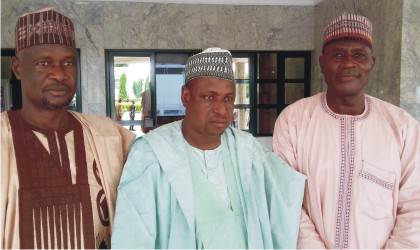
L-R: An Editor with the FRCN, Alhaji Abdulhamib Mariya, the station Manager, Freedom Radio, Dutse, Adamu Ladan and Editor-In-Chief, News Agency of Nigeria (NAN), Alhaji Lawal Ado, during a courtesy visit by Nigerian Guild of Editors to Governor Aminu Tambuwal in Sokoto on Friday.
FCT
A Kado Grade 1 Area Court, Abuja, yesterday sentenced
two men, Ali Idris and Shamsu Ibrahim, to one month imprisonment each for stealing a generator tank.
The convicts, who both reside at Jabi Motor Park, Abuja, had pleaded guilty to the charge.
The Judge, Alhaji Abubakar Sadiq, said the sentence would serve as a deterrent to others.
Sadiq, however, gave them an option of N5, 000 fine each.
Earlier, the prosecutor, Insp. Simon Ibrahim, told the court that a police patrol team from Utako Police Station, Abuja, arrested and brought the accused to the station on July 20 for stealing the generator tank.
Jigawa
Jigawa State Governor, Muhammad Badaru of Jigawa on
Tuesday said his administration had taken measures to address the shortage of 4, 500 teachers in primary and secondary schools in the state.
Badaru told members of the All Nigeria Conference of Principals (ANCOPs) who paid him a courtesy visit in Dutse, that he had engaged a consultant to recruit qualified teachers to bridge existing gap.
He also said that the administration would introduce a new technology to enhance teachings and learning in the state.
Badru said that his government would also give enough incentives to teachers to motivate them to deliver quality teaching to students.
He said the government had approved payment of its 2013 counterpart fund to the National Basic Education Commission, to enable it access vital funds for schools expansion and provision of furniture.
Kaduna
Stakeholders in child protection are to embark on massive
awareness campaign as part of efforts to push for the domestication of the Child Rights Acts in Kaduna State, an official has said.
Acting Director, Social Welfare and Child Development, Kaduna State Ministry of Women Affairs, Mr Ibrahim Musa, discused this to newsmen in Kaduna on Tuesday.
Musa said that several residents of the state were still not aware of the contents of the Acts and the need for its domestication at the state level after the National Assembly did it in 2003.
According to him, the awareness campaign has become necessary to enlighten the public about the contents and gains of the acts following increasing rate of child abuse in the state.
Musa said the enlightenment campaign would be done using media outfits, churches, mosques, community-based organisations and town-hall meetings.
The director said that the stakeholders would also carry out advocacy visits to relevant faith–based institutions, traditional rulers and government bodies, to seek their support.
Kebbi
The Governorship Election Petition Tribunal in Kebbi State
yesterday dismissed the petition filed by the PDP governorship candidate, retired Gen. Bello Sarkin-Yaki, challenging the election of Governor Atiku Bagudu.
Bagudu of the APC was returned elected as governor of the state by INEC at the April 2015 general election.
The Chairman of the tribunal, Justice Kazem Alogba, who delivered the verdict in Birnin Kebbi, said the petitioner failed to adhere to the process of filing a petition.
He averred that the petitioner abandoned the petition by filing for a free hearing notice behind time.
Counsel to the petitioner, Mr Ibrahim Mohammed, however, objected to the decision of the tribunal, stressing that an appeal would be filed at the Court of Appeal in Sokoto.
Kogi
The Nigerian Association of Hospital and Administrative
Pharmacists, yesterday in Lokoja expressed concern over the poor rating of Nigeria’s health system by the World Health Organisation (WHO).
According to the association, WHO in its recent report placed Nigeria in the 187 position out of 190 countries in its rating of global health systems.
The association, in a communiqué signed by its National Secretary, Mr Abdullahi Ndah-Ameh, suggested a multifaceted approach involving all health professionals to change the trend.
It said that improvement of health indices in Nigeria remains a collective agenda requiring holistic approach anchored on the triple framework of people, process and structure.
The association reiterated that pharmacists remained an integral and indispensable professional group in the delivery of quality healthcare to patients in Nigeria.
It frowned at the“ irrational use of drugs” in the country which had resulted in avoidable morbidity and mortality.
Kwara
The Zonal Transport Officer (ZTSO), Federal Road Safety Com
mission (FRSC), Ilorin Zonal Headquarters, Mr Godwin Zawua, has urged religious leaders to allow staff of his commission deliver lectures on road safety in mosques and churches.
Zawua made the request in Ilorin yesterday in his speech at the meeting of the Senate of Catholic Priests of Ilorin Diocese.
He said such enlightenment lectures could help in the effort at reducing carnage on the highways.
He said FRSC was also ready to assist in the training and retraining of students, priests and clergies at seminaries and theology schools.
He thanked the Catholic Priests Dioceses in Ilorin for giving him the opportunity to talk to them on road safety precautions.
Lagos
An Ebute Meta Chief Magistrates’ Court in Lagos State on Tues
day ordered the remand in Ikoyi Prisons of an alleged cult-member charged with the murder of Femi Egbekunle and Saliu Maja- during a street-fight.
The accused, Gbenga Shodiya, whose address was not disclosed, is facing a three-count charge bordering on murder and unlawful killing before Magistrate O.O.A. Fowowe-Erusiafe.
Fowowe-Erusiafe ordered that the accused be remanded at the Ikoyi Prisons for 30 days pending the receipt of legal advice from the Director of Public Prosecutions (DPPs).
She also directed the prosecutor to duplicate the case file to be forwarded to the DPPs for legal advice saying the court lacked the jurisdiction to prosecute murder cases.
Nasarawa
The Chairman, Wamba Local Government Council of Nasarawa
State, Alhaji Musa Shuaibu-Wayo, has called for 24 hours security surveillance in the area to check incessant robbery attacks on communities.
Shuaibu-Wayo made the appeal yesterday while briefing newsmen after the joint security and peace meeting of the area in Wamba.
He said that the strategy would curtail the activities of men of the underworld so as to enable the people of the area sleep with their two eyes closed as well as to go about their normal business without fear of attack.
“The aim of this joint security and peace meeting is to brainstorm on ways or how to ensure peace in this local government and the state at large because no nation or society can develop in an atmosphere of rancour, confusion and security challenges.
“The security challenges facing our area, the state and some parts of the country had not only affected our lives negatively but had also affected the socio-economic development of the country negatively.
Niger
A Minna Magistrates’ Court yesterday ordered the remand in
prison custody of a man, Samaila Umar, for allegedly committing rape.
The accused was arraigned in court on a 6-count charge of conspiracy, armed robbery, rape, mischief, resisting arrest and causing grievous hurt.
The Police Prosecutor, Insp. Daniel Ikwoche, told the court that one Isiaku Abubakar reported the matter at the Lapai Divisional Police station on July 21.
Ikwoche said that the complainant alleged that he was on his way to Lapai from Minna, with a girl, when the accused and four others, now at large, attacked him at a point between Takuti and Cheche villages with gun, cutlass and sticks.
He said the complainant further alleged that the suspect had carnal knowledge of the girl, and robbed them of N256, 000 as well as other valuables.
Ogun
A 30-year-old female sales representative, Adeola Salami, was
yesterday arraigned before an Abeokuta Chief Magistrates’ Court for alleged theft of N2.6 million, property of King’s Court Ideal Anchor Ltd.
According to the prosecutor, Insp. Sunday Eigbejiale, the accused committed the offence on June 20 at King’s Court Anchor Ltd, Ibara in Abeokuta.
He said that the accused, who was an employee of King’s Court Ideal Anchor Ltd., sold an assortment of recharge cards worth N2.6million.
The prosecutor submitted that the offences contravened Sections 383 (2) and 390 (6) of the Criminal Laws of Ogun, 2006.
The accused, who pleaded not guilty to a two-count charge of fraudulent conversion and theft, was represented by Olokede Obadina.
Oyo
An Iyaganku Senior Magistrates’ Court sitting at Iyaganku yes
terday sentenced a scavenger, Saudiq Olatunji,18, to 23 days imprisonment for stealing 56 pieces of casted iron rods from an uncompleted building.
The Senior Magistrate, Mrs Patricia Adetuyibi, who handed down the judgment, said Olatunji should serve the term with hard labour.
Adetuyibi said that the sentence would serve as a deterrent to other scavengers who steal in the guise of scavenging.
Olatunji was arraigned before the magistrate on a one-count charge of stealing.
Our correspondent reports that the convict was arraigned on July 22 and had pleaded not guilty to the crime.
Plateau
The police on yesterday arraigned two mechanics, Shuaibu Saleh,
23, and Abubakar Mohammed, 25, in a Jos Chief Magistrates’ Court for allegedly stealing a car.
The accused persons, both of Bauchi Road, Jos, were charged with criminal conspiracy and theft.
The prosecutor, Sgt. Thomas Ahmadu, told the court that one Francis Nimyel of Abbattior Jos, reported the matter at the A Division Police Station on July 29.
Ahmadu said that on the same date, the complainant alighted from his car to see a friend at the Old Bukuru Park, when the accused persons attacked him and made away with his Toyota Camry car valued at N950, 000.
He said that the accused also stole Nimyel’s wallet which contained N20, 000, three ATM cards, driver’s licence and two cell phones valued at N23, 000.
Taraba
Some residents of Jalingo yesterday urged the police to intensify
surveillance against fraudsters operating in Taraba State.
They told newsmen in Jalingo that increase in the activities of the fraudsters was a matter of great concern to the populace.
Alhaji Saidu Abdullahi, who lost N15,000 to two fraudsters on Friday, said they posed as estate agents, collected his money and vanished after promising him a two-bedroom flat.
Another victim, Miss Rifkatu Adda, claimed that she surrendered N9, 000 to a fraudster in Dorawa area of the town after she was hypnotised on Sunday.
The state correspondent of the Nigerian Tribune Newspaper, Mr Sylvanus Viashami, was however lucky to escape the antics of a fraudsters who called his cell phone.
Our correspondent gathered from victims that the fraudsters mostly operate around Mile Six, Sintali and Duwala market areas of Jalingo.



As the world commemorates World Water Day, the Hydrocarbon Pollution Remediation Project (HYPREP) has reaffirmed its commitment to providing potable water across Ogoni communities, in line with the recommendations of the United Nations Environment Programme (UNEP) Report on the Ogoni Environment.
In a statement issued by its Project Coordinator, Nenibarini Zabbey, on March 22, 2026, HYPREP noted that this year’s theme, “Water and Gender,” alongside the campaign slogan, “Where Water Flows, Equity Grows,” underscores its resolve to extend potable water supply beyond oil-impacted communities to all Ogoni communities.
Zabbey emphasized that access to clean water is a fundamental human right, adding that HYPREP remains committed to ensuring inclusive and equitable water access across the region.
He disclosed that the agency has successfully provided potable water to over 43 communities in Ogoni, while ongoing Phase 3 water projects are expected to benefit an additional 17 communities. He also highlighted steady progress on windmill-powered water projects in less populated areas, particularly in Khana Local Government Area.
According to him, the K-Dere Water Project, which is over 99 percent complete, will be commissioned in the coming weeks, even as work continues on other water schemes across Ogoni.
Zabbey further noted that HYPREP’s interventions are aligned with the United Nations Sustainable Development Goal 6, which focuses on ensuring the availability and sustainable management of water and sanitation for all by 2030.
To ensure sustainability, he explained that the agency has adopted a joint management model involving host communities, the Rivers State Ministry of Water Resources and Rural Development, and the Rivers State Small Towns Water Supply and Sanitation Agency (RSSTOWA). He added that Water Consumers’ Associations have been established in communities such as Nchia and Eleme, alongside training programmes conducted in collaboration with non-governmental organisations.
The Project Coordinator stressed the importance of community ownership and protection of water facilities, echoing the call by the Minister of Environment, Balarabe Abbas Lawal, for residents to safeguard the infrastructure provided in their areas.
Zabbey expressed optimism that the ongoing efforts will significantly improve access to safe drinking water, reduce waterborne diseases, and enhance public health outcomes across Ogoni communities.
The Hydrocarbon Pollution Remediation Project (HYPREP) has announced that the mangrove wetlands in Ogoniland have been officially designated a Ramsar Site of International Importance by the Secretariat of the Ramsar Convention on Wetlands.
The designation, according to HYPREP, underscores the global ecological significance of Ogoniland’s mangrove wetlands and highlights ongoing restoration efforts aimed at addressing environmental degradation in the area.
In a press statement issued by the Project Coordinator of HYPREP, Prof Nenibarini Zabbey, the recognition was described as a major milestone for the agency, the people of Ogoni and other stakeholders working towards environmental restoration in the region.
Zabbey explained that the mangrove wetlands, which cover more than 31,700 hectares, consist of islands, tidal creeks, mudflats and mangrove forests that support a wide range of biodiversity. The ecosystem provides habitat for several species including fin fish, shellfish, crustaceans, crocodiles, turtles and the endangered grey parrot.
He noted that beyond biodiversity conservation, the wetland also provides essential ecosystem services such as fisheries production, flood control, water purification and carbon storage. According to him, the international recognition will further support local livelihoods, promote ecotourism and bring global attention to the region.
The HYPREP coordinator disclosed that the designation followed a meticulous process that began in 2024 when the project submitted a memorandum to the National Council on Environment seeking support for the recognition of the Ogoni wetlands as a Ramsar site.
Following the council’s review and approval, the Honourable Minister of Environment and Chairman of HYPREP’s Governing Council, Balarabe Abbas Lawal, formally wrote to the Ramsar Convention Secretariat requesting international recognition of the wetlands.
After a comprehensive ecological assessment, the Ramsar Secretariat granted the designation, officially recognising the Ogoniland wetlands as one of the world’s sites of international importance.
Zabbey said the recognition would strengthen ongoing environmental restoration efforts in the area and encourage stronger conservation measures and sustainable management of the wetlands for the benefit of present and future generations.
He added that the designation also fulfils a key recommendation of the United Nations Environment Programme (UNEP) Environmental Assessment Report on Ogoniland, marking another significant step in the implementation of the report’s recommendations.
The HYPREP project coordinator reaffirmed the agency’s commitment to restoring the Ogoni environment through the remediation of oil-polluted land, shorelines and mangrove ecosystems.
He also called for collective responsibility and stakeholder support to sustain the progress of the Ogoni cleanup programme and facilitate the development of a comprehensive and sustainable management plan for the Ogoni mangrove wetlands.

The Permanent Secretary, Rivers State Ministry of Social Welfare and Rehabilitation, Mrs Lauretta Davies-Dimkpa, has attributed the successes of the 12-day programme organised for adolescent girls aimed at eliminating Female Genital Mutilation(FGM) in some parts of the State to the ability of the respective stakeholders to take ownership of the programme.
Mrs Davies-Dimkpa, who dropped the hint in an interview at the end of the programme in Elele-Alimini Community in Emohua Local Government Area on Saturday, said the event had a buy-in component, an ownership mentality, whereby facilitators, staff, and everyone involved took ownership of the project.
She explained that the Rivers State Ministry of Social Welfare and Rehabilitation, in collaboration with the United Nations Children’s Fund (UNICEF) and the United Nations Population Fund (UNFPA) had packaged a series of training sessions for adolescent girls aimed at ending the practice of Female Genital Mutilation (FGM) in some communities across the State.
According to her, the initiative was designed to educate young girls on the harmful effects of the practice and empower them to become advocates against it within their communities.
She noted that the programme, which lasted for several weeks, targeted adolescent girls from different local government areas where the practice is still prevalent, stressing that
data collected by UNICEF and the Ministry revealed that Female Genital Mutilation is still practised in some parts of the State, prompting the need for intensified sensitisation and community engagement.
Mrs Davies-Dimkpa explained that the programme adopted a “train-the-trainer” approach where adolescent girls were educated on the dangers of the practice and encouraged to share the knowledge with their peers, families and communities.
“This is a programme by the Rivers State Ministry of Social Welfare and Rehabilitation with support from UNICEF and UNFPA to train adolescent girls towards ending Female Genital Mutilation, which is still practised in some local government areas,” she said.
She further explained that each participating local government area had a three-day training session, with the exercise running for a total of 12 days.
The local government areas, where the programme took place, she noted, included Ahoada West, Abua-Odual, and Emohua, adding that the initiative is part of broader efforts by the state government and development partners to eliminate harmful traditional practices and protect the rights and wellbeing of girls.
She revealed that prior to the training of the adolescent girls, the Ministry and its partners had also engaged community facilitators, including older women and men, to sensitise them on the dangers associated with Female Genital Mutilation.
According to her, the involvement of community leaders and adults is essential in addressing the cultural and social factors that sustain the practice.
Speaking on the response of the participants, the permanent secretary expressed satisfaction with the level of engagement and enthusiasm shown by the girls throughout the training sessions.
She noted that many of the participants said they were learning about the harmful effects of Female Genital Mutilation for the first time.
“The girls are between the ages of 12 and 17 and from the interactions we had with them, they were very excited. Some of them are hearing these things for the first time and never knew that the practice is harmful,” she said.
She expressed optimism that the knowledge gained from the training would enable the girls to serve as advocates for change within their communities.
She added that the Rivers State Government, alongside its partners, would continue to intensify efforts and expand community-based interventions aimed at ending the practice across the State.
Meanwhile, the participants for Emohua Local Government Area were drawn from Elele-Alimini, Egbeda, Rumuji, Ibaa, Rumuekpe, Rumuakunde, Eligbarada, and Ogbakiri Communities.
The participants,who spoke in separate interviews described the training as eye-opening, noting that it helped them better understand issues surrounding adolescent health, personal hygiene, reproductive health, and the harmful consequences of Female Genital Mutilation.
Favour Azukwu from Rumuekpe community, said the programme provided a deeper understanding of the dangers associated with the practice, particularly its impact on the health and wellbeing of girls and women.
She explained that the training sessions exposed participants to the medical, social and psychological effects of Female Genital Mutilation, including severe bleeding, infections and complications during childbirth.
She revealed that she personally experienced the practice at the age of 12 and suffered heavy bleeding afterwards, an experience that has strengthened her determination to advocate for its eradication.
According to her, many communities still practise Female Genital Mutilation because it is perceived as a cultural tradition, despite the dangers associated with it.
“I do not support Female Genital Mutilation because there are many dangers involved. I experienced severe bleeding when it was done to me as a child.
Another participant, Glory Ken, a 16-year-old secondary school student from Rumuji community, said the programme broadened her understanding of several important topics affecting adolescents.
She explained that beyond the discussion on Female Genital Mutilation, the training also focused on issues such as personal hygiene, reproductive health, peer education, and self-care.
According to her, the sessions helped participants understand the importance of making informed health decisions and supporting one another as peer educators.
“I learned about many things that affect young people in society and how to take care of myself. I also learned that Female Genital Mutilation is harmful to our health. The message I am taking back to my community is that this practice should stop,” she said.
Also speaking, Goodness Kenjika Nyeche described the programme as very impactful.
She noted that the training equipped participants with the skills and confidence to educate others about the harmful effects of Female Genital Mutilation.
She said she plans to organise sensitisation among adolescents in her community, particularly girls between the ages of 10 and 19, to ensure they understand the dangers associated with the practice.
“I learned many things from this programme and I feel very good about it. I will educate other young girls in my community and help them understand why Female Genital Mutilation should not continue,” she said.
For Queen Dike from Ibaa community, the programme helped clarify misconceptions surrounding the practice.
She explained that in some communities, the practice is still referred to as circumcision and is viewed as part of cultural identity.
She said the training helped participants understand that Female Genital Mutilation involves the cutting or removal of parts of the female genital organs and that it has serious health consequences.
She stressed that awareness and education are key to ending the practice, especially among communities that continue to uphold it as tradition.
“I think the programme is very helpful because many people still believe it is part of culture. More awareness is needed so people can understand why it should stop,” she said.
Another participant, MyJoy Echika Amadi, said the programme provided critical information about adolescent health and the dangers associated with Female Genital Mutilation.
She described the initiative as enlightening and said it encouraged young people to become advocates for change in their communities.
According to her, participants were encouraged to use various platforms such as churches, peer groups, schools and community gatherings to spread awareness about the harmful effects of the practice.
“This programme has enlightened us about the dangers of Female Genital Mutilation. I will do my best to create awareness in my community and encourage people to stop the practice,” she said.
Many of the participants emphasised that the knowledge gained during the programme has empowered them to challenge harmful traditions and promote healthier practices among young people.
They also called on the Rivers State Government, development partners and civil society organisations to sustain the sensitisation campaigns and extend the training to more communities across the State.
According to them, empowering young people with the right information will play a critical role in eliminating Female Genital Mutilation and protecting the rights, health and dignity of girls in Rivers State.
The participants expressed appreciation to the Rivers State Ministry of Social Welfare and Rehabilitation, UNICEF and UNFPA for organising the programme and for investing in the wellbeing and future of adolescent girls in the State.