Business
Lagos NURTW Injects 100 New Buses Into BRT

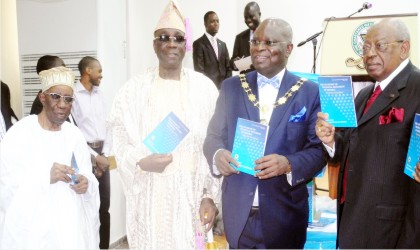
L-R: Founder, Chartered Institute of Bankers of Nigeria, (CIBN), Alhaji Oladimeji Otiti, Oba of Lagos, Obarilwan Akiolu, President, CIBN, Dr Sina Aina and Chairman, First City Monument Bank, Otunba Micheal Balogun, during the unveiling of a book titled “The Economy of Financial Inclusion In Nigeria” written by Dr Aina in Lagos.
The Chairman, Lagos State branch of the National Union of Road Transport Workers (NURTW), Alhaji Tajudeen Agbede said the union had injected nearly 100 new buses to Bus Rapid Transport (BRT) on Lagos roads, to ease passengers’ traffic.
Agbede told newsmen yesterday in Lagos that the NURTW buses were injected to phase out buses that were worn out from all BRT routes.
“We have pushed out almost 100 buses to reduce passengers’ traffic caused by less number of buses and those that are not in good condition and we are still expecting more.
“All the buses that are not in good condition are going to be phased out gradually.
“We cannot just remove every bus that is not in good condition out of the road.
“Removal of rickety buses at once will cause passengers’ traffic and reduce movement of people using the BRT buses.
“Rickety buses will be taken for repairs and put back to work to complement the number of buses available for passengers’ use.
“NURTW is committed to serve the people of Lagos State to their convenience,” Agbede said.
A passenger at Mile 12, Segun Muibi, said that most of the BRT buses were rickety and needed to be changed.
He commended the Lagos State Government for repairing the dilapidated BRT roads.
“All the vehicles brought in during the commencement of 1st BRT operations in Nigeria are still in use after they have gone through a lot of repairs.
“Most of the BRT buses are still plying the roads, because there were inadequate number of buses to replace the worn out buses,” Muibi said.
Another passenger, Mr Baderin Hakeem, said that the BRT buses should be increased to ensure that they were in line with their mandate of rapid movement of passengers.
Hakeem urged the management of BRT to handle the buses well so as to serve the people longer before they get spoilt.
“Some of the buses are still in operation since the time BRT was established by the Fashola regime.
“Most of the BRT buses in use now are in a very bad shape and need effective management by the operators, to make them last long in servicing the people.
He, however, commended the management of the organisation for injecting new busses to ease the stress of passengers using BRT routes across the state.
Solomon Akinola who patronises BRT buses, urged the management of BRT to maintain the tempo set by the immediate past administration in the state and phase out worn buses in its fleet.
Akinola stressed the need for BRT to increase the number of its buses so that people would not be waiting before moving to their various destinations.

Business
FIRS Clarifies New Tax Laws, Debunks Levy Misconceptions
Business
CBN Revises Cash Withdrawal Rules January 2026, Ends Special Authorisation
The Central Bank of Nigeria (CBN) has revised its cash withdrawal rules, discontinuing the special authorisation previously permitting individuals to withdraw N5 million and corporates N10 million once monthly, with effect from January 2026.
In a circular released Tuesday, December 2, 2025, and signed by the Director, Financial Policy & Regulation Department, FIRS, Dr. Rita I. Sike, the apex bank explained that previous cash policies had been introduced over the years in response to evolving circumstances.
However, with time, the need has arisen to streamline these provisions to reflect present-day realities.
“These policies, issued over the years in response to evolving circumstances in cash management, sought to reduce cash usage and encourage accelerated adoption of other payment options, particularly electronic payment channels.
“Effective January 1, 2026, individuals will be allowed to withdraw up to N500,000 weekly across all channels, while corporate entities will be limited to N5 million”, it said.
According to the statement, withdrawals above these thresholds would attract excess withdrawal fees of three percent for individuals and five percent for corporates, with the charges shared between the CBN and the financial institutions.
Deposit Money Banks are required to submit monthly reports on cash withdrawals above the specified limits, as well as on cash deposits, to the relevant supervisory departments.
They must also create separate accounts to warehouse processing charges collected on excess withdrawals.
Exemptions and superseding provisions
Revenue-generating accounts of federal, state, and local governments, along with accounts of microfinance banks and primary mortgage banks with commercial and non-interest banks, are exempted from the new withdrawal limits and excess withdrawal fees.
However, exemptions previously granted to embassies, diplomatic missions, and aid-donor agencies have been withdrawn.
The CBN clarified that the circular is without prejudice to the provisions of certain earlier directives but supersedes others, as detailed in its appendices.
Business
Shippers Council Vows Commitment To Security At Nigerian Ports
-
Business1 day ago
Shippers Council Vows Commitment To Security At Nigerian Ports
-
Business2 days agoNigeria Risks Talents Exodus In Oil And Gas Sector – PENGASSAN
-
Business1 day agoCBN Revises Cash Withdrawal Rules January 2026, Ends Special Authorisation
-
Business2 days ago
NCDMB, Others Task Youths On Skills Acquisition, Peace
-
Business1 day agoFIRS Clarifies New Tax Laws, Debunks Levy Misconceptions
-
News1 day agoTinubu Swears In Christopher Musa As Defence Minister
-
Women2 days agoRIVERS NAWOJ AND PHACCIMA PARTNER TO STRENGTHEN MUTUAL GOALS
-
online games2 days agoHow Pocket Option Works: A Complete Beginner’s Guide