
Agriculture
‘Nigeria’s Economic Boom Lies In Agric’

The prevailing free fall of
crude oil prices owing to the refusal of the United States, Nigeria’s major oil importer, to partronise the country and the discovery of oil by many countries as well as alternative energy sources are already hurting Nigeria’s finances.
These developments have given additional impetus to the Federal government’s focus on increasing non-oil revenues.
The agricultural sector according to the experts has the largest potential to diversify the country’s economy, create jobs, ensure food security and expand foreign exchange earnings.
An economist and Managing Director of CMC group, Eniola Olagbe commented that the continuous decline of the international oil prices will affect Nigeria’s fiscal management and there have been strings of responses from major stakeholders including leading firms and major contributors to the country’s GDP.
According to him, there has been an important shift in government policy towards emphasising agricultural transformation from subsistence to agric business in the country.
“Although a larger percent of African youths still believe agriculture is a primitive vocation meant for the uneducated rural peasant engulfed in a vicious circle of poverty and not what a young person should practise, it is gradually changing he said.
Olagbe added that the perception was gradually eroding as the number of youths in the agricultural sector was increasing in comparison to the past when youths shied away from agriculture because of the drudgery.
On his part, the President of All Farmers Association of Nigeria (AFAN) Lagos Chapter, Mr. Femi Oke, Nigeria’s population is expected to be more than double its current number by 2050.
He said the future of the country is in the hands of the Nigerian youths and that without a vibrant agricultural sector, the country’s future may not be viable.
Oke explained that oil money has not transformed Nigerian agriculture over the last 30 years. It has not fed hungry people or developed rural areas.
“You cannot eat oil, at least crude oil, and since Nigeria is a developing country unless Nigerians act fast to seize the opportunities at hand that are existing in agriculture there will be no headway for economic development”, he said.
He emphasised on the need for Nigeria to learn from England, India and Vietnam, saying that from the 18th Century India to Vietnam today, agriculture has proven that it can drive economic growth.
The AFAN boss who is also a Cassava farmer explained that GDP growth generated by agriculture has been shown to be at least twice as effective in reducing poverty as growth in other sectors.
President, Jonathan Trust Fund (JTF) Mr. Abiodum Dada however stressed the need to change the primary assignment of the National Youth Service Corps (NYSC) to farming for the country to create more jobs.
Nigerians he said should expect to see major improvements in the agricultural and mining sectors of the economy.
“Our past was agriculture and mining and so is the future of this country.
“These two sectors are capable of employing millions of Nigerians and also generate foreign earnings for the government through export.
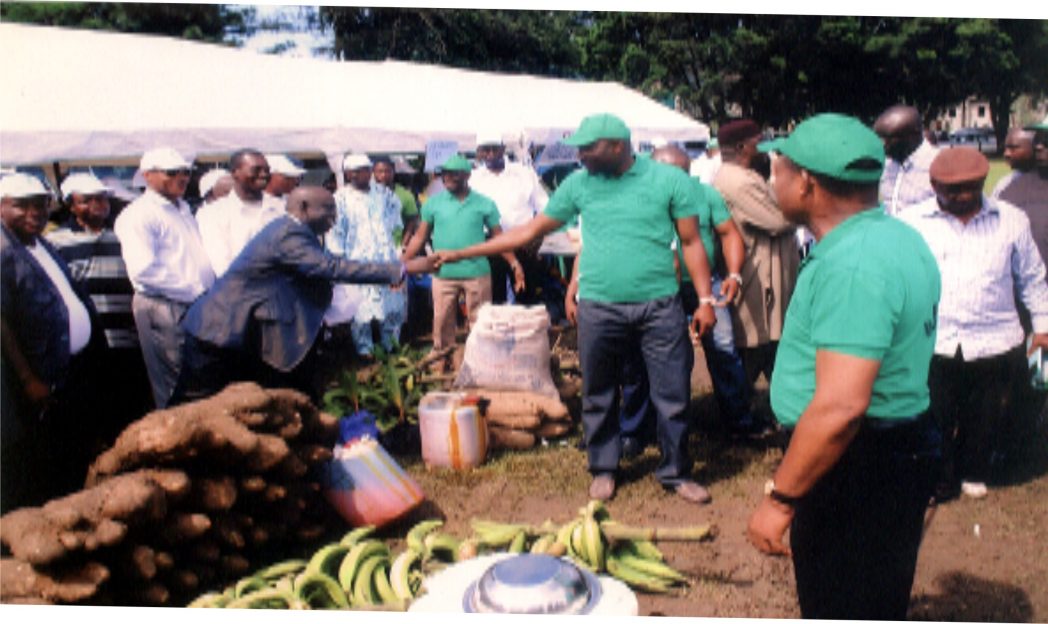
Rivers State Commissioner for Agriculture, Hon Emmanuel Chindah (middle) inspecting food stock, during World Food Day celebration. With him is Permanent Secretary of the ministry, Emmanuel Alex Hart and other officials. Photo: Prince Obinna Dele



Federal Government and the Ogun State Government, on Wednesday, distributed farm inputs to farmers as part of effort to address food security challenge.
The State Director, Federal Ministry of Agriculture and Food Security, Dr. Toyin Ayo-Ajayi, during the flag-off ceremony of Inputs Redemption Under The National Agricultural Growth Scheme-Agro Pocket (NAGS-AP), in Ogun State, disclosed that beneficiaries of the gesture were primarily rice, maize and cassava farmers across the State.
Ayo-Ajayi commended the Ogun State Government for partnering with the government at the centre for the effort in supporting farmers with inputs that would bring about yieldings for local consumption and likely exportation.
She noted that government is supporting rice, cassava and maize farmers with inputs worth N212,000; N189,000 and N186,000 respectively.
The Permanent Secretary in the State Ministry of Agriculture, Mrs Kehinde Jokotoye, who represented the Commissioner in the Ministry, Bolu Owotomo, stated that traditional farmers are critical in food production, hence the need to encourage and support them with inputs that would bring about desired results during harvesting.
Owotomo said: “Let us make good use of this opportunity, so that the success of this phase will make farmers benefit more from the state and federal governments of Nigeria.”
Earlier, State Coordinator, Federal Ministry of Agriculture and Food Security, Dr. Oluwatoyin Ayo-Ajayi, appreciated the present administration for partnering with the federal government for the initiative, adding that the programme is designed to support farmers at the grassroots level in cassava, rice and maize with inputs such as, seeds, pesticides, herbicides and fertilizers, to boost their production and enhance their livelihood.
-

 News3 days ago
Amend Constitution To Accommodate State Police, Tinubu Tells Senators
-
 Politics3 days ago
Senate Urges Tinubu To Sack CAC Boss
-

 News3 days ago
Disu Takes Over As New IGP …Declares Total War On Corruption, Impunity
-
Business3 days ago
President Tinubu Extends Raw Shea Nuts Export Ban To 2027
-
Business3 days ago
Crisis Response: EU-project Delivers New Vet. Clinic To Katsina Govt.
-
Sports3 days ago
NDG: Rivers Coach Appeal To NDDC In Talent Discovery
-
Business3 days ago
President Tinubu Approves Extension Ban On Raw Shea Nut Export
-
Rivers3 days ago
Etche Clan Urges Govt On Chieftaincy Recognition