
Oil & Energy
Bodo Community And Shell Compensation

Even as most Nigeri
ans currently struggle with the effects of the austerity measures declared by the Federal Government in response to the present economic reality in the country, the people of Bodo community in Gokana local government area of Rivers State are celebrating their economic fortune.
From the right, left and centre of this Ogoni community, many new buildings are being erected, old ones undergoing massive renovations; new fishing gears, canoes, vehicles and wholesome household items are being acquired.
This socio-economic boom in Bodo is as result of the N25 billion compensation paid to the natives by the Anglo-Dutch oil giant, Shell Production Development Company of Nigeria (SPDC) for a massive oil spill in the area in 2008.
Reliving the situation in an interview with The Tide in his house on Thursday, the Chairman, Bodo Council of Chiefs, Chief Livinus Kiebel, said “Bodo is agog. People who have not seen N10,000 before in their life are receiving at least N600,000.00 individual claims, as compensation, so you can see the joy in our faces, people dancing and women celebrating. It has never happened before in the community.
It is a long battle that started since 2008 when the community suffered a major oil spill from SPDC’s 28-inch pipeline from Bodo to Bonny Trans Atlantic, laid as far back as 1958,” he said.
He said due to the effect of salt water and corrosion on the pipes, there was rapture eruption and spill which gushed out uncontrollably for over one month polluting the water, killing seafoods, mangrove and in face all the acquatic life in the area.
Kiebel stated that when the community drew the attention of the oil company to the serious situation, “as usual, SPDC denied responsibility and started giving one excuse or the other. It said the spill was caused by a third party and illegal bunkering activities. And for over one month, the crude kept gushing.
“But we stood our ground, insisting that Shell must pay compensation. When we realised the company would not budge, we took our matter to the government through the Ministry of Environment at the state and federal levels and also drew the attention of some relevant NGOs and civil society organisaitons”, he said.
The Bodo Chiefs councils chairman remarked that when SPDC discovered that Bodo community meant business, they brought their experts and because of the influence of the joint negotiation between SPDC, Government, NGOs and civil society groups, the company accepted the spill was as a result of equipment failure and there fore accepted responsibility.
He disclosed that at first, the company applied its divide-and-rule system by covnering the youths and promising to pay them N10 million and that this angered the youths who reported the ploy to the entire community.
Kiebel, who is a former local government chairman said the community hired the services of a legal luminary and son of Ogoni, B.M Wifa (SAN) who then sued SPDC before a Federal High Court in Port Harcourt.
When that was moving at a slow speed because of the oil politics in Nigeria and the unwillingness of Federal Government to show interest, the community decided to drag Shell to The Heague.
“One of our sons, a lecturer at the University of Port Harcourt, suggested a legal firm, Leighday and Company – a legal firm which he uncovered through research had successfully handled similar matters in Africa insisting we could get justice through the law firm,” he continued, saying Leighday effectively handled the matter.
According to him, representatives of the firm were in Bodo Creek to Bonny and all over the community boarders to see the extent of the spill and damages and at last sued for both individual and communal claims.
Form more than six months, he said Leighday law firm interviewed our people, filmed and captured in many forms, cases of those whose livelihood depend on the sea and after the legal battle, Shell settled for a compensation of N25 billion, which was below but we decided to accept the offer.
Commending the Leiyhday law firm, Kiebel said they were professional and straight forward in their approach and the ability of the firm to secure justice for Bodo community has brought transformation to the area as the people happily invest their money into many economic activities.
One of the women told The Tide that, the name Leighday is a source of big joy to her and her family.
“I have five children. I received a huge sum and my children also got theirs individually and when we pooled the money together, it was like a big dream.
I thank Leighday, I thankGod for the turn around the development has brought to my family.
The respondent who identified herself as Mama Lebari noted that even women and youths who do not know how to speak English Language all know and sing with the name Leighday.
Another respondent, Mercy Job said, “I now own my own beauty Salon. I leant Salon business for past 5 years but could not open my own shop.
But today this big shop is mine and the next store with provisions and foodstuff is also mine. I thank Jehovah for his blessings.
“If I marry and born any child whether male or female, I don’t care, I will name that child “Leighday” to mark the time I met this turn around in my life,”she said.
Job said her family was living in a very small family house of three rooms but today, they have almost completed a five-bedroom flat with a three-room boys quarter.
A Bodo-based businessman who hails from Abia State, Charles Amobi, said he deals on building materials and that the economic transformation has reflected well in his business.
“The sale I normally make for one week before, I atimes make that in one day and my customers pay instead of buying on credit. I hope that this situation will remain,” he remarked.
The Tide gathered that churches in the community are also richer because of the economic boom in the community. Chief Kiebel who confirmed this said, “my church, St Patrick Catholic Church, has gotten N20 million through tithe and appreciations for members who received the compensation.
As a mark of appreciation, the traditional ruler also said the community was arranging a special package to Leighday legal firm which he could not disclose to me as a way of appreciating the firms support to his people.
However, the good fortune is not going without adverse effects on the community.
According to kiebel, two cases have been brought before his palace. “Some husbands have fallen apart from their wives. They asked their wives to bring their share so that they could combine it as part of joint account but the women refused and are asking for divorce instead,” said Kiebel.
He also said, that more young men are acquiring wives now that the money is available.
Chris Oluoh &
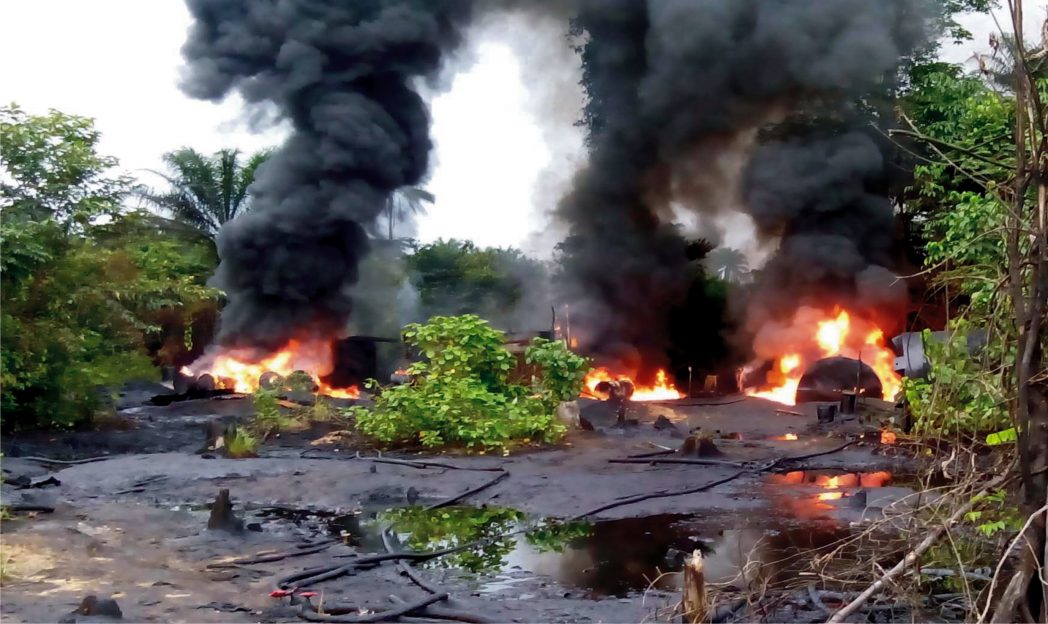
Illegal Refineries being destroyed by Naval Officers in Warri recently
Lydia William



-

 Education5 days ago
Elga boss tasks law students on academics strides
-

 News2 days ago
Amend Constitution To Accommodate State Police, Tinubu Tells Senators
-
 Politics2 days ago
Senate Urges Tinubu To Sack CAC Boss
-

 News2 days ago
Disu Takes Over As New IGP …Declares Total War On Corruption, Impunity
-
Business2 days ago
President Tinubu Extends Raw Shea Nuts Export Ban To 2027
-
Business2 days ago
Crisis Response: EU-project Delivers New Vet. Clinic To Katsina Govt.
-
Business2 days ago
President Tinubu Approves Extension Ban On Raw Shea Nut Export
-

 Business2 days ago
PENGASSAN Rejects Presidential EO On Oil, Gas Revenue Remittance … Seeks PIA Review